A port of the .NET Framework to Windows CE, allowing embedded and mobile devices to run .NET applications. See Smart Device Extensions.
The .NET Compact Framework is a key part of realizing goal to provide customers with great experiences—any time, any place, and on any device. The .NET Compact Framework's managed code and XML Web services enable the development of secure, downloadable applications on devices such as personal digital assistants (PDAs).
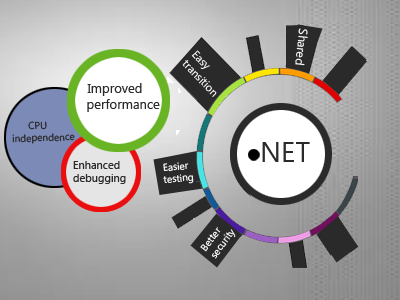
Following are the key benefits of using the .NET Compact Framework
Shared .NET programming model and Visual Studio .NET toolset. Using the .NET Compact Framework significantly decreases the mobile application's development cost and increases developer productivity. Portions of .NET Framework code may be utilized to create mobile applications using .NET Compact Framework.
Easy transition for Visual Studio .NET developers. Developing applications for smart devices is similar to developing desktop applications.
Better security. Security on the .NET Compact Framework is evidence-based.
Improved performance. Because the .NET Compact Framework is intended for resource-constrained devices, applications can achieve benefits such as high performance from the built-in just-in-time (JIT) compiler, memory efficiency, high productivity, and so on.
Enhanced debugging. While developing mobile applications, you can set breakpoints, step through code, watch and trace variables, view local variables, etc. You can also remotely debug a deployed mobile application from within Visual Studio .NET, using the integrated debugger.
Access to XML Web services. Mobile Web applications can consume XML Web services, accessing application logic from dissimilar systems (platform-independent access) using standard data formats and protocols.
Easier testing. The Visual Studio .NET design environment includes a first-rate device emulator, which simplifies testing.
CPU independence. Applications developed for a particular device by using the .NET Compact Framework will run independently of the CPU resident on the device. For instance, applications developed for Pocket PC can run on all Pocket PC devices without recompiling.
|