




Archive for September, 2008
Will effect of US subprime crisis the end of sky scrapers?
Image depicting fall of Lehman brothers US 4th largest bank,

trust and authority two different things in search engines.
A webmaster world thread analyzes the difference between trust and authority in Google. Its a good thread to discuss please join here www.webmasterworld.com/google/3753332.htm
“While studying Google’s recently granted [url=http://patft.uspto.gov/netacgi/nph-Parser?Sect1=PTO2&Sect2=HITOFF&u=%2Fnetahtml%2FPTO%2Fsearch-adv.htm&r=1&p=1&f=G&l=50&d=PTXT&S1=7,346,839.PN.&OS=pn/7,346,839&RS=PN/7,346,839]Historical Data patent[/url], I noticed that the language helps to separate two concepts that we tend to use casually at times: trust and authority.
…links may be weighted based on how much the documents containing the links are trusted (e.g., government documents can be given high trust). Links may also, or alternatively, be weighted based on how authoritative the documents containing the links are (e.g., authoritative documents may be determined in a manner similar to that described in [url=http://patft.uspto.gov/netacgi/nph-Parser?Sect1=PTO2&Sect2=HITOFF&u=%2Fnetahtml%2FPTO%2Fsearch-adv.htm&r=1&p=1&f=G&l=50&d=PTXT&S1=6,285,999.PN.&OS=pn/6,285,999&RS=PN/6,285,999]U.S. Pat. No. 6,285,999)[/url].
Clearly, Google has two different metrics going on. As you can see from the reference to Larry Page’s original patent, authority in Google’s terminology comes from backlinks. When lots of other websites link to your website, you become more and more of an authority.
But that isn’t to say you’ve got trust. So what exactly is trust? Here’s an interesting section from the same patent:
…search engine 125 may monitor one or a combination of the following factors: (1) the extent to and rate at which advertisements are presented or updated by a given document over time; (2) the quality of the advertisers (e.g., a document whose advertisements refer/link to documents known to search engine 125 over time to have relatively high traffic and trust, such as amazon.com, may be given relatively more weight than those documents whose advertisements refer to low traffic/untrustworthy documents, such as a pornographic site);
So we’ve got two references here, government documents and high traffic! From other reading, I’m pretty sure that trust calculations work like this – at least in part. Google starts with a hand picked “seed list” of trusted domains. Then trust calculations can be made that flow from those domains through their links.
If a website has a direct link from a trust-seed document, that’s the next best situation to being chosen as a seed document. Lots of trust flows from that link.
If a document is two clicks away from a seed document, that’s pretty good and a decent amount of trust flows through – and so on. This is the essence of “trustrank” – a concept described in [url=http://dbpubs.stanford.edu:8090/pub/2004-17]this paper by Stanford University and three Yahoo researchers[/url].
This approach to calculating trust has been refined by the original authors to include “negative seeds” – that is, sites that are known to exist for spamming purposes. The measurements are intended to identify artifically inflated PageRank scores. See this pdf document from Stanford: [url=http://dbpubs.stanford.edu:8090/pub/showDoc.Fulltext?lang=en&doc=2005-33&format=pdf&compression=&name=2005-33.pdf]Link Spam Detection[/url]
To what degree Google follows this exact approach for calculating trust is unknown, but it’s a good bet that they share the same basic ideas. “
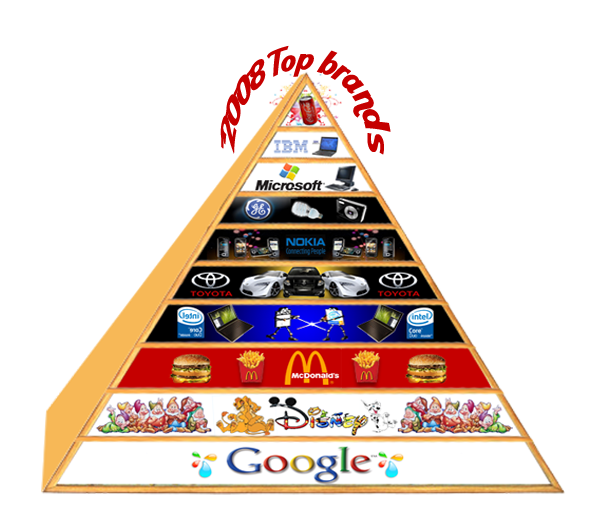
Top 10 brand pyramid – 2008 top brands
SEO – Spam – spam spam and more spam from junk SEO companies.
We get these regular spam emails and we at Search Engine Genie are against spamming people for SEO related work.
Spam SEO email:
“On studying the lately Google algorithms – we have launched our new Link Building packages which are highly competitive and more productive in terms of Back Links and SERPs of website. You might have noticed that these days when we analyze PR pattern in top ranking sites, most of them are not high PR and even if you analyse backlinks of any site, most of the sites listed in backlinks list are low PR. In nutshell, there is no pattern of Pr is fond either in SERPs or Backlinks. Therefore only relevancy of the linking page matters these days. Also, it is suggestible to go with a mixture of all page rank links to avoid Google Filter Trap as Google tend to catch the uniformity in patterns of incoming links and it tends to reduce the weightage you should be getting of each campaign.
This founding has made us launch a new package of thematic links (irrelevant of PR) as well as update our existing packages to match with Google requirements. We have now included the following in all our packages – 1. We offer deep links in each campaign (acquiring links for inner pages with home page, targeting keywords for their related pages only).2. We offer rotating anchor texts (a set of couple of link details is used to make sure that Google does not identify a similarity in anchor texts for all back links).3. We offer a mixed PR links in the final report.4. We create links slowly and do not get all links created in a day or 2, so as to make it look natural for Search Engines.
These are not the only quality benchmarks but are only a few of those which are always taken care of while creating links for a project site. Still, if you find any link below the quality expected for genuine reasons, we replace it immediately without asking a second question (the first one will be the reason for which it was rejected).
We realize how important it is for many companies to outsource their business to other reliable companies and therefore to choose the Right Outsourcing Partner. Most companies overseas have achieved a significant amount of savings by outsourcing either complete or part of their Link Building, SEO or designing/development projects to India not only to cut the costs but also to ensure guaranteed results.. Thanks to the IT talent and cheaper labor costs in India.
With all our campaigns we assure you – -> Links will produce an organic traffic at website by doing ethical link building-> An appreciable improvement to current SERPs (search engine result position) at targeted keywords and keyword phrases.-> Balanced mechanism to prevent Google Filter trap.-> Goal oriented strategies for cost and time effective end product i.e.-> Complete return on investment ( ROI)
The methodologies we use to build links are —>Article posting – well written and preapproved by you, articles are submitted to highly reputed article directories.–>Link Popualrity – One way links are created by getting links on other theme related websites.–>Directory listings – Links are placed on relevant categories of a few highly reputed directories.
Please note that we can do all or a few selected methods to create links on the basis of your choice. We have a few packages for each of these.. with base package starting @ $5 per link. Please feel free to let us know for more details on quality, process or pricing.
Minimum order quantity is 100 links. We provide links @ 25 links/week.”
Top 10 Global brands – rated 2008 rankings for top brands globally.
1. Coca-Cola – The Coca-Cola Company (NYSE: KO) is the world’s largest beverage company, largest manufacturer, distributor and marketer of non-alcoholic beverage concentrates and syrups in the world, and one of the largest corporations in the United States. The company is best known for its flagship product Coca-Cola, invented by pharmacist John Stith Pemberton in 1886. The Coca-Cola formula and brand was bought in 1889 by Asa Candler who incorporated The Coca-Cola Company in 1892. Besides its namesake Coca-Cola beverage, Coca-Cola currently offers nearly 400 brands in over 200 countries or territories and serves 1.5 billion servings each day.[2]
The company operates a franchised distribution system dating back to 1889 where The Coca-Cola Company only produces syrup concentrate which is then sold to various bottlers throughout the world who hold an exclusive territory.
The Coca-Cola Company is headquartered in Atlanta, Georgia. Its stock is listed on the NYSE and is part of DJIA and S&P 500. Its current president and CEO is Muhtar Kent.
2. IBM – The character of a company — the stamp it puts on its products, services and the marketplace — is shaped and defined over time. It evolves. It deepens. It is expressed in an ever-changing corporate culture, in transformational strategies, and in new and compelling offerings for customers. IBM’s character has been formed over nearly 100 years of doing business in the field of information-handling. Nearly all of the company’s products were designed and developed to record, process, communicate, store and retrieve information — from its first scales, tabulators and clocks to today’s powerful computers and vast global networks.
IBM helped pioneer information technology over the years, and it stands today at the forefront of a worldwide industry that is revolutionizing the way in which enterprises, organizations and people operate and thrive.
The pace of change in that industry, of course, is accelerating, and its scope and impact are widening. In these pages, you can trace that change from the earliest antecedents of IBM, to the most recent developments. You can scan the entire IBM continuum from the 19th century to the 21st or pinpoint — year-by year or decade-by-decade — the key events that have led to the IBM of today. We hope that you enjoy this unique look back at the highly textured history of the International Business Machines Corporation.
3. Microsoft – Microsoft Corporation is an American multinational computer technology corporation, which rose to dominate the home computer operating system market with MS-DOS in the mid-1980s, followed by the Windows line of operating systems.
Throughout its history the company has been the target of criticism for various reasons, including monopoly status and anti-competitive business practices including refusal to deal and tying. The U.S. Justice Department and the European Commission, among others, have ruled against Microsoft for various antitrust violations.[8][9]
It develops, manufactures, licenses, and supports a wide range of software products for computing devices.[10][7] Microsoft’s best-selling products are the Microsoft Windows operating system and the Microsoft Office suite of productivity software.
4. GE – The General Electric Company, or GE (NYSE: GE) is a multinational American technology and services conglomerate incorporated in the State of New York.[5] In terms of market capitalization as of 30th June 2008, GE is the world’s sixth largest company and also second in the BrandZ ranking. In the 1960s, aspects of U.S. tax laws and accounting practices led to a rise in the assembly of conglomerates. GE, which was a conglomerate long before the term was coined, is arguably the most successful organization of this type.
5. Nokia – Nokia is a Finnish multinational communications corporation, headquartered in Keilaniemi, Espoo, a city neighbouring Finland’s capital Helsinki. Nokia is focused on wireless and wired telecommunications, with 112,262 employees in 120 countries, sales in more than 150 countries and global annual revenue of 51.1 billion euros and operating profit of 8.0 billion as of 2007.[1][3] It is the world’s largest manufacturer of mobile telephones: its global device market share was about 40% in Q2 of 2008, up from 38% in Q2 2007 and up from 39% sequentially.[2] Nokia produces mobile phones for every major market segment and protocol, including GSM, CDMA, and W-CDMA (UMTS). Nokia’s subsidiary Nokia Siemens Networks produces telecommunications network equipments, solutions and services.
6. Toyota – Toyota Motor Corporation (トヨタ自動車株式会社, Toyota Jidosha Kabushiki-gaisha?) (pronounced [to-yo-ta]) is a multinational corporation headquartered in Japan, and is currently the world’s largest automaker.[3][4]
In 1934, while still a department of Toyota Industries, it created its first product Type A engine and in 1936 its first passenger car the Toyota AA. The company was eventually founded by Kiichiro Toyoda in 1937 as a spinoff from his father’s company Toyota Industries to create automobiles. Toyota currently owns and operates Lexus and Scion brands and has a majority shareholding stake in Daihatsu Motors,[5] and minority shareholdings in Fuji Heavy Industries Isuzu Motors, and Yamaha Motors. The company includes 522 subsidiaries.[6]
Toyota is headquartered in Aichi, Nagoya and in Tokyo. In addition to manufacturing automobiles, Toyota provides financial services through its division Toyota Financial Services and also creates robots. Toyota Industries and Finance divisions form the bulk of the Toyota Group, one of the largest conglomerates in the world
7. Intel – Intel Corporation (NASDAQ: INTC; SEHK: 4335) is the world’s second largest semiconductor company and the inventor of the x86 series of microprocessors, the processors found in most personal computers. Founded on July 18, 1968 as Integrated Electronics Corporation and based in Santa Clara, California, USA, Intel also makes motherboard chipsets, network cards and ICs, flash memory, graphic chips, embedded processors, and other devices related to communications and computing. Founded by semiconductor pioneers Robert Noyce and Gordon Moore, and widely associated with the executive leadership and vision of Andrew Grove, Intel combines advanced chip design capability with a leading-edge manufacturing capability. Originally known primarily to engineers and technologists, Intel’s successful “Intel Inside” advertising campaign of the 1990s made it and its Pentium processor household names.
Intel was an early developer of SRAM and DRAM memory chips, and this represented the majority of its business until the early 1980s. While Intel created the first commercial microprocessor chip in 1971, it was not until the success of the personal computer (PC) that this became their primary business. During the 1990s, Intel invested heavily in new microprocessor designs and in fostering the rapid growth of the PC industry. During this period Intel became the dominant supplier of microprocessors for PCs, and was known for aggressive and sometimes controversial tactics in defense of its market position, as well as a struggle with Microsoft for control over the direction of the PC industry.[5][6] The 2007 rankings of the world’s 100 most powerful brands published by Millward Brown Optimor showed the company’s brand value falling 10 places – from number 15 to number 25.[7]
8. McDonald’s – McDonald’s Corporation (NYSE: MCD) is the world’s largest chain of fast food restaurants, serving nearly 47 million customers daily.[3] McDonald’s primarily sells hamburgers, cheeseburgers, chicken products, French fries, breakfast items, soft drinks, milkshakes and desserts. More recently, it has begun to offer salads, wraps and fruit. Many McDonald’s restaurants have included a playground for children and advertising geared toward children, and some have been redesigned in a more ‘natural’ style, with a particular emphasis on comfort: introducing lounge areas and fireplaces, and eliminating hard plastic chairs and tables.
In addition to its signature restaurant chain, McDonald’s Corporation holds minority interest in Pret A Manger (a UK-based sandwich retailer), and owned the Chipotle Mexican Grill until 2006 and the restaurant chain Boston Market until 2007.[4] The company has also expanded the McDonald’s menu in recent decades to include alternative meal options, such as salads and snack wraps, in order to capitalize on growing consumer interest in health and wellness.
Each McDonald’s restaurant is operated by a franchisee, an affiliate, or the corporation itself. The corporations’ revenues come from the rent, royalties and fees paid by the franchisees, as well as sales in company-operated restaurants. McDonald’s revenues grew 27% over the three years ending in 2007 to $22.8 billion, and 9% growth in operating income to $3.9 billion.[5]
9. Disney – The Walt Disney Company (NYSE: DIS) is one of the largest media and entertainment corporations in the world. Founded on October 16, 1923, by brothers Walt and Roy Disney as an animation studio, it has become one of the biggest Hollywood studios, and owner of eleven theme parks and several television networks, including ABC and ESPN. Disney’s corporate headquarters and primary production facilities are located at The Walt Disney Studios in Burbank, California. The company is a component of the Dow Jones Industrial Average.
10. Google – Google Inc. is an American public corporation, earning revenue from advertising related to its Internet search, e-mail, online mapping, office productivity, social networking, and video sharing services as well as selling advertising-free versions of the same technologies. The Google headquarters, the Googleplex, is located in Mountain View, California. As of 30 June 2008 the company has 19,604 full-time employees.[
webmaster central tools now in other languages,
According to Google webmaster central blog, Now we have webmaster central tools in other languages,
“We’re always working for new ways to make life a bit easier for webmasters. We’ve had great feedback to many of the initiatives that have taken place in Webmaster Tools and beyond, but given the complex nature of managing a website, there are some questions regarding the tools that come up quite often across the Webmaster Help Groups. This got us thinking: how can we best address these questions? Well, if you’re like me, then you find it a lot easier to learn how to use something if you actually get to see someone else doing it first; with that in mind, we’ll launch a series of six video tutorials in French, German, Italian and Spanish over the next couple of months. The videos will take you through the basics of Webmaster Tools as well as how to use the information in the tools to make improvements to your site and hence your site’s visibility in Google’s index. Our first video provides an overview of the different information you can access depending on whether you’ve verified ownership of your site in Webmaster Tools. We’ll also explain the different verification methods available. And just to whet your appetite, here are the topics covered in the series: Video 1: Getting started, signing in, benefits of verifying a siteVideo 2: Setting preferences for crawling and indexingVideo 3: Creating and submitting SitemapsVideo 4: Removing and preventing your content from being indexedVideo 5: Utilizing the Diagnostics, Statistics and Links sectionsVideo 6: Communicating between Webmasters and Google”
Google now provides webmaster tools in
Italian, french, spanish and other languages,
How google evaluates search – Google engineer talks
How google evaluates search:
Scott of Google has given a good insight of how Google evaluates search results: Look at this to get a good idea on how Google handles search evaluation:
“Evaluating search is difficult for several reasons.
- First, understanding what a user really wants when they type a query — the query’s “intent” — can be very difficult. For highly navigational queries like [ebay] or [orbitz], we can guess that most users want to navigate to the respective sites. But how about [olympics]? Does the user want news, medal counts from the recent Beijing games, the IOC’s homepage, historical information about the games, … ? This same exact question, of course, is faced by our ranking and search UI teams. Evaluation is the other side of that coin.
- Second, comparing the quality of search engines (whether Google versus our competitors, Google versus Google a month ago, or Google versus Google plus the “letter T” hack) is never black and white. It’s essentially impossible to make a change that is 100% positive in all situations; with any algorithmic change you make to search, many searches will get better and some will get worse.
- Third, there are several dimensions to “good” results. Traditional search evaluation has focused on the relevance of the results, and of course that is our highest priority as well. But today’s search-engine users expect more than just relevance. Are the results fresh and timely? Are they from authoritative sources? Are they comprehensive? Are they free of spam? Are their titles and snippets descriptive enough? Do they include additional UI elements a user might find helpful for the query (maps, images, query suggestions, etc.)? Our evaluations attempt to cover each of these dimensions where appropriate.
- Fourth, evaluating Google search quality requires covering an enormous breadth. We cover over a hundred locales (country/language pairs) with in-depth evaluation. Beyond locales, we support search quality teams working on many different kinds of queries and features. For example, we explicitly measure the quality of Google’s spelling suggestions, universal search results, image and video searches, related query suggestions, stock oneboxes, and many, many more.”
Source: Google Blog: http://googleblog.blogspot.com/2008/09/search-evaluation-at-google.html
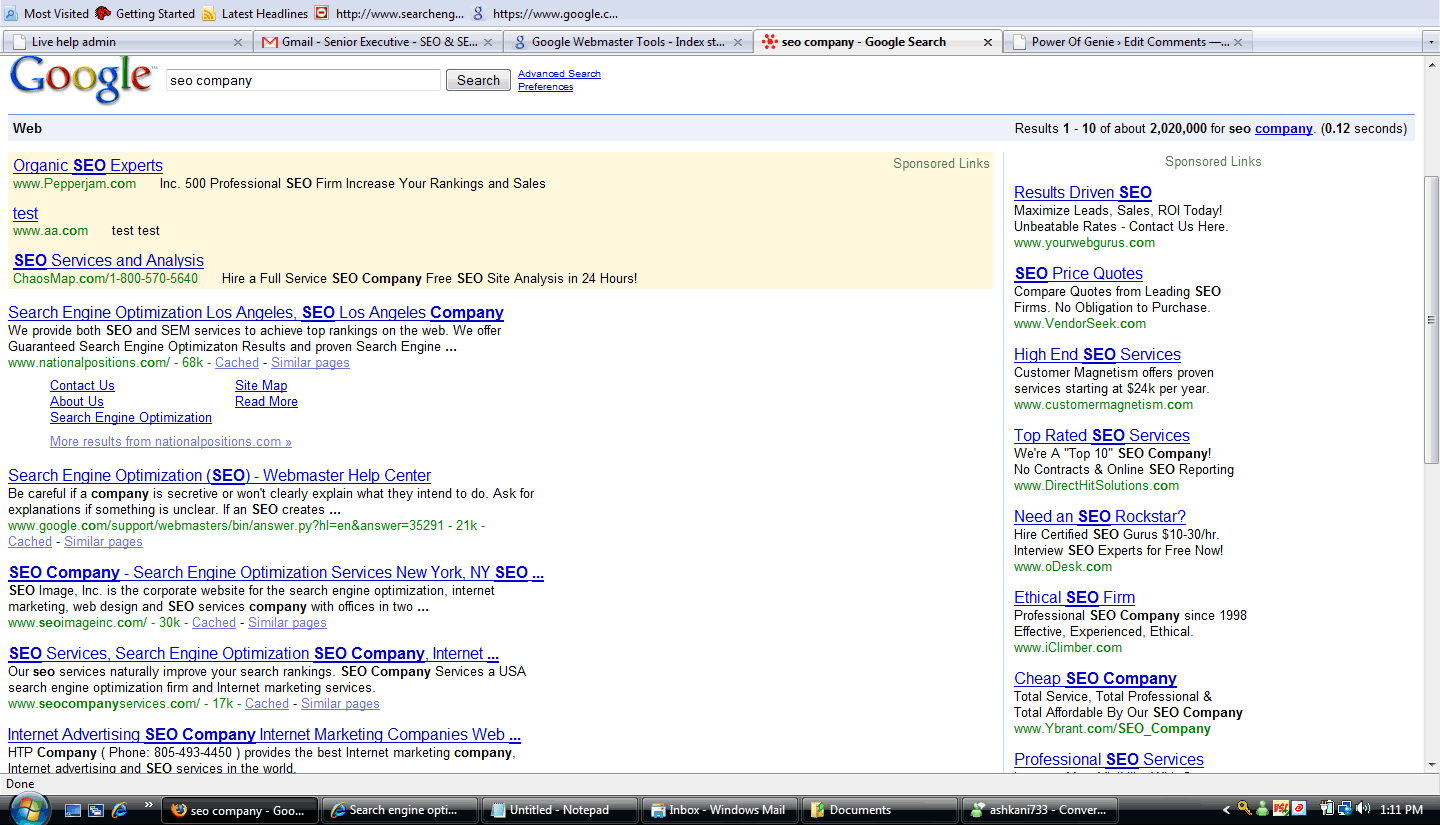
Google testing or Adwords hacked ?
When i was recently doing some queries related to our site i saw a weird adwords result right on top of the page.
2nd result from the top had something which said test and the URL as aa.com i haven’t seen this before i wonder why Google is testing on live adwords results or whether the adwords results had been hacked. When i clicked on the results it actually went to aa.com so it mostly looks like some sort of testing.
Did anyone else notice it look at this screen shot:
Apologies to our users for Badware attack on our site.
We recently had our site being attacked by a virus injection code due to the vulnerability on our server. Older version of IE was responsible for this code injection and since it happened in a weekend we were unable to fix it immediately. We got a warning note from Google but our tech guy was there to fix the site by sunday afternoon. Monday morning Google removed the warning message from its search results after we cleaned the site for potential badware and filed a review. Google was very quick to fix the results and we are very much thankful to Google.
Now we have our guys monitoring the site 24 hours a day 7 days a week for potential problems they will be able to fix it immediately if there is any sort of problem. I once again apologize to our dear website users. We get more than 10,000 users a day and if anyone’s system got affected we apologize for it and will make sure this will never happen again.
Our site is a safe site and will remain to be safe now and for ever,
Unfortunately we have the following message in Google safe browsing diagnostic. Google has all the rights to protect its users from malicious codes we will make sure this never happens with our site again.
“What is the current listing status for www.searchenginegenie.com/?
This site is not currently listed as suspicious.
What happened when Google visited this site?
Of the 105 pages we tested on the site over the past 90 days, 2 page(s) resulted in malicious software being downloaded and installed without user consent. The last time Google visited this site was on 09/14/2008, and the last time suspicious content was found on this site was on 09/13/2008.
Malicious software includes 2 exploit(s). Successful infection resulted in an average of 1 new processes on the target machine.
Malicious software is hosted on 1 domain(s), including :::::::::.com.
1 domain(s) appear to be functioning as intermediaries for distributing malware to visitors of this site, including ******.cn.
Has this site acted as an intermediary resulting in further distribution of malware?
Over the past 90 days, www.searchenginegenie.com did not appear to function as an intermediary for the infection of any sites.
Has this site hosted malware?
No, this site has not hosted malicious software over the past 90 days.
“
Duplication problem with Google – how Google handle duplicates.
Official Google webmaster central blog has an interesting post on how Google handles duplicates.
Susan of webmaster central team state:
“When we detect duplicate content, such as through variations caused by URL parameters, we group the duplicate URLs into one cluster.
We select what we think is the “best” URL to represent the cluster in search results.
We then consolidate properties of the URLs in the cluster, such as link popularity, to the representative URL.
Here’s how this could affect you as a webmaster:
In step 2, Google’s idea of what the “best” URL is might not be the same as your idea. If you want to have control over whether www.example.com/skates.asp?color=black&brand=riedell or www.example.com/skates.asp?brand=riedell&color=black gets shown in our search results, you may want to take action to mitigate your duplication. One way of letting us know which URL you prefer is by including the preferred URL in your Sitemap.
In step 3, if we aren’t able to detect all the duplicates of a particular page, we won’t be able to consolidate all of their properties. This may dilute the strength of that content’s ranking signals by splitting them across multiple URLs.
In most cases Google does a good job of handling this type of duplication. However, you may also want to consider content that’s being duplicated across domains. In particular, deciding to build a site whose purpose inherently involves content duplication is something you should think twice about if your business model is going to rely on search traffic, unless you can add a lot of additional value for users. For example, we sometimes hear from Amazon.com affiliates who are having a hard time ranking for content that originates solely from Amazon. Is this because Google wants to stop them from trying to sell Everyone Poops? No; it’s because how the heck are they going to outrank Amazon if they’re providing the exact same listing? Amazon has a lot of online business authority (most likely more than a typical Amazon affiliate site does), and the average Google search user probably wants the original information on Amazon, unless the affiliate site has added a significant amount of additional value.
Lastly, consider the effect that duplication can have on your site’s bandwidth. Duplicated content can lead to inefficient crawling: when Googlebot discovers ten URLs on your site, it has to crawl each of those URLs before it knows whether they contain the same content (and thus before we can group them as described above). The more time and resources that Googlebot spends crawling duplicate content across multiple URLs, the less time it has to get to the rest of your content.
In summary: Having duplicate content can affect your site in a variety of ways; but unless you’ve been duplicating deliberately, it’s unlikely that one of those ways will be a penalty. This means that:
You typically don’t need to submit a reconsideration request when you’re cleaning up innocently duplicated content.
If you’re a webmaster of beginner-to-intermediate savviness, you probably don’t need to put too much energy into worrying about duplicate content, since most search engines have ways of handling it.
You can help your fellow webmasters by not perpetuating the myth of duplicate content penalties! The remedies for duplicate content are entirely within your control. Here are some good places to start.
“
Blogroll
Categories
- AI for eCommerce
- AI Search & SEO
- author rank
- Authority Trust
- Bing search engine
- blogger
- CDN & Caching.
- Content Strategy
- Core Web Vitals
- eCommerce Growth
- Experience SEO
- Fake popularity
- gbp-optimization
- Google Adsense
- Google Business Profile Optimization
- google fault
- google impact
- google Investigation
- google knowledge
- Google panda
- Google penguin
- Google Plus
- Google Search Console
- Google Search Updates
- Google webmaster tools
- google-business-profile
- google-maps-ranking
- Hummingbird algorithm
- infographics
- link building
- Local SEO
- local-seo
- Mattcutts Video Transcript
- Microsoft
- Mobile Performance Optimization
- Mobile SEO
- MSN Live Search
- Negative SEO
- On-Page SEO
- Page Speed Optimization
- pagerank
- Paid links
- Panda and penguin timeline
- Panda Update
- Panda Update #22
- Panda Update 25
- Panda update releases 2012
- Penguin Update
- Performance Optimization
- Sandbox Tool
- search engines
- SEO
- SEO Audits
- SEO Audits & Monitoring
- SEO cartoons comics
- seo predictions
- SEO Recovery & Fixes
- SEO Reporting & Analytics
- seo techniques
- SEO Tips & Strategies
- SEO tools
- SEO Trends 2013
- seo updates
- Server Optimization
- Shopify Optimization
- Shopify SEO
- Shopify Services
- Small Business Marketing
- social bookmarking
- Social Media
- SOPA Act
- Spam
- Technical SEO
- Uncategorized
- User Experience (UX)
- Webmaster News
- website
- Website Security
- Website Speed Optimization
- Yahoo