




Archive for February, 2011
PPC Google Ads Verses PPC Banner Ads
Two of the most accepted choices in paid internet marketing today are Pay per Click Ads with Google, and Pay per Click Banner Ads. Each presents an excellent, but different opportunity, so their uniqueness should be weighed carefully. Paid ads have moderately a few advantages over organic SEO results, one of which is a nearly instant response. But which type of ad is more suitable to your business – Banner ads, or PPC text based Google ads?
Google harnesses the expertise behind Pay per Click (PPC) ads with AdWords. This program is so accepted because it has capabilities that permit the user to control every aspect of the campaign, from keywords, negative keywords, and ad copy. Each feature of the AdWords campaign can be managed and fine-tuned for increased competence and a better result in terms of getting the right people to your site. This sort of control makes Google’s PPC ads attractive to those who understand how to use the capabilities of Adwords to run a very cost proficient, effective campaign.
PPC Google ads permit the user to set the budget right down to the dollar. The minimum necessary budget per day to advertise with PPC Google Ads is only one dollar. Not only does the user only pay when the ad is clicked, but they can bid on how much they’re prepared to spend for each click on a certain word or phrase.
PPC Banner Ads also work on the basis that payment is based on visitor clicks. Banner ads can be triggered by any keywords supplied by the client. This lessens their capability to focus on a particular audience. Instead, advertisers rely on the fact that their banners are evident on related websites. The more intimately the ad is related to the website it’s placed on, the more likely it is to be effective and attain its target audience.
Banner ads are generally charged by Cost per Impression (CPI, or CPM). Often a cost will be set based upon a cost per thousand impressions. Banner ads may use Flash, or startling graphics to get their point across, rather than text. This can be helpful for some products that rely on images to relay a message. Banner ads can be harder to control, however, because a new banner ad will have to be uploaded for any changes. Placement on some pages may be costly, and some internet users have developed something called ‘banner blindness’. This means that some people intentionally ignore banners due to their prevalence in advertising.
If this is not satisfactory, there are some banner programs that do depend on keywords. When a related word is searched for in the search bar, the suitable banner will be displayed on the results page. As the internet user has shown interest in this meticulous topic, there is a somewhat higher possibility that he or she will click on the ad.
The decision to use Google PPC ads, Banner ads or both may be a hard one. In the end, the option will be tied directly to the product or idea that you’re advertising. If you’re not sure if one or both is better for your audience, use a full service Internet Marketing Company who will research your viewers or target market, and craft the best strategy for you.
Facebook PPC Verses Google PPC
Facebook is a social network that has had the success of breaking into the social networking sight and surpassing its competitors all the way to its present position at the top of the social media sphere providing its services to over 400 million users.
Facebook provides a PPC (Pay per Click) service that focuses on the various position markets that connect on the social network. The social site allows you to target your ads to only appear on certain profile pages.
Here is a view of the setup and the various demographics on Facebook:
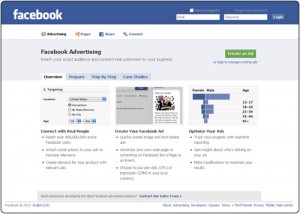
These ads are non-invasive, similar to Google’s PPC, but Facebook allows you to add images and they also provide the user the chance to vote on whether or not they like the advertisement making the ads that much more responsible to their target audience.
Here’s a Facebook’s example of a PPC advertisement:
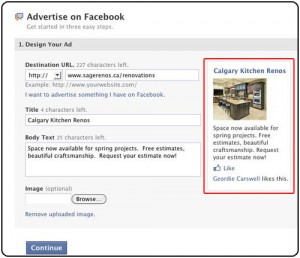
There are issues with Face book’s PPC; for example it is said that Facebook tends to have a very low CTR (Click Through Rate). Also, while Facebook may permit for more targeted niches, it is not a search engine and doesn’t have the volume that Google has. So, although Facebook gives you the capability to enhanced reach those buying your products or services, Google allows for a broader audience and a larger number of prospects.
However, Facebook ads are rapidly gaining in fame, and appear to be a very obliging tool for small to medium businesses attempting to increase traffic with PPC.
If you are trying to choose between the two, the only way to come to the right decision is to try them both and calculate the results over a defined period of time.
Google Makes Longer Headlines For Paid Search Ads
Google announced that select ads will feature a new format. Many analysts always try to find ways to maximize each line of their ad to get their message across to users. To help this Google is making a change to certain ads that will allow you to display more information where it’s most likely to be noticed in the headline.
For some ads where each line appears to be a separate sentence and ends in the proper punctuation, description line 1 will be taken over to the headline and separated by a hyphen. As an effect, some top placement ads will have longer headlines. Here’s an example:


It is found that the change results in higher clickthrough rates for ads that are revealed with the longer headline, as well as other top ads that appear beside them. It also creates a enhanced experience for users by highlighting more information in the ad.
While only some ads will be shown with the longer headline, you can augment your chances by ensuring that each line of your ad appears to be a separate sentence and ends in the proper punctuation (e.g., a period or a question mark). Since this is a global change, punctuation will differ by country.
More Powerful AdWords Reports In Your Campaign
You can now see how customers interact with your ads before they click through to your website and even know how often do they open a product extension plusbox or get directions to your store directly from the ad. And can check out how long customers stay watching the video and display ads or interact with your ad’s content.
Google has launched a new report in AdWords to help you determine interactions that take place before a click-through for video ads, display ads built with the Display Ad Builder, product extensions and location extensions. If you’re not yet using these ad products, now is a great time to give them a attempt given the expanded reporting now available.
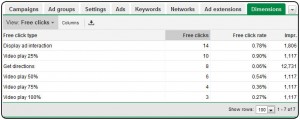
To access the new report, choose the “Free clicks” view within the Dimensions tab of your AdWords account. If you don’t see the Dimensions tab, you can allow it by clicking the arrow button next to your present tabs above your performance table.
Here, you can find stats on actions your customers take without having to click through to your website. To differentiate them from clicks that you pay for, we’ve labeled them “Free clicks” and kept them apart from the paid clicks listed in other tabs.
Campaigns or ad groups with a high number of free clicks may mean that your ads are performing good than they appear to be elsewhere in your account. A high free click rate may specify ads that your customers find useful without needing to visit your website. For example, getting directions to your store (via a location extension ad) may be all your client needs to instigate an in-store purchase. Conversely, video ads that have low play rates may signify a creative change that needs to take place to keep customers engaged.
Knowing how customers interact with your ads will help give insight into how they research and buy online and what content captures their interest and prompts action. Ads are likely to persist to be more and more interactive, so take advantage of this new report to create ads that are more engaging and useful, all with the decisive goal of increasing sales for your business.