




An interesting checklist of why a site could be dropped from google' index posted in webmasterworld.com
Written by power
@ 1:07 AM
permanent link on
Wednesday, December 29, 2004
| Post a Comment |
0
comments


One of the most common themes of posting here in WW starts something like:
"Last night, my site disappeared..."
"Losing" a site can be a painful and
frustrating experience. To help ease the pain, perhaps a starting list of
potential issues might help. I'll probably miss more than I'm catching with this
list, but at least it's a start.
Do a site search at the SE in question to
determine if all of some of your pages are gone. Some think that their site has
vanished, when in fact an algo update or tweak has occured causing their pages
to drop. Or, individual pages have been filtered or penalized, but not entire
sites:
If *all* of your pages are gone (search on URL's to check that), then
perhaps: • your server was down at an inopportune time. • you have a robots.txt
problem. • you've been removed from the index based on a perception of bad
behavior (not good).
If only some pages are gone, or if your pages have
simply dropped badly in the SERP's, then perhaps: • you have some other
technical issue not noted above (e.g., badly executed redirects), • the algo
changed, • you've done something recently that the SE did not like, or, • the
algo changed and something that was previously "OK" is now being filtered or
penalized.
Here are some specific things to look at:
Start with the
basics: Was your server down recently? Server failure is always a good item to
check off your list when searching for problems. No need to start remaking your
site if all that happened was a temporary problem.
Are you using a
robots.txt file, and if so, has it changed. , Is the syntax correct? There are a
variety of potential problems that can be caused by improper code in robots.txt
files, or placement of the robots.txt file in the wrong location. Search WW on
this topic if you're not sure what you're doing. Use the WW Server Header
Checker. At worst, a robots.txt file can tell a SE to go away, and you really
don't want that. ;-)
Have you more aggressively optimized recently? Internal
changes that can lead to potential problems include: • More aggressive kw
optimization, e.g., changes to Titles, META's,tags, placement and
density of kw's, etc. • Link structure changes, and especially link text
changes. Updates to link text or structure, if done for optimization reasons,
can push a site into filter/penalty territory. Look in particular for overuse of
kw's.
Have you added redirects? The SE's *can* sometimes become confused by
redirects. Assuming that the changes are intended to be permanent, use 301's,
not 302's. Be especially careful about large scale changes. If done properly,
redirects are important tools. Done without proper knowledge, they can lead to
short term pain, often on the order of 1-6 months.
webmasterworld.com/forum3/8706.htm
Do you have a significant number of
interlinking sites? If ever there was a strategy that might be summed up as:
"Here today, gone tomorrow..." interlinking is it. You can succeed with this
strategy. But if you add too many sites or links to the mini-net you're
creating, or interlink too aggressively, it can catch up to you. Penalties can
range from soft filters to complete manual removal in rare cases. Even with no
recent changes to your sites, the SE algo's can change, making something that
squeaked by yesterday illegal today. webmasterworld.com/forum3/4618.htm
Are
you linking to sites in "bad" neighborhoods? If ever there was a strategy that
might be summed up as: "Gone today..." linking to "bad" sites is it. If you
think that you might be linking to the dark-side, lose that link instantly, if
not sooner.
webmasterworld.com/forum3/8053.htm
Could you be suffering from a
duplicate content penalty? Some practices or occurances that can cause problems
in this regard include: • Use of a single, site-wide template • Use of one
template across multiple sites • Competitors stealing or mirroring your content
• Redirects from an old domain to a new one • Over reliance on robots.txt files
to exclude bots from content areas you don't want exposed. WebmasterWorld
Thread: webmasterworld.com/forum3/22494.htm
Are you cloaking? Some cloak merely to deliver "accurate" pictures of
sites/pages to the SE's. Examples of this are sites with lots of graphics and
little text. But if you're a mainly text based site that is delivering one set
of content to the SE's while users are seeing something
less...umm...optimized...then there's always the risk that you've been caught.
Are you using AdWords? This is pure speculation on the part of some seniors
here, but some do seem to firmly believe that if you place highly with an
Adwords listing, it might actually hurt your position in the SERP's. Don't shoot
me. I'm just the messenger.
IF OTOH, the only issue is that you're not as
high in the rankings as you'd like, then a better place to start would be
Brett's 26 Steps to 15K a Day.
Source: http://www.webmasterworld.com/forum5/4584.htm
Search Google Ads - searching google's sponsored links
Written by power
@ 10:38 PM
permanent link on
Friday, December 24, 2004
| Post a Comment |
0
comments
www.google.com/sponsoredlinks it shows ads which google shows for adwords are adsense, seems like a good feature to know who are the advertisers for a particular keyword phrase and how many ads are displayed for a given keyword,
Iprospect cashes out for more than 40 million dollars
Written by power
@ 7:15 PM
permanent link on
Wednesday, December 22, 2004
| Post a Comment |
0
comments
News story in yahoo news,
Isobar Acquires iProspect to Create World's Number One Search Engine Marketing Entity
Isobar, the global full service digital network created earlier this year by U.K. firm Aegis PLC, today announced it has acquired 100% of iProspect, the Original® Search Engine Marketing Firm. The news marks Isobar's first acquisition in the U.S. market, and the 7th for Isobar globally in the past six months.
Source: biz.yahoo.com/prnews/041222/sfw009_1.html
How much they were cashed out information here
Aegis has acquired US internet search marketing agency iProspect.com in a deal that could net the founders of the firm $50m (£26m).
Aegis will pay an initial £16.7m with a further £9.4m deferred and payable over two years, subject to performance-related targets. IProspect will become part of Aegis Group's digital media network Isobar, which has made a number of acquisitions over in the past six months, including Korean digital agency Agency W and Australian digital agency One Digital. Founded in 1996 and headquartered in Watertown, Massachusetts, iProspect is one of the pioneers in search engine marketing. Earlier this year, it was named among the top 50 fastest-growing companies by Inc.
Source: www.revolutionmagazine.com/News/index.cfm?fuseaction=ViewNewsArticle&ID=231352
Google Adwords displaying all the ads
Written by power
@ 7:13 PM
permanent link on
| Post a Comment |
0
comments
Discussion here, www.webmasterworld.com/forum81/4107.htm
forum users report index / home page missing in yahoo's new update
Written by power
@ 11:34 AM
permanent link on
Tuesday, December 21, 2004
| Post a Comment |
0
comments
www.webmasterworld.com/forum35/2875-3-10.htm
Google fixes their desktop search tool flaw,
Written by power
@ 10:38 AM
permanent link on
| Post a Comment |
0
comments
Now google seem to have fixed the issue, news here,
news.xinhuanet.com/english/2004-12/21/content_2360777.htm
Site:www.example.com Returns 5x Greater Number of Pages Than on the Site
Written by power
@ 9:59 AM
permanent link on
| Post a Comment |
0
comments
From what i can see there are no changes in site: command, probably what that user found was just a glitch,
www.webmasterworld.com/forum3/27157.htm
Google as Web King - An interesting thread discussion in webmasterworld
Written by power
@ 9:50 AM
permanent link on
| Post a Comment |
0
comments
This article neatly describes the future of google and how they can improve them selves from their current standings,
2 significant posts in this thread are from 2 regular users, they had a very good insight into the article, Source of the article; www.technologyreview.com/articles/05/01/issue/ferguson0105.asp?p=1
Iguana says,
I think I understand what Charles H. Ferguson is saying. He seems to be
saying that Google needs to develop commercial APIs to their search - because
this is what Microsoft has done before with windows and their applications and
made (nearly) all the facilities available to developers.
But I don't regard
'Web Search' as that important a function to require APIs. I still regard it as
a way to quickly access the statically delivered content on the web. Obviously
Google already have a developers API (with very limited usage) and Adsense
websearch. Amazon have their new e-commerce webservice that allows you access to
their search results (Google-derived and Alexa enhanced) that is in beta and may
be subject to a charge in the future. Both of these seem to be allowing websites
to incorporate their own websearch facilities. I don't think they will be taken
up in large enough numbers to have a big impact on searches done.
What he is
talking about is the next generation of search - the one that includes the
'hidden web' desktop PC file systems, emails, handhelds, and Linux. To provide a
cross-platform access to all of this would be nice - but hardly a 'killer app'.
I haven't bothered to download Google or MS desktop search - I know where my
files are and what they contain and can use windows explorer to check them. I
only need a deep search of previous web pages/emails/files about every 2 weeks.
If you said I could search and access the text of any book ever written, any
software, any album details (cover/real lyrics/ track listing/sample), access
MP3s of my music and the music collections of any friends (wishing all my vinyl
was converted to MP3) - then I would be excited both in my working and home
life. But copyright prevents a lot of this and I couldn't afford to actually
purchase these as products.
I just fail to make that jump from search being
a quick, sometimes frustrating, way to access web content to being the nervous
system that unifies my informational world. In the long term (10-20 years?) it
will be that. But for the next few years, when the Google/MS competition will
take place, it is the web search that will be the battleground. I used to think
the real crux could be how you access the search - when the browser disappears
from Windows and becomes part of the desktop then Microsoft can make it awkward
for people to change the default search from MSN to Google. It didn't work last
time with the built-in IE search but maybe will work better this time. Luckily
enough Google should have the financial clout to quickly stop Microsoft using
any unfair tactics, unlike some other companies in the past who have had to wait
5 years for their multi-million dollar settlements that are just loose change
for Mr Gates.
I realise that I am holding up my hand and saying I just don't
have the imagination/foresight to see how APIs and extending the search content
is the next step. Given that Microsoft won't be able to just leverage control of
the major operating system to eliminate Google, I keep on coming back to the
thought that for the next 5 years it's the same old, same old thing - quality of
the search results. All the pain of the Florida update, the obfuscations that
have reduced the power of Pagerank, the 'filters/sandbox/hilltop/ anchor text/
over-optimisation penalties' - has failed to produce better Google search
results. Google needed to move from a keyword-based search with Pagerank to
something else (now that Pagerank was understood and spammed rather than natural
web linking). I really believed that Google was going to move to the next stage
and figure out what a page was about before serving it as a result as opposed to
ever more elaborate counts/weighting of keywords in the document. But they have
failed. I think that Yahoo and Teoma may now be its equal and that Microsoft may
catch up in a year. Google could become a minor player long before the big
battle over control of access to digital content is fought - if one of the other
players comes up with a search engine that actually understands something about
what the user is searching for.
Namaste says,
Web search is a service, and in a service, the quality of service matters. MS
has never won a service war, only a product war.
From what I have seen of
Google's strategy so far, it seems to be sound:
1. Index deep. 2. Go beyond
the web 3. Earn revenue from increased distribution 4. Make search convenient:
fast, desktop, etc. 5. Build a WebOS 6. Don't be evil
These 6 are common
sense strategies and if they stick to them, they should have a sound future.
For all that is said, MS also sticks to some common sense strategies that
have seen it win many battles: 1. Make everything easy to use 2. Provide
reasonably good quality 3. Provide it cheap 4. Push it to the max 5. Get
developers on your side
It beat Netscape, Apple, Novell, IBM, etc. using
just these five strategies. But these strategies are blunt against Google,
because Google is already doing the first four, and there isn't much scope for
the fifth in search.
The big question is what will happen when MS provides
integrated desktop search? The answer is that Google still wins if it follows
it's own 1 and 2 and stays ahead of MS. People who are searching will goto
Google.
Further, we are moving to the high bandwidth era, where we are using
more web applications than ever before. If Google can successfully engineer some
key applications (such as Gmail) to be equivalent to desktop software (such as
Outlook), people will automatically migrate to web apps as they are completely
portable.
I am also surprised that the author hasn't spoken about patent
acquisition as a strategic advantage. We have seen many tech wars won as a
result of patents (Minolta vs Carl Zeiss for example). This important factor
could decide the MS vs Google battle. Both players realize the importance of
patents and must be amassing them in hordes. Google ofcourse has a head start in
this as far as search and WebOS goes.
As far as APIs are concerned, I
believe, Google will provide full fledged APIs when it can successfully offer a
WebOS. Possibly just before Longhorn.
Let us not underestimate the Linux
factor in all this. In one or two years, Linux will be as friendly to use as
Windows (still some issues with fonts, installations, etc.). When the time comes
for people to discard Windows XP, the big question is will they go for Longhorn
or the new Linux. In my opinion, it will be the new Linux.
The future:
People will "upgrade" from Windows to Linux; and use more web apps as compared
to desktop apps.
Has MS considered building a WebOS? No news there so far.
If they do, then we are talking serious competition to Google in a few years.
Source: of the thread, www.webmasterworld.com/forum3/27178.htm
Yahoo opens new research and development in chennai india
Written by power
@ 2:50 AM
permanent link on
Sunday, December 19, 2004
| Post a Comment |
0
comments
News here,
Yahoo, HP to launch operations in Chennai,
Internet major Yahoo Inc and Hewlett Packard are in the process of setting
up their development centres in Chennai and will soon be launching their
operations, IT secretary of Tamil Nadu, Vivek Harinarain said in Chennai on
Thursday.
Yahoo is currently in the process of setting up its
development centre and is expected to launch its operations on December 24. In
the next couple of months, Hewlett Packard will be starting its operations in
Chennai with a total headcount of around 500 and plans to take it to 1000 in the
next couple of years," he said, while addressing a two-day conference on
'Creating A New Generation Of Entrepreneurs.'more here, www.expressindia.com/fullstory.php?newsid=39692
Significant Yahoo Update! reported around the forums,
Written by power
@ 2:43 AM
permanent link on
| Post a Comment |
0
comments
Check the active thread discussion in webmasterworld.com
www.webmasterworld.com/forum35/3009.htm
An unrelated thread turning into a Google Bashing thread in webmasterworld.com
Written by power
@ 7:55 AM
permanent link on
Thursday, December 16, 2004
| Post a Comment |
0
comments
This seem to be a common hatred among SEOs these days towards google, I personally use google for all my needs and am happy with what google does for me,
Check that thread here,
www.webmasterworld.com/forum97/278-2-10.htm
Is it right that SEOs hate google, Is this what google want to achieve from their new mission of sandboxing sites, Please feel free to comment on this,
Yahoo Launches Video Search, yahoo search now introduces a new feature which enables people to search for videos
Written by power
@ 7:46 AM
permanent link on
| Post a Comment |
0
comments
When we started thinking about how to make it easier for anyone to expose video
and other rich media content, one of the first things we thought of was
podcasting and RSS. Podcasting uses RSS Enclosures to provide an audio file
along with a news item or blog posting in an RSS feed.
So rather than build
a completely new way to do this, we decided to see what it takes to make RSS
Enclosures work for video content as well: video enclosures. It's not a new idea
but we think it's one whose time has come.
At the most basic level, this is
just a matter of pointing to a video instead of an MP3 file.
Instead of
this:
You could use this:
For many publishers, that's all
it takes. The beauty of this is that there's existing infrastructure for
handling simple enclosures. Many RSS readers already consume enclosures just
fine.
In the very near future the Yahoo! Video Search crawler will support
indexing video enclosures in RSS feeds.
From yahoo Search blog here - www.ysearchblog.com/archives/000060.html
Written by power
@ 7:42 AM
permanent link on
| Post a Comment |
0
comments
People who are interested can check this datacenter 216.239.59.99 for their new updated backlinks,
Yahoo to begin testing desktop search in January,
Written by power
@ 1:24 PM
permanent link on
Tuesday, December 14, 2004
| Post a Comment |
0
comments
Yahoo is bound to launch its desktop search in the money of January, Reuteurs article says this,
Yahoo said on Thursday it will begin testing a free desktop search service in early January, following rivals hoping to extend the reach of wildly profitable search-related advertising.
Desktop search, which helps excavate information buried on computer hard drives, is seen as the next frontier in the booming search sector that has generated billions in revenues from ads generated by Web search queries.
More here, itweb.co.za/sections/internet/2004/0412130917.asp?S=Reuters&A=REU&O=FRGN
Darker side of exchanging links, bad link exchange tactics deployed by some sneaky webmasters discussed here,
Written by power
@ 1:17 PM
permanent link on
| Post a Comment |
2
comments
webmasterworld.com/forum12/2036.htm
Bad webmaster! Bad...
Delink your links page
Bury the link to your
links page on a single page that takes about five clicks to get to
robots.txt
Run your outbounds through your cgi-bin counter script
Another interesting beta search engine toolbar released,
Written by power
@ 1:02 PM
permanent link on
| Post a Comment |
1
comments
Features of the new MSN toolbar beta includes,
- Find anything on your computer Documents, photos, music and more!
- Find e-mail messages in seconds From Microsoft Outlook or Outlook Express
- Try the New MSN Search Search the web smarter and better
- Block annoying pop-ups Surf without interruptions
- Fill out forms online Fill out forms and web site passwords in one click
Search engine strategies conference coverage by seroundtable.com
Written by power
@ 11:59 AM
permanent link on
| Post a Comment |
0
comments
Please visit this site for more information on the various topics on this,
www.seroundtable.com
Mesothelioma keywords overture PPC ( pay per click bid ) reaches all time highest
Written by power
@ 10:25 AM
permanent link on
Friday, December 10, 2004
| Post a Comment |
4
comments
No bidder can bid over 100$ for mesothelioma related keywords for Pay per click, Now it seems they changed the policy, I just checked overture bids tool for pay per click for mesothelioma and it has reached to 160$, That is one heck of a money for one click, It seems overture has released its new maximum bid limit policy and let people to increase it to 160$ :-(
here is a screen shot of the maximum bid in overture for mesothelioma
Google launches google suggest beta- A great google addon feature
Written by power
@ 10:12 AM
permanent link on
| Post a Comment |
2
comments
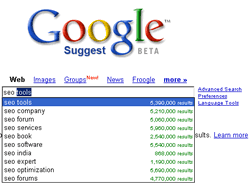
For example if you type google it will bring down relevant list of deep queries, for example words like google search, google suggest a site, google toolbar, google scholar etc,
it is a great product you can reach it here, google.com/webhp?hl=en&complete=1
Screen shot of the new google product google suggest
Resource zone on the move, Dmoz forum taken down for maintainence,
Written by power
@ 7:56 PM
permanent link on
Wednesday, December 08, 2004
| Post a Comment |
0
comments
Resource Zone, Extreme Tech Support, What Pisses You Off, BobSchwarz.com,
Extreme VB and the rest of the sites are moving to a new home. This is a huge
undertaking so expected time to re-opening is December 8, 2004. If any further
delays are encountered I will update this page.
An Interview with Tim Converse - Interesting discussion with Tim of yahoo search posted in yahoo search blog
Written by power
@ 11:39 AM
permanent link on
Tuesday, December 07, 2004
| Post a Comment |
0
comments
ysearchblog.com
An extract from the interview,
JQ: When it comes to fighting spam, there's all kinds of software and many
people trying to stop spam attempts. With all of us trying to detect this, is
there a way to tell the search engines about it?
A: We get a lot of that
data on our own. We have a pretty large view and we're approaching the spam
problem from a lot of different directions. But nobody should expect to see any
sudden change in spam just yet.
Take weblog comment spam, for example. Two
things will have to happen for comment spam attempts to decrease; one is that
spamming will have to not work for search engines and the second is that comment
spammers will have to realize it. (laughs). There could be a long lag there
where, even if every search engine totally nailed them, spammers could still
operate under the belief that it worked. What we can do from the search engine
point of view is make spam not help.
How do you spell Levenshtein?
Written by power
@ 11:34 AM
permanent link on
| Post a Comment |
0
comments
Saw an interesting posting in MSN search blog about their spelling correction system implementation into their new MSN beta search, see what have are saying,
More here, blogs.msdn.com/msnsearch/archive/2004/12/06/275899.aspxHow do you spell Levenshtein?
Doing a good job of helping Search users to
correct misspelled queries is super important for two main reasons: a) 5 billion
crawled docs and a bleeding edge ranking algorithm can't do much if the query
isn't spelled right and b) more than 10% of all searches are misspelled! So we
made sure our new search engine included a revamped spelling correction system
that's much better than our old one.
To improve the speller we worked with
Silviu Cucerzan and Eric Brill from Microsoft Research's Text Mining, Search and
Navigation Group. Silviu and Eric have developed some novel techniques for using
search query statistics and iterative transformation of query strings to improve
spell correction. Their published paper on this topic – Spelling correction as
an iterative process that exploits the collective knowledge of web users –goes
into much more detail on some of the technical thinking that inspired the
spelling correction system we built.
new gaggle of Groups (update)
Written by power
@ 10:47 AM
permanent link on
| Post a Comment |
0
comments
Whether your interests run to knitting or brain surgery, chances are good
other people out there share them. The new Google Groups not only helps you find
information on millions of topics; now you can actively share ideas and opinions
with others about each and every obsession of yours. And if you don't find a
group already focused on your passion, by all means start one. Invite others to
join your group so that all interested parties can read and respond to messages,
share opinions and ideas via email or your own group's web page. If you're
looking for a group to join, we could definitely use some thoughtful insight (or
idle speculation) over at my space elevator group. Shannon Bauman Associate
Product Manager, Google Groups
More here ( google.com/googleblog/2004/12/new-gaggle-of-groups-update.html )
Is SEM different from SEO, An interesting discussion in forums search engine watch
Written by power
@ 10:12 AM
permanent link on
Saturday, December 04, 2004
| Post a Comment |
0
comments
Here is my opinion on the same thread,
I agree with tomslick, SEO is part of SEM,
SEM IMO consists of,
1. SEO
2. PPC
3. PFI ( Optional )
4. Link Building
5. Affiliate SE Marketing
6. ROI and conversion tracking
7. Sponsored Search engine listing(some search engines).
8. Shopping feeds ( shopping search engines )
SEO - Search Engine Optimization, Ability to improve a site to make it relevant to Search Engine Algorithm and make the algorithm rank a site based on User queries.
Source: forums.searchenginewatch.com/showthread.php?t=3045
Yahoo reportedly settles trademark dispute with Geico
Written by power
@ 10:09 AM
permanent link on
| Post a Comment |
0
comments
MSN Beta Adds New Drop Down Search Button for more convenience
Written by power
@ 9:54 AM
permanent link on
| Post a Comment |
0
comments
Check this screen show

Brett Tabke Founder webmasterworld.com - Brett one of the foremost SEO GUY
Written by power
@ 9:41 AM
permanent link on
| Post a Comment |
3
comments
The topmost SEO intellectual, Brett Tabke was exposed to computers and the net world from his school days itself. His interest and curiosity grew from his mere childhood and it did not take much of a time for Brett to establish himself in the SEO field. Brett is now the CEO of the famous optimization site, Webmasterworld.com
When Brett Tabke finished his college, he started working part time for Epyx, Berkeley Softworks, TwinCities, and others in Commodore software. He authored a book for Western Design and Ahoy magazine. Then, Brett started working with bulletin Board system (BBS) and Net Promotions.
BBS is the precursor of the present forums. Brett put the first BBS online in 1984. From there he picked up building websites and also learned about online traffic. It did not take much time for Brett to be the authority on internet traffic.
About search engine marketing Brett explains, "Search Engine Marketing is just a fancy name for checkbook SEO. That's not what I deal with - it is optimization and promotion I am concerned with."
Brett looks forward to expand the forum offerings to address the growing needs of the web world. He envisions a full service site that supports all the needs of webmasters. But Brett does not like to deviate from his own field of search engine promotion.
Brett's site: http://www.webmasterworld.com
Jill Whalen - SEO Lady - The Web Whiz - Jill whalen
Written by power
@ 11:58 AM
permanent link on
Wednesday, December 01, 2004
| Post a Comment |
6
comments
An internationally recognized consultant in SEO, Jill Whalen is the owner of High Rankings which specializes in search Engine Optimization. She is also the proficient editor of the free weekly High Rankings Advisor Search Engine Marketing Newsletter. One of the experts on the internet, Jill Whalen is also famous for her effective talks on seminars and conferences.
Jill has been performing search engine optimization since 1995 and established herself in the career in 1997. Her buoyancy in the work she does motivates her in taking up new assignments from her clients and proves herself right in the way she gives away results.
A regular presenter at Danny Sullivan's Search Engine Strategies Conferences, Jill Whalen also conducts her own marketing seminars. She claims to have 5000 registered members in her site which also claimed to have an instant success within days of launching. Jill was the successful administrator and moderator of the Google Forum, at Cre8asite SEO web development Forum and also at Web Page Content Forum.
Her frequent rapport with people who writes articles on search engine optimization helps her to understand the changing trends in the market and thus brings out necessary changes in the strategy she employs. Jill's creative expertise is proved in the articles she wrote for SearchNewz, WebProNews, WorkZ.com, ClickZ.com, Inc.com, Lycos Small Business.
The critically acclaimed Rank Write Roundtable was efficiently moderated by her. PageRank Explained written by the programmer, Chris Ridings was effectively edited by Jill Whalen. She has also started, Searchcreativ.com to design search engine friendly websites.
With gifted caliber and proficiency in the field of search engine optimization techniques, Jill Whalen leads her successful journey with strong determination and resolve unfolding newer strategies and employing better policies in the field of online marketing.
She practices search engine optimization for more than 6 years her work has brought lots of business to many website owners,
She runs a popular high traffic search engine optimization forum named the highrankings forum, I learned a lot from frequenting her forum,
Jill's site: www.highrankings.com
Google Toolbar pagerank Not accurate - A reply possibly from google,
Written by power
@ 11:02 AM
permanent link on
| Post a Comment |
1
comments
"The PageRank that is displayed in the Google Toolbar is for
entertainment purposes only. Due to repeated attempts by hackers to
access this data, Google updates the PageRank data very infrequently
because is it not secure. On average, the PR that is displayed in the
Google Toolbar is several months old. If the toolbar is showing a PR of
zero, this is because the user is visiting a new URL that hasn't been
updated in the last update. The PR that is displayed by the Google
Toolbar is not the same PR that is used to rank the webpage results so
there is no need to be concerned if your PR is displayed as zero. If a
site is showing up in the search results, it doesn't not have a real PR
of zero, the Toolbar is just out of date"
Source: forums.searchenginewatch.com/showthread.php?t=3054