




What does a Title Tag have in Common?
Duplicate titles are rather we often see on newly developed websites or CMS that don’t allow correct control of individual pages. When developing new sites, the title tag can get ignored, many internet knowledge software developers still don’t take title tag customization into account.
In some cases it is just a matter of some artistic programming to fix. In others it might need some major reworking of the system, or a scraping of the system in total. And, of course, other times it is just an issue of taking the time to get into your HTML or your CMS and writing exclusive title tags for all your products and content pages. If you have a lot of products or pages, this can be time consuming, but its well significance the effort.
If you can pull it off with your CMS, allow Titles to be automatically generated based on on-page criterion, but also give yourself the chance to overwrite the defaults with your own customization. This is particularly helpful for product pages. At some point you may want to get in and create a unique title tag for more and better search engine rankings. Having both options will give you the greatest amount of control without having duplicate titles until you get around to customizing them.
SEO getting bad press?
To find Google search volumes for any of the given phrase or term is a notoriously hard task. Google is offering a number of tools to their Ad sense and Ad words customers, and the Google Trends deliver you a graphical representation (without absolute figures) for search volumes that are mapped against press coverage.
Searching Google trends for the term ‘search engine optimization’ will return an interesting result.
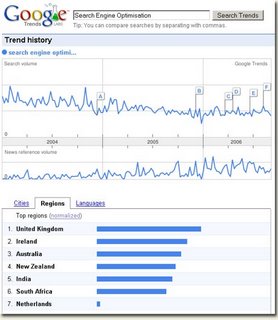
Captivatingly, while news reporting seems to have increased, the search volume for ‘search engine optimization’ has been progressively decreasing.
5 cause to leverage Google’s Custom Search
Designing Website
Are you tried of designing your website! It is one of the difficult processes to apply the type of algorithms as Google does. It helps to sort the result in a smarter alphabetical way. In the custom search engine, the algorithms are applied to obtain wide benefits.
Access Content
The sites on the web have excellent, reliable and informative content that will be within the different links. The custom search engine allows the web searchers to find best content without getting frustrated. The custom search results will be accomplished newly with excellent content required for the users. Fresh, updated content can be obtained from Google search result.
You can customize the configuration using Google custom search engine in different ways that inclusive of look and feel results, style of search boxes, ads placement, AdSense, mode of searching the sites and method of displaying the results.
The Three Essentials of Search Engine Optimization SEO
Keyword Prominence
Where does your keyword explore terms show up first? Frequently the closer your keywords appear to the top of the page, the more importance search engines give them. This is because they crawl the html code of your site earlier than the content. Putting keyword search terms into places such as your title can give you a separate advantage over other webmasters who only use keywords in their content.
Inbound Link
Back in the day, it was very important to get reciprocal links to your website. Search engines located a lot of importance on who you were linking to and vice versa. Instead of link exchange, search engines are placing more value on inbound links normally referred to as back links. In essence, search engines vision this as a kind of referral system. One site is recommending another without having to give back.
Web Site Content
While search engines do worth your keyword prominence and amount of back links to your site it still comes down to what’s on your webpage. The internet is at the dawning of a video revolt but that only means more information will be necessary.
Write as many unique and excellence articles as possible and place them on your website. If you want to, you can outsource this process or just visit the article directories and find content associated to your niche and use it on your website. Be sure to read the term and conditions in regards to using other people’s articles. Grow your web content gradually, so it looks more natural to the search engines. Keep posted the information frequently.
Overview of Stumble Upon’s
It is enormous status might be credited to its innovative – yet entirely familiar – approach to social bookmarking. The attitude behind Stumble Upon is giving its users the chance to ”channel surf the internet”, which is to say it brings a powerful element of the random to the experience of discovering new sites, serving up sites just as a TV viewer might flick through TV channels. Behind this seemingly, refreshingly random selection however is a powerful system that taps directly into your responses to previously served content. The more you use Stumble Upon, the smarter it becomes to your tastes.
When you sign up to Stumble Upon you will be ask which categories of websites you are interesting in being served. After this, you will have a del.icio.us style button added to your browser. When you click the button it will take you to an optional site based on your preferences. Here you can either click on thumbs up icon to tell it you like the site, and save it to your collection, or a thumb down icon to suggest that this was a poor selection.
What sets it apart?
* Stumble Upon brings an excite element of the random to your browsing experience, but retains all of the features of a traditional del.icio.us style social bookmarking service
* The Stumble Upon toolbar is really general, allowing you to find and rate bookmarks in a number of different ways without having to go to the Stumble Upon homepage
* Stumble Upon learns and adapt to your tastes over time, bringing you fresh recommendation you are more likely to be involved in without having to search for yourself
Creating links and adding images
Links within content can be created a number of ways:
Entering HTML Source
You can directly enter valid HTML link tags (a href, img, etc) by switching to the source view (html) and hand entering tags that you are familiar with.
WYSIWYG Controls
The WYSIWYG editor contains controls for easily adding hyperlinks and images.
Adding hyperlinks – The web link control () allows you to specific any valid URL in a pop-up window. To use, select the text you wish to link, click the () icon and enter the URL you wish to reference. The pop-up window also allows you specify if you want the link to open a new window or in the same window and allows you to enter text that will appear upon hovering over the link.
Adding images – The Insert/Modify Image control () allows you to specify any valid image URL. Using this pop-up window you can easily set various attribute that relate to an image. Images may be from other places on the Internet, from this site, attachments to your content, or image nodes from the image gallery.
Note: If you are using a pop-up blocker or have pop-up blocking turned on in Firefox be sure to allow this site to create popups in order for this to work properly.
Special Markup – NOT FOUND: xx
This system also contains a special markup tag which allows you to easily reference attached files. By entering the text such as “NOT FOUND: 1, the system will reference the first attached file.
By adding “=yourtext” to the tag (i.e. NOT FOUND: 1) you may also optionally specify the title text for the file. For images, the title text will be used as a roll-over tooltip. For all other files, the title text will be the actual link text.
RSS Alternatives
I have put together a slide presentation that explains the differences between three types of RSS feed:
* Generalized
* Group-Specific
* Personalized
On the same site, I provide a working prototype of a simple, personalized feed.  In this demonstration, we collect name and email address and the feed then carries a unique ID that ties back to those identity items.
Are You Buying Links or Outsourcing Your Link Building?

It’s a straightforward question, but many people get confused by this one. There’s a vast difference between outsourcing link building and buying links. One is just simple exchange of cash for certain links. It’s a straightforward deal – you will pay for a particular link; that’s all.
Link buying is normally a pretty standard transaction. In many cases, you rent text links from websites, but you can also buy reviews or sponsor a website theme. You are making an out-and-out purchase. There’s a money transaction especially for the link itself.
Outsourcing Your Link Building
Outsourcing is not concerning buying links at all. While you outsource your link building campaign, you hire someone to do the entire dynamic link building work you do if you had the time and assets to do it yourself.
Outsourcing means you trust your campaign to link building service who would take the time to study about your business and goals. They do in-depth research about your business, your opposition and your company so that they create dynamic links that aren’t purchased. They will be doing the interactive link building that creates real drone in your industry.
If you locate the right company to outsource, they involve an industry researcher and a qualified copywriter familiar with your firm who can grow articles, blog postings and press release on what you do that will arrest the attention of visitors to your website and countless others.
They would be well-known with authority sites, education pages and quality news feed that you don’t have time to research or access if you were trying to build links yourself. This unique combination of skill and access makes outsourcing your link building a good idea for many businesses.
What Sets Link Building Apart from Purchased Links
Link building is naturally content-rich. As the link is imbedded in a few kind of content that has to justify its existence, it has to be somewhat interesting enough to be of value. It might be an interesting how-to article, a thought-provoking reply on a popular blog, a press release picked up on an industry news wire, it really doesn’t matter where the link is.
What matters is the content is costly to the reader, which makes the link more likely than a typical purchased link. It’s also why outsourcing your link building can be a huge investment- you aren’t buying links; you’re just buying a team of researchers, writers and industry experts who are doing what you would do.
How to set up a good link
- Make certain that where your link appear is not in ‘Known bad list’, which can be found by probing for it Google.
- Make definite that the page you will be on in the Google directory and is frequently cached.
- Make sure that your link will be there lengthy period. Try to obtain it on a page with very few outgoing links, fewer than 100 is advised, but try to obtain on a page with less than 50.
- Don’t just go for page with high Page Rank, a lot of high ranking pages can be misconstrue as spam, so get a fine spread of sites from 0 to 10 Page Rank if probable.
- Do not contain too many links going exist at the same time, not as significant for a well-known site, but fresh site owners need to be aware, depending on your business, but a maximum of 30 a day will keep your site below the radar.
- Make sure the page title of the page you are receiving your link as of and try to incorporate part or every page title into your anchor text.
- Try to get your link as high up on the page as feasible.
- Make sure that we should not use the same anchor text for all links; try to differ your linking text.
- We advise starting with ten keywords and use each of it ten times, then replicate the process with a further diverse ten anchor texts, so your initial one thousand links are prepared from one hundred lots of ten.
- A good place to begin building links is by means of directories. Dmoz is the finest place to begin, although your site needs to be totally perfect and submitted correctly to the right category.
- Once you have build a few incoming links, and Google has updated their Page Rank display, you will possibly start getting requests for reciprocal link exchanges. We recommend against reciprocal linking, but that is just personal option.
How to maintain your Search Engine Positions in the number One Spot
Apparently there are some exceptions and the reasons are very hard to identify sometimes. However such factors like the number of competition for your keywords and the type and amount of links you get all result how fast you get rankings.
This is what you require to do once you start getting high rankings:
1) Check that your link partners are at rest linking back to your website.
2) Add new articles once in a while, even though the more you add the better as long as they are articles you generate not copied.
3) Add no follow tags on convinced links like terms of conditions, earning disclaimers and privacy policies. There is no requirement for these pages to rank high in search engines.
4) Examine your search engine rankings for your keywords. If a particular keyword looses ranks employment on that keyword. It means get back links so it regains position. Use the keyword in the anchor text of each back link but always alter it a bit now and then. Changing a bit means add a word or two dissimilar with the keyword.