




Web Development
How Search Engines Crawl Websites: A Developer’s Perspective
As developers, we tend to spend the majority of our time concentrating on issues such as functionality, speed, security, and user interface. We develop quick websites, make optimizations, and resolve various technical problems. However, one area that is often overlooked is how search engines discover websites.
Whether you’re building a simple business website or a large web application, understanding how search engines crawl websites can help you make better development decisions and improve your site’s visibility in search results.
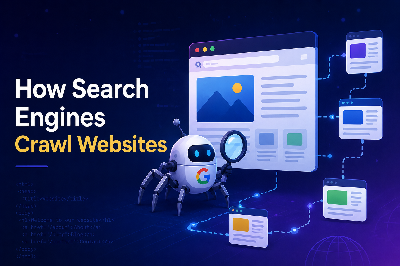
Every day, Google and other search engines explore billions of web pages across the internet to discover new content and keep their search results up to date. They do this using automated programs known as crawlers or bots. Google’s crawler, called Googlebot, constantly moves from one page to another by following links, finding new content, and checking existing pages for updates. Before your website or webpage can appear in Google search results, Google first needs to find it, crawl it, and understand what the content is about.
The process of crawling, from the viewpoint of developers, entails much more than just a search engine visiting a particular web page. Googlebot visits the web page, exchanges information with the web server, gathers the information on that web page, analyzes its HTML code, clicks through links, and tries to understand the topic of that page. Therefore, the architecture of the website is very important because it either facilitates or impedes the access of the search engine to web page content.
Modern website development has enabled websites to become faster, more interactive, and more engaging in comparison with websites from previous times. Frameworks such as React, Vue, Angular, and Next.js have enabled software developers to create dynamic websites that provide an enjoyable user experience. Nonetheless, it can be challenging for search engines to crawl and index content developed by means of these frameworks. Despite improvements in Google’s algorithms in terms of processing JavaScript code, client-side rendered content can take additional time to become available for crawling and indexing. This is one of the reasons why developers use methods such as SSR and SSG.
The faster your site loads, the better you will offer an experience to visitors, but that is not all. It will also help search engine bots index your web pages more efficiently. Your newer pages and posts are also more likely to be discovered and indexed faster because search engine bots can explore your website more efficiently when it loads quickly. There are simple ways to increase the loading speed of websites, such as image optimization, code cleaning, cache enabling, and using reliable hosting services.
Technical problems can become an obstacle for successful crawling of the site by the search engine. Technical problems like using robots.txt incorrectly, links that don’t work on the page, redirections, server problems, or canonical tag configuration problems can prevent important pages from being crawled. It happens quite often that good sites with valuable information fail to get indexed due to inaccessible pages.
With the increasing complexity of sites, another aspect that becomes critical is the idea of the crawl budget. Crawl budget refers to the amount of resources search engines allocate to crawling a website. If a website consists of thousands of low-quality pages, then it is likely that crawlers will spend their valuable time on those pages rather than on useful content.
A lot of developers aim to create fast, reliable, and feature-packed websites. However, one should always keep in mind that if search engines cannot locate these websites in the first place, users will never have the opportunity to access them, despite the content being very useful. This makes knowledge of website crawling crucial. Indeed, developing websites with good navigation and internal linking makes crawling much easier for search engines, making it easier for more people to find these websites through organic search.