SEO
Search intent is the reason behind a user’s search. It tells us what someone is actually trying to find when they type a query into Google.
A person searching for “how to improve website speed” wants information. Someone searching for “best SEO tools” may be comparing options. Another user searching for “SEO company near me” may already be ready to contact a service provider.
Understanding this difference helps businesses create content that matches what users actually want.
What Is Search Intent?
Search intent, also called user intent, is the goal behind a search query.
Google tries to understand whether a user wants to learn something, find a specific website, compare products or services, or take action.
This is why two similar keywords can show very different search results.
For SEO, choosing the right keyword is important, but understanding the intent behind that keyword is just as important.
Why Search Intent Matters for SEO
Search engines aim to show results that are most useful for the user.
If someone is looking for information but lands on a sales-focused page, they may leave quickly. In the same way, someone ready to buy may not want to read a long educational article.
When your content matches the user’s intent, it becomes more relevant and useful. This can improve engagement and help attract visitors who are genuinely interested in your content, product, or service.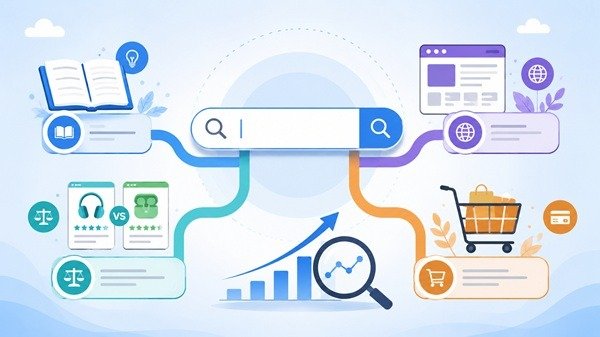
Types of Search Intent
Search intent is usually grouped into four main types.
Informational intent is when users want to learn something or find an answer.
Navigational intent is when users are looking for a particular website or brand.
Commercial intent is when users are researching and comparing options before making a decision.
Transactional intent is when users are ready to take action, such as buying a product, contacting a company, or signing up for a service.
Knowing the type of intent helps you decide what kind of page or content to create.
How to Understand Search Intent
One of the easiest ways to understand search intent is to look at the current Google results for your target keyword.
If most of the top results are blog posts, the intent is likely informational. If the results mostly show product or service pages, the intent may be commercial or transactional.
SERP features such as People Also Ask, featured snippets, shopping results, local listings, and videos can also give useful clues about what users are expecting.
How to Optimize Content for Search Intent
Start by understanding what the user wants before creating the content.
If the search is informational, provide a clear answer. If the user is comparing options, give helpful comparisons. If the intent is transactional, make it easy for the visitor to take the next step.
Your title, headings, and main content should all match the purpose of the search.
It is also useful to review older pages from time to time because search intent can change as user behavior and search results evolve.
Final Thoughts
Search intent helps you understand the meaning behind a keyword.
Instead of creating content only to target search terms, focus on giving users the type of information or solution they are actually looking for.
When your content matches search intent, it becomes more useful for visitors and more relevant for search engines.
Tags: content-optimization, Google Rankings, Keyword Research, on-page-seo, Organic Search, Search Intent, Search Queries, SEO Strategy, SEO Tips, User Intent
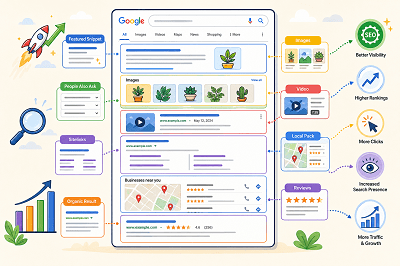
When you search on Google, the results page often shows more than a list of blue links. You may see images, videos, featured answers, local results, ratings, or other special elements.
These are commonly called SERP features.
What Are SERP Features?
SERP stands for Search Engine Results Page. SERP features are special elements that appear alongside or instead of traditional search results.
Google changes the features it shows depending on the search query. For example, a local search may show local results, while an image-related search may display more images.
Common Types of SERP Features
Some common SERP features include:
- Featured snippets
- Rich results
- Images
- Videos
- Sitelinks
- Review information
- Local results
- People Also Ask results
Google also supports different visual search elements depending on the type of content and the user’s search.
What Is a Featured Snippet?
A featured snippet is a special result that displays a short answer or information from a webpage prominently in the search results.
Google automatically decides whether a page is suitable for a featured snippet. Website owners cannot manually mark a page as a featured snippet.
What Are Rich Results?
Rich results are search listings that can include additional visual information such as ratings, images, product details, event information, or other interactive elements.
Adding the correct structured data can help Google understand your page and make it eligible for certain rich results. However, adding structured data does not guarantee that a rich result will appear.
How Do SERP Features Affect SEO?
SERP features can make a search result more noticeable and give users more information before they click.
Appearing in a featured snippet, image result, video result, or rich result can give your website additional visibility on the search results page.
At the same time, SERP features also create more competition for attention because traditional organic results may appear alongside many other visual elements.
How Can You Improve Your Chances of Appearing?
Start by creating clear, useful content that directly answers what users are searching for. Use descriptive headings, relevant images, and well-structured pages.
Where appropriate, you can also add supported structured data to help Google better understand your content and make it eligible for richer search appearances.
SERP features have made Google search results much more visual and interactive. Understanding how they work can help you create content that is easier for search engines to understand and more noticeable to users.
Tags: Featured Snippets, Google Rankings, Google SERP, Local Pack, People Also Ask, Rich Results, Search Visibility, SERP Features
Backlinks are an important part of SEO, but the idea behind them is actually very simple.
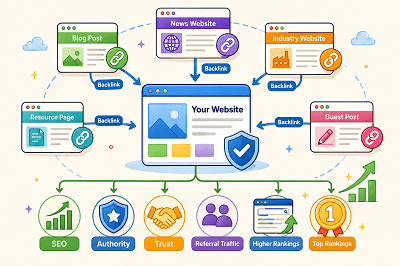
A backlink is a link from another website that points to your website.
For example, if another blog mentions your business and links to one of your pages, your website has received a backlink.
 What Is a Backlink?
Backlinks connect one website to another.
Imagine you publish a useful guide on your website. Another website finds that guide helpful and links to it in one of its articles.
That link becomes a backlink to your website.
Backlinks can send visitors directly to your site and can also help search engines discover your pages.
Why Do Backlinks Matter for SEO?
Backlinks can act as signals that other websites find your content useful or worth mentioning.
When reputable and relevant websites link to your pages, it can help strengthen your website’s authority and visibility in search results.
However, quality is more important than quantity.
One useful backlink from a trusted website can be more valuable than many links from low-quality or unrelated websites.
What Makes a Good Backlink?
A good backlink usually comes from a website that is relevant to your industry, trusted, and publishing useful content. The link should also appear naturally within the content instead of being forced. For example, if you run a digital marketing website, a backlink from a respected marketing or technology blog would usually be more valuable than a link from an unrelated website.
Are All Backlinks Good?
Not all backlinks are helpful. Some may come from spammy, low-quality, or unrelated websites, and these links may provide little value. Buying large numbers of backlinks or creating links only to manipulate rankings can also lead to SEO problems. A better approach is to focus on earning natural links from relevant and trustworthy websites.
How Can You Get Backlinks?
You can earn backlinks by creating useful content that other websites want to mention or share. This may include helpful guides, original research, industry articles, useful resources, or content that solves a common problem. You can also reach out to relevant websites or look for broken-link opportunities. The main goal is to create something valuable enough that another website has a genuine reason to link to it.
Backlinks vs Internal Links
Backlinks and internal links are different.
A backlink comes from another website to your website.
An internal link connects one page of your own website to another page on the same site.
Both are useful for SEO, but they serve different purposes.
Backlinks can help build your website’s authority, while internal links help users and search engines navigate your website.
Backlinks remain an important part of SEO because they can help search engines discover content and understand which pages other websites consider useful. Instead of chasing as many links as possible, focus on earning relevant, trustworthy, and natural backlinks by publishing genuinely useful content.
Tags: Backlinks, Domain Authority, Google Rankings, Link Building, Off-Page SEO, Quality Backlinks, Referral Traffic, SEO Backlinks, SEO Tips, Website Authority
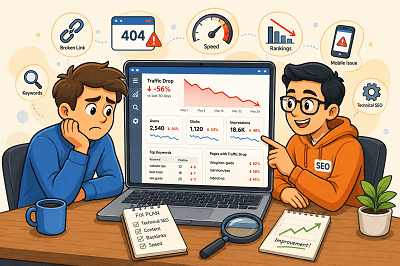
Seeing your website traffic suddenly fall can be worrying. But a traffic drop does not always mean your SEO has failed.
Rankings, technical issues, competitors, seasonal searches, and outdated content can all affect your visitor numbers. The key is finding out where the drop started and what caused it.
First, Find Out Where the Traffic Dropped
Before changing your website, check Google Search Console and Google Analytics.
Look for:
- Pages that lost the most visitors
- Keywords receiving fewer clicks
- Changes in impressions
- Traffic drops from specific devices or countries
Once you know where the decline happened, finding the cause becomes much easier.
Did Your Google Rankings Fall?
A ranking drop is one of the most common reasons for losing organic traffic.
Check whether your important pages and keywords have moved lower in Google. If they have, review the pages ranking above you and improve your content, headings, internal links, and overall usefulness.
Is Your Content Getting Old?
Content that performed well a year ago may no longer provide the best answer.
Update old statistics, replace outdated information, improve weak sections, and add useful new details. Sometimes refreshing an existing page is more valuable than publishing another similar article.
Are Technical Problems Hurting Your Site?
A broken page, indexing issue, server problem, or incorrect redirect can quietly reduce traffic.
Check important pages in Google Search Console and make sure Google can crawl and index them correctly. Also look for broken links and pages returning errors.
Have Your Competitors Improved?
Sometimes your traffic falls even when you haven’t changed anything.
Competitors may have published better content, improved their websites, or earned stronger backlinks. Compare the pages ranking above yours and look for areas where your page can offer something more useful.
Has Search Demand Changed?
Not every traffic decline is an SEO problem.
Some searches are seasonal. Others become less popular as customer interests change.
Compare traffic with the same period from the previous year before assuming something is wrong. Google Trends can also help you understand whether interest in a topic has changed.
Is Your Website Slow or Difficult to Use?
Slow pages and poor mobile experiences can frustrate visitors.
Make sure your website loads quickly, works properly on mobile devices, and makes important information easy to find.
Website traffic can drop for many reasons, so avoid making random SEO changes immediately. Start with your data, identify which pages or keywords lost traffic, and then investigate the cause. Once you understand what changed, you can focus on the improvements that matter most.
Tags: Google Rankings, google-search-console, Keyword Rankings, Organic Traffic, seo-audit, Traffic Drop, Website Performance, Website Traffic
If your website does not show up on Google, there might be some reasons.
At times, it is because Google has not indexed your website. It may be the case that Google has indexed your website but your site is ranking very low.
Here are the seven most common SEO issues:
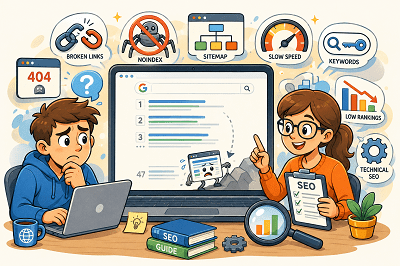
1. Google Has Not Indexed Your Website
In order to show your web pages on Google, first, Google needs to crawl them.
Fix: Configure Google Search Console, submit your sitemap, and use URL Inspection tool.
2. Your Website Is Blocking Google
You have set noindex on your website or you have blocked your site by using a robots.txt file.
Fix: Make sure that you are not blocking Google in any way.
3. Your Website Has Technical SEO Issues
It may happen due to various technical issues such as broken links, server errors, incorrect redirects, and duplicate pages.
Fix: Do an SEO audit and correct any technical issues that might hinder crawling and indexing.
4. The Information Provided by Your Content Is Inadequate
Pages that have very little information can fail to rank.
Google loves content that is valuable, clear, and user-focused.
Fix: Make sure you create valuable content that clearly communicates your products, services, or topic.
5. You are Using the Wrong Keywords
Your site may fail to show up if you don’t target the terms used by people searching.
Fix: Make sure you use the right keywords within your title, headings, and body copy.
6. You Have Bad Internal Linking
Pages that have no or few internal links are less likely to be found by Google.
Fix: Make sure you link your pages and blog posts to each other for easy navigation by visitors and search engines.
7. Your Website Has a Low Rank
Your website might already be indexed but ranks below your competitors.
This is often due to the better content, backlinks, or SEO of competing sites.
Fix: Improve your website and its SEO over time.
Google Search Console can help you check whether your pages are indexed and identify possible SEO problems. If your website is not showing up on Google, start by checking indexing, then review your technical SEO, content, keywords, and internal links. Fixing these basic issues can help Google better understand your website and improve its chances of appearing in search results.
Tags: Google Indexing, Google Rankings, google-search-console, SEO Problems, SEO Tips, Technical SEO, Website Ranking
A sudden drop in organic traffic can be one of the most frustrating experiences for a website owner. If you own a corporate website, online store, or blog, experiencing a drop in traffic can be frustrating and is often a cause for worry when considering rankings, lead generation, and other aspects of your online presence. Even though a fall in traffic might be disheartening initially, there are particular reasons behind it.
First of all, it is important to know that the organic traffic will almost never decrease for no apparent reason. There are updates to search engine algorithms, there are advancements in the websites of your competitors, there might arise certain technical problems, and so forth. In many cases, just a minor adjustment you make to your site might impact the work of the search engines in terms of crawling, indexing, and ranking. This is why it is critical to establish the time when the decrease took place.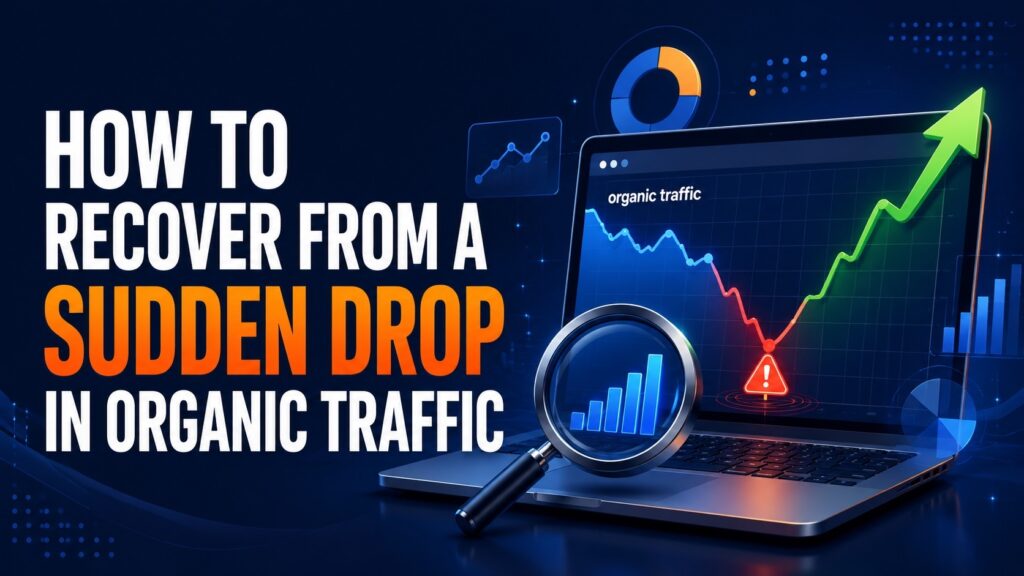
A possible reason for lower organic traffic could be a fall in the rankings of keywords. Pages that used to rank on the first page of Google may start getting lower rankings, causing lower clicks and lower visits. This can happen for several reasons, including increased competition, old content, or algorithm updates by Google. Keeping track of keyword ranks will give you a clear picture of the pages where you might have to work to increase rankings and traffic.
Problems related to technical SEO are another reason behind a fall in the number of visitors. Technical issues such as broken pages, indexing problems, crawl errors, and incorrect redirects can prevent search engines from accessing important pages on your website. Often, website owners don’t even know that there are technical problems until their traffic starts falling. Checking Google Search Console is very helpful for this.
The quality of the content is another essential factor that contributes significantly to keeping the website visible on search engine results. The idea behind this practice is to deliver the most relevant and useful information to the customers. Outdated content that does not satisfy the search criteria anymore will lead to falling rankings. Thus, it is necessary to update the existing content and address customer concerns.
Backlinks are another area that should be considered. Backlinks continue to play an important role in the rankings process, and any links lost from authoritative sites may impact your rankings. Tracking your backlinks will enable you to determine if any valuable links were lost or if competitors became more authoritative.
Website loading time and the user experience factor cannot be ignored as well. Poor loading speed, bad mobile compatibility, and Core Web Vitals may harm users and the website’s ranking. A speedy and responsive website stimulates interaction and allows for the faster crawling process by search engines. Website image optimization, removal of unnecessary scripts, and good hosting services may benefit SEO efforts.
The algorithm updates by Google can also affect the traffic you receive through organic searches. The search engines periodically make adjustments in their algorithms to provide better search results and lower the visibility of poor-quality pages. In case the fall in traffic was witnessed simultaneously with an update of the algorithm by Google, you should take time and analyze your website in detail. Make sure you are providing high-quality content and meeting other criteria to ensure better visibility and ranking even after the algorithm is updated.
Competitor monitoring is also crucial for you. Since ranking is very dynamic, and since your rivals could be producing superior quality content and gaining good backlinks, among others, then you need to compare yourself with them. This will help you to see where you are weak and how you can exploit those weaknesses to strengthen your content as well as improve your ranking.
If you have noticed a drop in organic traffic, know that you are not alone. Almost every website goes through ups and downs in search traffic at some point. The important thing here is how fast you find the reason behind the problem and react accordingly. By constantly monitoring your website, updating its content, and solving technical problems, you will definitely find your way back to being visible online.
Tags: Google Rankings, google-search-console, Keyword Rankings, Organic Traffic, Organic Traffic Drop, SEO Tips, seo-audit, TechnicalSEO, Website Traffic
Search Engine Optimization (SEO) helps websites appear higher on search engines like Google. One of the most important parts of SEO is On-Page SEO, which focuses on improving individual web pages to make them more helpful for both users and search engines.
Good On-Page SEO helps websites get more visibility, attract more visitors, and improve user experience. Even small improvements can help websites perform better over time.
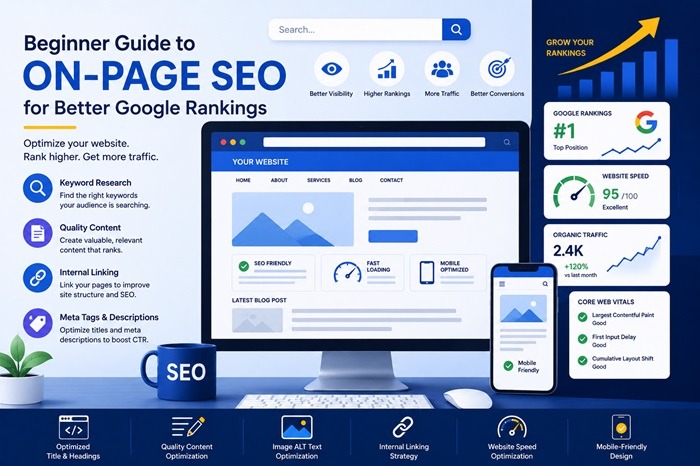
Here are 20 simple and beginner-friendly On-Page SEO tips every website owner should know.
1) Use Simple and Clear Page Titles:
Your page title should clearly explain what the page is about. Clear titles help people understand your content quickly and encourage more clicks from search results.
2) Add Keywords Naturally:
Use important keywords naturally throughout your content so search engines can understand your topic without making the content feel forced or repetitive.
3) Write Helpful Content for Readers:
Focus on creating useful content that answers questions, solves problems, and gives visitors the information they are looking for.
4) Organize Content with Headings:
Using headings helps break content into sections, making pages easier to read and helping visitors quickly find important information.
5) Write Good Meta Descriptions:
Meta descriptions are short summaries shown in Google search results. Clear descriptions can encourage more people to click your website.
6) Make Your Website Load Faster:
Fast websites create better experiences for visitors and help keep people from leaving your website too quickly.
7) Make Your Website Mobile-Friendly:
Most people browse websites on phones, so your website should look good and work properly on all screen sizes.
8) Add Links to Other Pages on Your Website:
Internal links help visitors explore more content and help search engines understand your website structure more clearly.
9) Use Optimized Images:
Large image files can slow down your website, so use properly sized and compressed images to improve loading speed.
10) Add Descriptions to Images:
Image alt text helps search engines understand your images and improves accessibility for users with screen readers.
11) Use Clean and Simple URLs:
Short and readable URLs make pages easier for users and search engines to understand.
12) Keep Paragraphs Short and Easy to Read:
Small paragraphs and simple language improve readability and help visitors stay engaged longer on your website.
13) Update Old Content Regularly:
Refreshing older pages with updated information helps keep your website relevant and useful for visitors.
14) Avoid Copying Content from Other Websites:
Original and unique content helps build trust and improves your chances of ranking better on search engines.
15) Secure Your Website with HTTPS:
Secure websites help protect visitor information and create more trust for both users and search engines.
16) Improve Overall User Experience:
Easy navigation, clear layouts, and fast-loading pages help visitors use your website more comfortably.
17) Use Attention-Grabbing Headlines:
Interesting headlines attract readers and encourage more people to click and continue reading your content.
18) Provide Valuable Information:
Content that teaches, helps, or answers questions creates better experiences for visitors and improves SEO performance.
19) Remove Unnecessary Plugins and Features:
Too many plugins or extra features can slow down your website and create a poor browsing experience.
20) Stay Consistent with SEO Improvements:
Regularly improving your website, updating content, and maintaining quality helps build long-term SEO success over time.
Tags: BeginnerSEO, GoogleRankings, MobileSEO, OnPageSEO, SearchEngineGenie, SEOGuide, SEOtips, TechnicalSEO
In 2026, E-E-A-T (Experience, Expertise, Authoritativeness, Trust) remains one of the most important frameworks Google uses to evaluate content quality, especially after the rise of AI-generated content. While E-E-A-T is not a direct ranking factor, it strongly influences how Google’s systems assess credibility and usefulness. Searches like “E-E-A-T SEO”, “Google E-E-A-T ranking factors”, and “on-page trust signals” continue to grow because website owners want to know what still works. Google now places more weight on real-world experience, accurate information, and trustworthy presentation—making practical on-page optimization more important than ever.

For 2026, Google rewards content that clearly demonstrates first-hand experience and subject expertise. Practical on-page signals include original examples, screenshots, case studies, and step-by-step explanations that show the author has actually done the work. Thin, generic content—even if well-written—struggles to rank. High-performing pages use structured headings, updated publish dates, and accurate technical details to prove relevance. Keywords like “E-E-A-T SEO best practices” and “experience signals in SEO” align strongly with pages that provide actionable insights instead of surface-level advice.
Authoritativeness in 2026 is built through topical consistency and strong internal linking, not just backlinks. On-page signals such as detailed author bios, links to related expert content, and clear content hierarchy help search engines understand who is qualified to speak on a topic. Websites that publish consistently within a single niche perform better than sites covering unrelated topics. Including outbound links to reputable sources also reinforces authority. Searches like “E-E-A-T authority signals” and “SEO trust and authority” highlight the demand for clear, structured guidance on this topic.
Trust is one of the strongest E-E-A-T components in 2026. Google expects websites to be secure, transparent, and user-focused. Practical on-page trust signals include HTTPS, clear contact information, privacy and policy pages, honest claims, and non-deceptive UX. Pages with misleading titles or exaggerated promises often underperform, even with good content. User reviews, testimonials, and visible brand information also contribute to trust perception. High-traffic searches such as “SEO trust signals” and “how to build trust for Google rankings” reflect this growing importance.
As search results become more influenced by AI and user intent, E-E-A-T helps Google decide which content deserves visibility. Pages that combine real experience, expert knowledge, authority, and trust consistently outperform competitors relying on automation alone. By implementing practical on-page signals—clear authorship, structured content, original insights, and transparency—websites can improve rankings, engagement, and long-term visibility. In 2026, E-E-A-T is not about gaming algorithms; it’s about proving genuine value in a crowded search landscape.
Tags: eeat, google-eeat, google-ranking-factors, on-page-seo
Google doesn’t always display the exact title you set in HTML or your SEO plugin. Sometimes it rewrites your title in search results to better match what the user searched, to make the snippet clearer, or to remove duplication and keyword stuffing. This post is for business owners, bloggers, and local service companies who want higher clicks (CTR) and more leads from Google-especially if your titles are getting changed in search and your rankings or traffic feel “stuck.” If you’re seeing a different title on Google than the one you wrote, don’t panic-understanding how Google chooses titles helps you fix the cause and regain control.
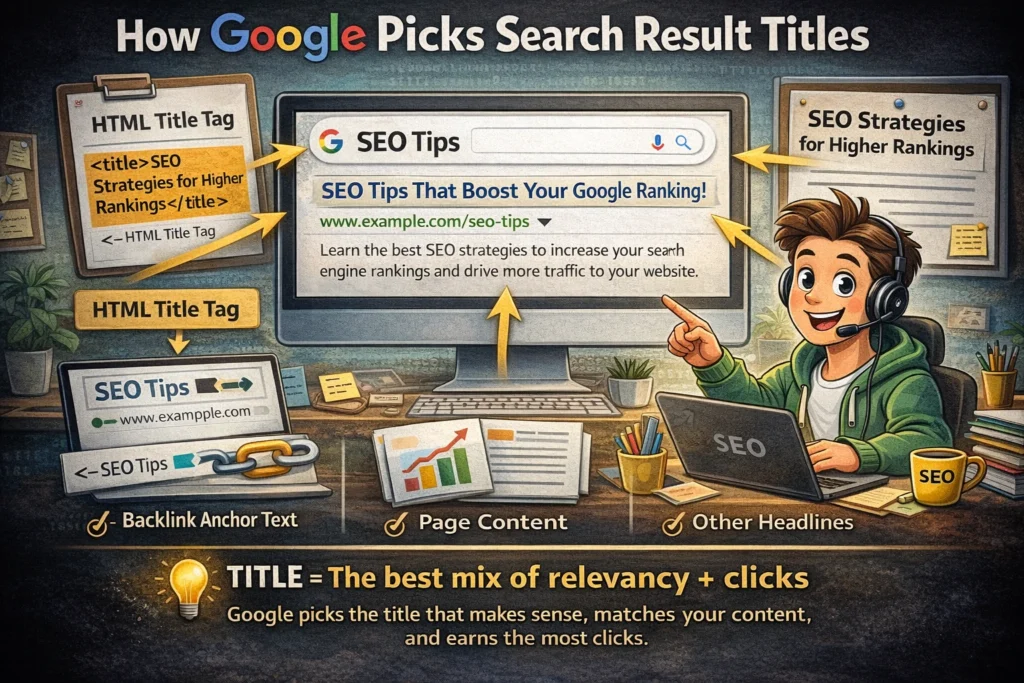
First, Google usually starts with your HTML title tag (the title you set in RankMath/Yoast or inside your page settings). This is still the most important “title source,” but it works best when it’s clean and accurate. If your title is too long, stuffed with keywords, or doesn’t match the page content, Google may rewrite it using other on-page signals. A strong title tag is simple: keep it around 50-60 characters, put the main keyword near the front, add a clear benefit, and avoid repeating the same words or city names. For local pages, use a natural format like “SEO Services in Dubai – More Leads & Rankings | Search Engine Genie” instead of “SEO Dubai, SEO Company Dubai, Best SEO Dubai, Dubai SEO Agency.”
Next, Google looks at your on-page headings, especially the H1 (your main page heading) and important H2/H3 subheadings. If your H1 is clearer than your title tag-or if your title tag looks templated across many pages-Google may pull your H1 as the search title. That’s why your title tag and H1 should match in meaning even if the wording is slightly different. Your headings should also be easy to skim: use short sections, bullet points, and “quick answer” style lines so Google and users understand the page fast. A good structure includes what you offer, who it’s for, what’s included, service areas, and proof (case studies, testimonials, results).
Google also uses page content and the search query itself to decide what title best fits. If someone searches “local SEO audit for car rental company” but your title is generic like “Home” or “Services,” Google might replace it with a line from your content that better matches the query. To reduce rewrites, keep the page focused on one main intent, mention your primary keyword naturally in the first 100 words, and support it with related phrases. For example, target one main keyword like “SEO Services for Car Rental Companies” and support it with phrases like “increase car rental bookings,” “local SEO,” “Google Maps ranking,” and “airport car rental keywords.”
Another influence many people miss is backlink anchor text-the words other websites use when linking to your page. If multiple sites link using a phrase like “car rental SEO agency,” Google may treat that as a clue about your page topic and sometimes reflect that language in your snippet title. This is one reason why quality links matter beyond ranking alone: they also shape how Google interprets your content. A smart local angle is to strengthen relevance through your Google Business Profile (GBP) and Google Maps signals. If you serve multiple cities, build location pages (example: “SEO Services in Dubai,” “SEO Services in Sharjah”) and connect them with GBP services, posts, and consistent NAP citations-this improves both map visibility and organic click-through.
Now for the “do this next” part: audit your top pages where Google rewrites titles, then align your title tag + H1 + page intro so they all communicate the same promise. Add one supportive image or screenshot (your title tag settings in WordPress, plus a “before/after” search snippet example), compress images to WebP to keep the page fast, and internally link to your key services like GBP optimization, SEO services, Core Web Vitals/PageSpeed optimization, and security audits. If you want, send your website URL and your target city, and I’ll suggest optimized title tags and H1s that are more likely to stick in Google and drive more clicks.
Tags: google-title-rewrite, meta-title, serp-optimization, title-tag
The world of search is changing fast. Traditional keyword-based SEO is no longer the only way people discover content, because AI-powered search assistants like ChatGPT, Perplexity, Gemini, and Bing Copilot are becoming part of how users search and make decisions. Instead of typing short phrases, users now ask conversational prompts and expect direct, personalized answers. This shift is creating a new frontier—prompt-driven SEO—where brands need to adapt their content strategy so they remain visible and “recommended” inside AI-generated responses, not just ranked on a results page.
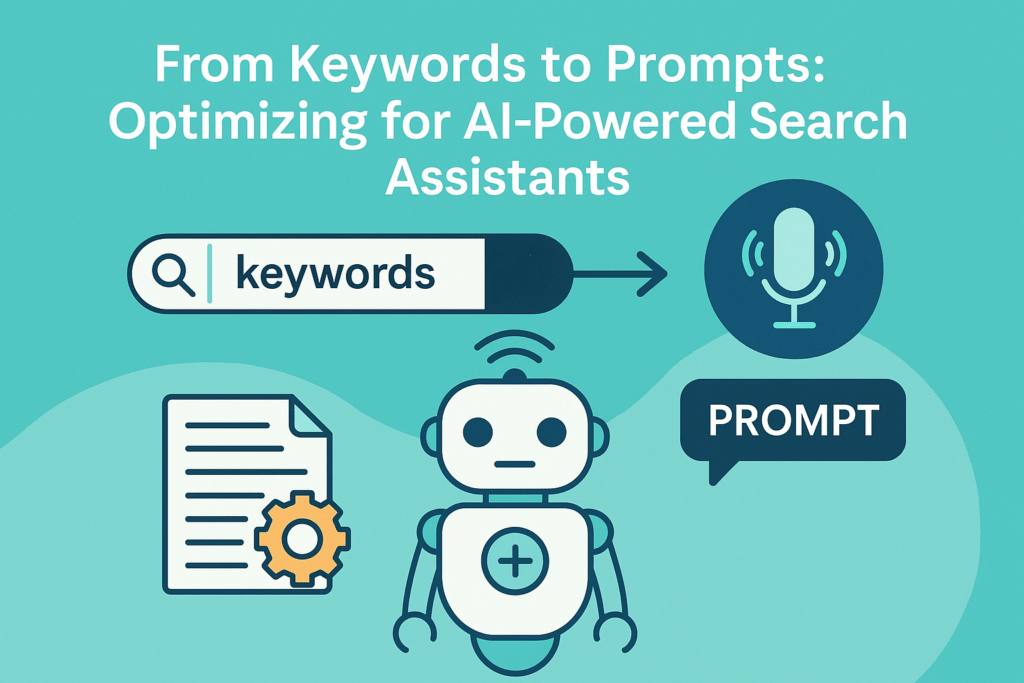
For decades, SEO revolved around keyword research and targeting high-volume terms, but keywords alone are no longer enough when intent is expressed in natural language. Compare the old search “best SEO tools” with a modern prompt like “What are the best SEO tools for small businesses in 2025, and which ones use AI features?” That second query includes audience, timeframe, and specific preferences—meaning your content needs to answer detailed, context-rich questions rather than just repeating a keyword. Prompts are basically the new SEO currency: AI assistants don’t just retrieve links, they generate answers, and your content has a better chance of being surfaced when it’s written conversationally, covers topics in depth, anticipates follow-up questions, and explains concepts clearly with examples, comparisons, pros/cons, and FAQs.
To optimize for AI-powered search, you’ll want to shift from pure keyword targeting to creating content around conversational queries and strong structure. Use question-style headings that mirror how people prompt AI (for example, “What is the difference between keywords and prompts?”), and build entity and semantic clarity by naming relevant tools, concepts, and terms while connecting them with internal links and schema where possible. This is where GEO—Generative Engine Optimization—comes in: a growing discipline focused on making content easy for AI systems to understand, trust, and reuse in generated answers. For example, if you run a fashion eCommerce store, instead of only optimizing for “men’s charcoal grey suit,” you’d also publish content answering prompts like “What occasions are best for wearing a charcoal grey three-piece suit?” or “How should men style a pleated pant suit for weddings?” The future of SEO is beyond keywords; brands that embrace prompt-optimized, comprehensive, entity-rich content now will be the ones that win visibility in the AI-driven search economy.