




SEO
What should expect in the next months in terms of SEO for Google?
Today’s webmaster video is answering the question, what should we expect in the next few months in terms of SEO for Google?
Mattcutt replies,” we’re taping this video in early May of 2013.So I’ll give you a little bit of an idea about what to expect as far as what Google is working on in terms of the web spam team. In terms of what you should be working on, we try to make sure that that is pretty constant and uniform. Try to make sure you make a great site that users love, that they’ll want to tell their friends about, book mark, come back to, visit over and over again, all the things that make a site compelling.
We try to make sure that if that’s your goal, we’re aligned with that goal. And therefore, as long as you’re working hard for users, we’re working hard to try to show your high quality content to users as well. But at the same time, people are always curious about, OK what should we expect coming down the pipe in terms of what kinds of things Google is working on? One of the reasons that we don’t usually talk that much about the kinds of the things we’re working on is that the plans can change. The timing can change.When we launch things can change. So take this with a grain of salt. This is, as of today, the things that look like they’ve gotten some approval or that look pretty promising. OK, with all those kinds of disclaimers, let’s talk a little bit about the sort of stuff that we’re working on. We’re relatively close to deploying the next generation of Penguin. Internally we call it Penguin 2.0.And again, Penguin is a web spam change that’s dedicated to try to find black hat web spam, and try to target and address that. So this one is a little more comprehensive than Penguin, than Penguin 1.0.And we expect it to go a little bit deeper and have little bit more of an impact than the original version of Penguin, We’ve also been looking at advertorials, that is sort of native advertising, and those sorts of things that violate our quality guidelines.
So again, if someone pays for coverage or pays for an ad or Something like that, those that should not flow page rank. We’ve seen a few sites in the US and around the world that take money and then do link to websites and pass page rank. So we’ll be looking at some efforts to be a little bit stronger on our enforcements as far as advertorials that violate our quality guidelines. Now there’s nothing wrong inherently with advertorials or native advertising, but they should not flow page rank. And there should be clear and conspicuous disclosure, so that users realize that something is paid and not organic or editorial. It’s kind of interesting. We get a lot of great feedback from outside of Google. So for example, there were some people complaining about searches like Payday Loans on Google.co.uk.So we have two different changes that try to tackle those kinds of queries in a couple different ways. We can’t get into too much detail about exactly how they work. But I’m kind of excited that we’re going from having just general queries be a little more cleaned to going to some of these areas that have traditionally been a little more spammy, including for example, some more pornographic queries. And some of these changes might have a little bit more of an impact in those kinds of areas that are a little more contested by various spammers and that sort of thing. We’re also looking at some ways to go upstream to deny the value to link spammers.
Some people who spam links in various ways, we’ve got some nice ideas on trying to make sure that becomes less effective. And so we expect that will roll out over the next few months as well. And in fact we’re working on a completely different system that does more sophisticated link analysis. We’re still in the early days for that, but it’s pretty exciting. We’ve got some data now that we’re ready to start mugging and see how good it looks. And so we’ll see how that bears fruit or not. We also continue to work on hacked sites in a couple different ways. Number one, trying to detect them better. We hope in the next few months to roll out a next generation of hack site detection that is even more comprehensive. And also trying to communicate better to webmasters, because sometimes we see confusion between hack sites and sites that serve up malware. And ideally you would have a one stop shop where once someone realizes that they’ve been hacked, they can go to Webmaster Tools and have some single spot where they could go and get a lot more info to sort of point them in the right way to hopefully clean up those hacked sites. So if you’re doing high quality content whenever you’re doing SEO, this shouldn’t be a big surprise. You shouldn’t have to worry about a lot of different changes. If you’ve been hanging out on a lot of black hat forums and trading different types of spamming package tips and that sort of stuff, then it might be a more eventful summer for you. But we have also been working on a lot of ways to help regular webmasters. So we’re doing a better job of detecting when someone is sort of an authority in a specific space. It could be medical. It could be travel, whatever, and trying to make sure that those rank a little more highly if you’re some sort of authority or a site that, according to the algorithms, we think might be a little bit more appropriate for users.
We’ve also been looking at Panda and seeing if we can find some additional signals–and we think we’ve got some– to help refine things for the sites that are kind of in the border zone, in the grey area a little bit. And so if we can soften the effect a little bit for those sites that we believe have got some additional signals of quality, then that will help sites that might have previously been affected to some degree by Panda. We’ve also heard a lot of feedback from people about, OK, if I go down three pages deep, I’ll see a cluster of several results all from one domain. And we’ve actually made things better in terms of you would-be less likely to see that on the first page, but more likely to see that on the following pages. And we’re looking at a change, which might deploy, which would basically say, once you’ve seen a cluster of results from one site, then you’d be less likely to see more results from that site as you go deeper into the next pages of Google search results. And that was good feedback that people have been sending us. We continue to refine our host clustering and host crowding and all those sorts of things. But we will continue to listen to feedback and see what we can do even better. And then we’re going to keep trying to figure out how we can get more information to webmasters. So I mentioned more information for sites that are hacked and ways that they might be able to do things. We’re also going to be looking for ways that we can provide more concrete details, more example URLs that webmasters can use to figure out where to go to diagnose their site. So that’s just a rough snapshot of how things look right now. Things can absolutely change and be in flux, because we might see tacks, different types of things. We need to move our resources around. But that’s a little bit about what to expect over the next few months in the summer of 2013.I think it’s going to be a lot of fun.
I’m really excited about a lot of these changes, because we do see really good improvements in terms of people who are link spamming or doing various black hat spam would be less likely to show up, I think, by the end of the summer. And at the same time, we’ve got a lot of nice changes queued up that hopefully will help small, medium businesses, and regular webmasters as well. That’s just a very quick idea about what to expect in terms of SEO for the next few months as far as Google.”
Google- PPV movies on youtube
This time Google may begin pay-per-view movies through you tube. This contain the new release movies offer $5 per film. You tube by now offers same kind with a few older titles of a rental cost .99 to $4 but the catalog is partial. The movie studios like Lions Gate, Sony, MGM, and Warner Bros had been talked by Google…


Google TV will offer television and the navigation capability of the web. Viewers can tune the TV to discover the programs and channels they want to watch. And advertisers can link in their commercials to take concerned viewer to the company’s website, which will allow for more effective internet marketing. Both the pay-per-view service and Google TV are lounging in the same time. This will give a more comfortable viewing experience than sitting at a computer desk or watching a film on a small laptop screen.
Moreover, you don’t need to leave your house to get the movies, there are no late fees, and you don’t have to worry about getting a DVD that is scratched and won’t play or skips constantly. Google is aiming on the popularity of YouTube to make their pay-per-view service a success. Currently, YouTube is one of the most popular sites on the web, with approximately 100 million visitors every month, and an outstanding Alexa rating of 3 worldwide. This high traffic website by now has huge addressees that will be aware of this new service when it launches.
The worth of long tail keywords in SEO traffic


A long-tail keyword is more of a “phrase” than a keyword itself. For example, a targeted keyword is “diamond studs in Chennai,” while a long-tail keyword would be “wedding diamond studs in Egmore, Chennai.” A long-tail keyword is characteristically four words or more and contains a phrase, rather than a mass of all-purpose terms. The long tail keywords are usually take up for Seo campaigns, Companies frequently fail to notice the importance of long-tail keywords because of the difficulty to put up together the articles and the web content. Though, when we start using the long keywords we can come up with the good SEO than a site over fed with plentiful short, targeted keywords. Long tail keywords are more successful in diverting the traffic directly to your site. If the user changes or alters the long tail keywords it still has a chance of increased search engine activity than a site doesn’t use the long tail keywords. Search engine rankings are very important for any site. By using key phrases that are pertinent to general keywords used in the SEO, can increase the ranking. Before choosing a long tail keyword , consider its status and rivalry, can be done through the tools such Google external keyword tool or keyword spy etc.Create a list of general tools and do a tool search.The companies should consider the use of long tail keywords for more traffic and higher rankings.
Forum posting for back links -Be watchful

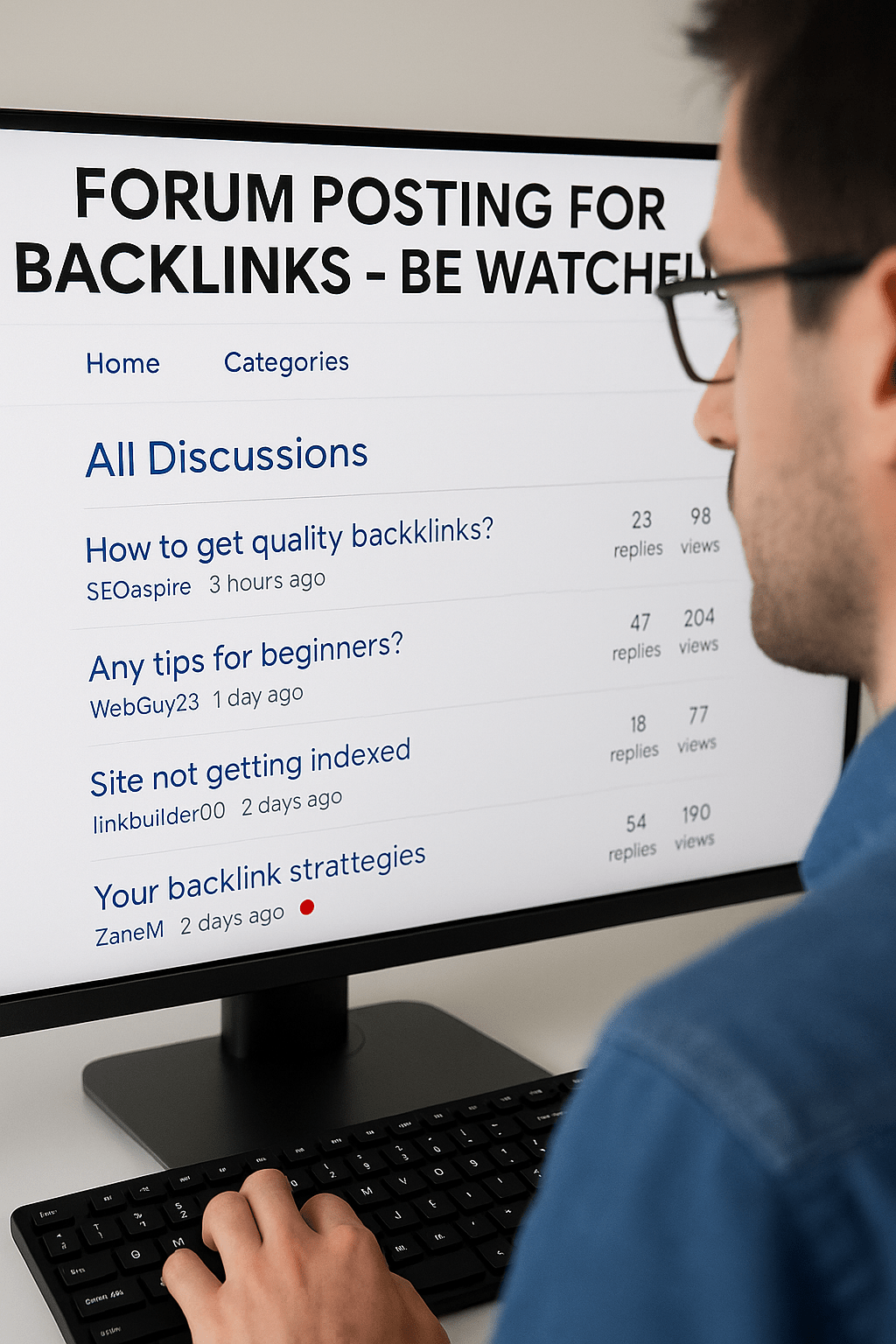
Those who thought forum posting for back links might be a fine idea for your dealing, here is a statement of suggestion: be watchful. There are many risk and consequence in link building approach in the Google system. Lots of the indigenous category feels their Google environment has been overwhelmed by Panda and Penguin, making it even more complex. Many webmasters, business owners and SEOs have been trying to mess up with uncovering the best new methods of building back links and dominating search. The majority of business owners remain in the dark as to what techniques could help them or hurt them. One of the most common link-building techniques is forum posting, drive incredible amounts of traffic to a site, it’s not from cheap SEO forum posting that you can pay for online. In fact, should know that worthless forum posting for the purpose of gaining a back link back-up can actually smash up your website’s reputation. Once you’ve proved your worth in forum posting you gain the respect of the club and can pick the benefits of your group alliance. As a business holder, you’ll be left wondering why hundreds or thousands of people visited your site only to scorn your product. But many SEOs who participate in forums for their clients and do a great job with it. If you want to increase your traffic, not help other people find solutions to their problems. That takes a lot of time and effort and it’s hard to play the subtle game of give first when all you want is to form some sales. The cause forums can drive so much traffic is because people are seeking and providing answers. Both forums and search in general operate largely on the “give and you shall receive” hymn. To summarize, SEO services be able to be harmful to online efforts, specifically forum posting. Instead of focusing on simply building links, focus on building a eminence by providing useful resources to potential clients or customers.
Tips to Help New Online Entrepreneurs for Organized at Work
Starting your journey as an online entrepreneur is exciting—but it can also feel overwhelming. Between managing clients, running marketing campaigns, tracking finances, and building your brand, it’s easy to lose focus and fall into chaos. The good news is: with the right strategies, you can stay organized, boost productivity, and grow your business with confidence.


Here are some practical tips to help new online entrepreneurs stay organized at work.
1. Start With a Daily Plan
Having a roadmap for the day prevents distractions and helps you focus on priorities.
-
Use digital planners like Google Calendar or Notion.
-
Break tasks into small, manageable steps.
-
Follow the 80/20 rule—focus on the 20% of tasks that bring 80% of results.
A structured plan keeps you in control and ensures you don’t waste time on non-essentials.
2. Embrace Project Management Tools
Instead of juggling sticky notes and endless email threads, use project management apps:
-
Trello or Asana for task tracking.
-
Slack for team communication.
-
ClickUp for all-in-one project and document management.
These tools centralize your work, reduce stress, and ensure nothing slips through the cracks.
3. Automate Repetitive Tasks
Time is your most valuable asset. Automating routine work gives you more time to focus on growth.
-
Use email marketing automation (Mailchimp, ActiveCampaign).
-
Set up social media schedulers (Buffer, Hootsuite).
-
Automate invoicing and payments with tools like QuickBooks or Wave.
Automation = consistency + more free time to innovate.
4. Organize Your Digital Workspace
A cluttered digital environment can be just as stressful as a messy desk.
-
Create folders for projects and clients.
-
Use cloud storage like Google Drive or Dropbox.
-
Clean your inbox with filters and unsubscribe from unnecessary newsletters.
A clean workspace equals a clear mind.
5. Manage Your Time With Productivity Methods
Being your own boss means learning how to manage yourself.
-
Try the Pomodoro Technique: 25 minutes of work + 5 minutes break.
-
Batch similar tasks together (e.g., answering emails once in the morning and once in the afternoon).
-
Set boundaries to avoid burnout define working hours and stick to them.
6. Keep Track of Finances From Day One
Financial chaos is one of the biggest reasons businesses fail.
-
Separate personal and business accounts.
-
Use simple accounting software like FreshBooks.
-
Track expenses and income weekly to avoid surprises at tax time.
7. Build Habits for Long-Term Organization
Staying organized isn’t a one-time effort it’s a daily practice.
-
End each workday by reviewing your progress.
-
Prepare your to-do list for tomorrow.
-
Continually refine your workflow as your business grows.
Final Thoughts
Becoming a successful online entrepreneur takes discipline, consistency, and organization. By planning your day, using digital tools, automating tasks, and keeping finances in order, you’ll create a system that keeps you focused and productive.
Remember, being organized isn’t about doing everything it’s about doing the right things in the right way. Master that, and your entrepreneurial journey will be smoother, more efficient, and far more rewarding.
Getting back with the basics of seo
In the ever-changing digital world, algorithms, AI tools, and ranking strategies evolve constantly. But despite all the new trends, one thing remains true: the basics of SEO never go out of style. Whether you’re a beginner or a seasoned marketer, revisiting these fundamentals ensures that your website is always optimized for search engines and ready to climb the rankings.


Let’s break down the core principles of SEO that every business should master.
1. Keyword Research The Foundation of SEO
Before writing a single word of content, you need to know what your audience is searching for.
-
Use tools like Google Keyword Planner, SEMrush, or Ahrefs.
-
Target a mix of short-tail keywords (e.g., “SEO basics”) and long-tail keywords (e.g., “how to learn SEO for beginners”).
-
Focus on search intent—why the user is searching, not just what they type.
Without proper keywords, your content won’t connect with the right audience.
2. On-Page Optimization Make Your Content Search-Friendly
On-page SEO ensures search engines understand your content.
-
Place keywords in title tags, meta descriptions, headers (H1, H2, H3), and URLs.
-
Use alt text for images to improve accessibility and rankings.
-
Keep URLs clean and descriptive:
www.example.com/seo-basicsinstead ofwww.example.com/page?id=123.
3. Quality Content The Heart of SEO
Google’s ultimate goal is to serve users the most helpful content.
-
Write valuable, original, and engaging articles.
-
Use E-E-A-T principles: Experience, Expertise, Authoritativeness, Trustworthiness.
-
Update old posts regularly to keep information fresh.
Remember: content that solves problems ranks higher.
4. Technical SEO Build a Strong Website Structure
Even the best content won’t rank if your site has technical issues.
-
Improve site speed (use CDNs, image compression, and caching).
-
Ensure your site is mobile-friendly.
-
Submit an XML sitemap to Google Search Console.
-
Fix broken links and redirect errors.
5. Link Building Authority Matters
Links act as votes of confidence. The more high-quality backlinks you earn, the more credible your site becomes.
-
Create share-worthy content like guides, case studies, and infographics.
-
Reach out to bloggers and industry experts for collaborations.
-
Avoid spammy or paid links—they do more harm than good.
6. User Experience (UX) Optimize for Humans, Not Just Bots
SEO isn’t just about pleasing algorithms it’s about making your site enjoyable for people.
-
Keep navigation simple and clear.
-
Use readable fonts and clean layouts.
-
Reduce intrusive pop-ups and distractions.
Happy visitors = lower bounce rates = higher rankings.
7. Track and Measure Performance
SEO is not a one-time task—it’s ongoing.
-
Use Google Analytics 4 to monitor traffic and conversions.
-
Check keyword rankings with SEO tools.
-
Identify what works, then double down on those strategies.
Final Thoughts
Getting back with the basics of SEO is about remembering that simplicity wins. By focusing on keyword research, on-page optimization, quality content, technical health, backlinks, and user experience, you’ll create a strong foundation for long-term success.
The fancy tactics may change, but the core SEO principles remain timeless. Master the basics, and the results will follow.
Honesty In Social Media Sites
Why Transparency Builds Trust
In today’s digital era, social media has become the backbone of communication, branding, and marketing. From Facebook to Instagram, Twitter (X), LinkedIn, and TikTok, billions of users engage daily. But with so much content being shared, one value stands out as the most powerful—and often overlooked: honesty.


Being authentic and transparent on social media is no longer optional. It’s the key to building trust, credibility, and long-term relationships with your audience. Let’s explore why honesty matters and how both individuals and businesses can embrace it.
1. Why Honesty Matters on Social Media
-
Trust is the new currency: People are quick to unfollow or call out dishonesty. Authentic accounts get more engagement and loyalty.
-
Audiences are smarter: Users can spot fake reviews, stock photos, and scripted messages.
-
Algorithms reward realness: Platforms like Instagram and TikTok push authentic, relatable content.
Bottom line: honesty humanizes your brand and makes you relatable.
2. The Dangers of Dishonesty Online
Posting exaggerated claims or fake content might give short-term attention, but it damages long-term reputation.
-
Fake followers = low engagement and credibility.
-
Misleading promotions = customer backlash.
-
Over-edited images = unrealistic expectations and criticism.
Once trust is broken, it’s difficult to rebuild.
3. How to Be Honest on Social Media
Here are some actionable ways to practice transparency:
-
Show behind-the-scenes moments: Let followers see the real process, not just the polished product.
-
Admit mistakes: A quick apology post shows accountability and earns respect.
-
Use authentic visuals: Share real photos, not just over-edited or stock images.
-
Be clear in promotions: Mark ads with #sponsored or #ad to stay compliant and transparent.
-
Engage genuinely: Reply to comments and messages with sincerity, not copy-paste answers.
4. The Business Advantage of Honesty
For brands and entrepreneurs, honesty is not just a moral choice—it’s a business strategy.
-
Honest reviews build customer loyalty.
-
Transparent policies reduce negative feedback.
-
Authentic storytelling increases conversions because people connect with real emotions.
In fact, studies show that 90% of consumers trust a brand that is transparent on social media.
5. Balancing Honesty and Professionalism
Honesty doesn’t mean oversharing every personal detail. It’s about being real yet respectful.
-
Share stories that connect with your niche.
-
Avoid misleading clickbait headlines.
-
Maintain a professional tone while staying authentic.
Final Thoughts
Honesty in social media sites is the foundation of digital trust. Whether you’re a business, influencer, or everyday user, being real builds stronger connections than any viral gimmick ever could.
In a crowded digital space where fake news and filters are common, honesty stands out as your greatest competitive advantage. Start posting with transparency today—and watch your audience grow in trust, loyalty, and engagement.
Negative SEO
What It Is, How It Works, and How to Protect Your Website
In the competitive world of digital marketing, every business wants to rank higher on Google. While most focus on ethical SEO practices, some resort to Negative SEO — a harmful tactic aimed at damaging a competitor’s rankings and online reputation. Understanding what negative SEO is and how to defend against it is crucial for safeguarding your website’s visibility and brand trust.


What is Negative SEO?
Negative SEO refers to malicious practices intended to lower a competitor’s search engine rankings. Instead of building their own authority, attackers attempt to harm others by manipulating Google’s algorithms against them.
These tactics can involve spammy backlinks, fake reviews, duplicate content, and even website hacking. The goal is to trick search engines into believing your site is engaging in black-hat SEO, resulting in penalties or ranking drops.
Common Types of Negative SEO Attacks
1. Spammy Backlinks
Attackers create hundreds or thousands of low-quality backlinks pointing to your site, making it look like you’re engaged in link schemes.
2. Content Scraping & Duplication
Copying your original content and publishing it across multiple sites can confuse search engines about the original source, lowering your site’s authority.
3. Fake Reviews & Reputation Attacks
Negative SEO often involves posting fake negative reviews on Google, Yelp, or other platforms to harm credibility.
4. Hacking & Malware Injections
Some attackers hack websites, insert spammy links, or add malicious code that triggers Google’s security warnings.
5. Click Fraud
Competitors may use bots to repeatedly click on your PPC ads, draining your ad budget without generating real leads.
How to Detect Negative SEO
-
Monitor backlink profiles using tools like Ahrefs, SEMrush, or Google Search Console.
-
Watch for sudden drops in rankings or spikes in spammy links.
-
Use plagiarism tools to detect duplicate content.
-
Regularly track Google Search Console alerts for security issues.
-
Keep an eye on sudden increases in bounce rates or abnormal traffic patterns.
How to Protect Your Website from Negative SEO
- Disavow Spammy Links
- Use Google’s Disavow Tool to tell search engines to ignore toxic backlinks.
- Secure Your Website
- Enable HTTPS, strong passwords, and firewalls to prevent hacking attempts.
- Monitor Content Theft
- Use Copyscape or Grammarly Plagiarism Checker to find and report duplicate content.
- Track Online Reviews
- Regularly audit reviews and report fake ones to Google and review platforms.
- Use SEO Monitoring Tools
- Set up alerts with SEO tools to detect suspicious activities early.
Why Negative SEO is Dangerous
Negative SEO not only affects search engine rankings but also damages brand credibility and user trust. In some cases, it can take months to recover from the damage, making prevention and quick detection essential.
Final Thoughts
While Negative SEO is a dark side of digital marketing, being proactive can protect your website. By monitoring backlinks, securing your site, and addressing fake reviews, you can minimize risks and maintain strong search engine rankings.
Remember: a solid SEO strategy plus continuous monitoring is your best defense against malicious attacks.
Peer-to-Peer Search Engine Introduced by YaCy
A German search company Yacy has released a peer-to-peer search engine that uses networked systems to index the web and deliver the results has been brought into being by Free Software Foudnation of Europe.
An attempt has been made to match the breadth and power of Google’s Index. Every individual who downloads and runs the YaCY is helping to power searches and build indexes.
ll the searches are encrypted and no user information is stored,this is one important part regarding the privacy.Project Leader of YaCy Micheal Christen says “Search isthe vital link between us and the information we’re looking for. For such an essential function, we cannot rely on a few large companies, and compromise our privacy in the process.”
It works in the same technique as torrent and the information storehouse of all the systems on the netowork are being used to conduct the search and keep the database together.Even when the user is not actively browsing,the site the visitors are not automatically added ot the index.There are totally 600 pages on the network that have indexed 1.4 billion pages of content.
“YaCy isn’t a challenge to Google, and is a long way from becoming one. It’s not even intended to challenge Google.” says Karsten Gerloff,President of Free Software Foundation of Europe.
There are some unique advantages in Yacy where no central server na fail and there is no central instance that can decide can filter the results to some people.An innovative system has been introduced by YaCy that benefits both users and businesses.Increasing information stability and privacy will be decided if peer-to-peer concept succeeds in the coming days.
Yahoo mail revamped, integrates more features
In order to survive and be a competitive player in the market Yahoo mail underwent significant changes. The new features includes a redesigned email format, an option to update Facebook and Twitter account via yahoomail platform and above all double faster service with 100 megabytes attachment capabilities. The ‘makeover’ also consist of better chatting ability with dear ones who are logged into Facebook and also improved Junk mail controls. These overhauls are mainly to get modernized with the current trends where people spend more time Social media and also due to the rivals’ constant up gradation. Though once upon a time Yahoo was much larger than its rival Google, for the past several months they are losing the grip. According to Comscore research report, yahoo faces a drop out in its subscribers whereas Gmail had grown to 220 million with 24% increased subscribers on to their credit. Russia’s most popular search engine Yandex will be offering shares double of Google’s earning.