




Pending Spammers – Aggressive affiliate Marketers
Google and other search engines have weeded out most of the spam out of their search engines. But still one industry that keeps Spamming the search engines using very innovative methods. is the ever aggressive affiliate marketing industry. I know many affiliates still depend on Search Engines for traffic to their spam site will affiliate links all over the place. So how many of us like affiliate.
Personally affiliate sites are a No-No for me. When I click on Search engine results and end up an a affiliate page first thing I do is to close the browser and find an other result. I hate to buy from someone who is reselling the product than buying directly from the dealer.
Affiliates still spam the search engines using methods search engines are never aware of before. Its very difficult to tackle this industry since lot of money is involved in this industry and many affiliate marketers are not willing to find better ways to do online business. I don’t blame all affiliate sites there are some rare sites which do provide Good information while have random affiliate links mixed on their site but most of the affiliate sites don’t add any value for any visitor. Also MFA ( Made For Adsense ) sites are an other disgrace to search engine users. When i click on a result and see a page full of adsense ads, affiliate links i never enjoy the site nor will i want to visit the site again.
i hope search engines completely get rid of all sites that have affiliate links and dont add any value for users this is the last type of death to spam I am looking for in Search engines.
TPR penalty websites still not ready to change their ways
Lots of TPR ( Toolbar Pagerank Reduction ) Penalty websites which got affected in december 2007 update are still not ready to change their ways. Most of them like searchenginejournal, forbes.com, washingtonpost.com got their pagerank back,
Searchenginejournal was slapped with 3 points reduction to PR4 now are back to PR7, Forbes lost 2 points and was slapped to PR5, now they removed the paid text link ads and are back to PR7, Washingtonpost.com lost 3 points and was slapped with PR5 now they are back to PR8.
So what is the secret behind getting the Pagerank back and remove TPR Penalty.
First if you check Searchenginejournal they removed all text link ads and now all ads pass through a redirect script that doesn’t pass pagerank,
Forbes completely removed all text links and possibly the pagerank came by itself or they might have sent a reconsideration to check their site for paid links.
Washington past now has Nofollow on all the text links they sell, if you take the source of their page you can see that the text link ads that go out of their page don’t pass pagerank anymore all of them go through a nofollow.
I know there are some sites who are not ready to go friendly with Google when it comes to TPR and are happy to be at PR4 or PR5 and continue to do what they are not recommended to do. Instead they have their usual blogging power to curse Google for what they did to protect their algorithm. I recommend those sites to correct what they did and possibly file a reconsideration request to get back their Toolbar Pagerank or just keep the credit of running website that has lost some trust in Google’s algorithm.
Though I would like to stay away from commenting about individual sites one site I personally admire is SEOchat.com they look too silly to have a PR of 4. Being hit with TPR a reduction of 3 points were applied and their regular pagerank was PR7. Obvious reason is their option to sell text link ads on their site without any nofollow which is not a great sign especially for a site which depends so much on Google to discuss in their forum and so many tools that query Google. Their forum’s discussion has 75% discussion on Google and remaining about common issues and other search engines.
For all the 100s of 1000s of users who are regular to SEOchat its not a great way to welcome them with a PR4, Pagerank is like a fashion issue for a website. Most of the people out there especially people who are into search engines see Pagerank as a value of quality for a website. I hope SEO Chat a great site for SEOs will get their Pagerank back by no-following text link ads on their sites. They should set an example for all users who visit their site for SEO purposes.
rel= external nofollow and rel=nofollow difference
I have seen many people ask in forums what’s the difference between rel=external nofollow and rel=nofollow,
Nofollow is a co-ordinated efforts from Google, yahoo , MSN to stop crawling links that are considered not trustworthy or spammy. Today many blogs, message boards, forums, news sites use nofollow tag to prevent spam in their comments or other areas of the blogs or forums. Now there is a new tag that is similar to rel=nofollow that is rel=external nofollow, external nofollow works the same as nofollow tag but this tag opens links in a new window instead of the same window. If you want to try just add rel=”external” it will open the link in a new window. it sort of works like target=_blank. Target blank opens all hypertext links in the new window and rel=external nofollow, blocks all link juice and opens the link in a new window.
So if you find a blog that uses this dont get too excited, links from these blogs dont count. Move on and better luck next time
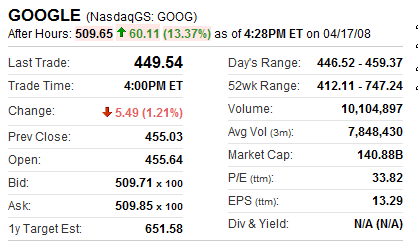
Google ( Goog ) Gains more than 12% after Q1 2008 RESULTS
Google’s ( GOOG ) Q1 financial results are released and breaking everyone’s expectation Google has gained 42% profit over the first Quarterly of 2007 and has gained 7% over the last Quarter of 2007. This is much better than everyone’s expectations especially after decline in value of many company’s shares.
At this moment Google’s shares are trading around 13% increase which is a very good sign for Google.
Financial results Summary as per Google’s investor relations:
Q1 Financial Summary
Google’s results for the quarter ended March 31,
2008, include the operations of DoubleClick Inc. from the date of acquisition,
March 11, 2008, through the end of the quarter, and are compared to
pre-acquisition results of prior periods. The overall impact of DoubleClick in
the first quarter of 2008 was immaterial to revenue and only slightly dilutive
to both GAAP and non-GAAP operating income, net income and earnings per
share. Google reported revenues of $5.19 billion for the quarter ended March 31,
2008, an increase of 42% compared to the first quarter of 2007 and an increase
of 7% compared to the fourth quarter of 2007. Google reports its revenues,
consistent with GAAP, on a gross basis without deducting traffic acquisition
costs, or TAC. In the first quarter of 2008, TAC totaled $1.49 billion, or
29% of advertising revenues. Google reports operating income, net income, and
earnings per share (EPS) on a GAAP and non-GAAP basis. The non-GAAP
measures, as well as free cash flow, an alternative non-GAAP measure of
liquidity, are described below and are reconciled to the corresponding GAAP
measures in the accompanying financial tables.
GAAP operating income
for the first quarter of 2008 was $1.55 billion, or 30% of revenues. This
compares to GAAP operating income of $1.44 billion, or 30% of revenues, in the
fourth quarter of 2007. Non-GAAP operating income in the first quarter of
2008 was $1.83 billion, or 35% of revenues. This compares to non-GAAP operating
income of $1.69 billion, or 35% of revenues, in the fourth quarter of 2007.GAAP net income for the first quarter of 2008 was $1.31 billion
as compared to $1.21 billion in the fourth quarter of 2007. Non-GAAP net
income in the first quarter of 2008 was $1.54 billion, compared to $1.41 billion
in the fourth quarter of 2007.
GAAP EPS for the first quarter of 2008 was
$4.12 on 317 million diluted shares outstanding, compared to $3.79 for the
fourth quarter of 2007 on 318 million diluted shares outstanding. Non-GAAP
EPS in the first quarter of 2008 was $4.84, compared to $4.43 in the fourth
quarter of 2007.
Non-GAAP operating income, non-GAAP operating margin,
non-GAAP net income, and non-GAAP EPS are computed net of stock-based
compensation (SBC). In the first quarter of 2008, the charge related to
SBC was $281 million as compared to $245 million in the fourth quarter of
2007. Tax benefits related to SBC have also been excluded from these
non-GAAP measures. The tax benefit related to SBC was $51 million in the
first quarter of 2008 and $42 million in the fourth quarter of 2007.
Reconciliations of non-GAAP measures to GAAP operating income, operating margin,
net income, and EPS are included at the end of this release.
GOOG Financial results.
Interview with Udi Manber Google’s search quality scientist
I just read this very interesting interview from Vice president of Search Quality in Google Mr.Udi Manber,
http://www.popularmechanics.com/blogs/technology_news/4259137.html
According to wikipedia
“Udi Manber (Hebrew: אודי מנבר) is an Israeli computer scientist. He is one of the authors of agrep and GLIMPSE. As of December 2007, he is employed by Google as one of their vice-presidents of engineering.
[edit] BiographyHe earned both his bachelor’s degree in 1975 in mathematics and his master’s degree in 1978 from the Technion in Israel. At the University of Washington, he earned another master’s degree in 1981 and his Ph.D. in computer science in 1982.
He has won a Presidential Young Investigator Award in 1985, 3 best-paper awards, and the Usenix annual Software Tools User Group Award software award in 1999.
He was a professor at the University of Arizona and authored several articles while there. He wrote Introduction to Algorithms — A Creative Approach (ISBN 0-201-12037-2), a book on algorithms.
He became the chief scientist at Yahoo! in 1998.
In 2002, he joined Amazon.com, where he became “chief algorithms officer” and a vice president. He later was appointed CEO of the Amazon spin-off company A9.com. He filed a patent on behalf of Amazon.[1]
As of February 8, 2006, he has been hired by Google as one of their vice-presidents of engineering. In December 2007, he announced Knol, Google’s new project to create a knowledge repository.[2]
“
John Muller’s example of Google local search ranking
John Muller in one of his recent blog post explains how easy its to get into Google local search and how important its for business.
From the time Google’s Local Search was introduced people were eager to get into it. Some think its difficult to get into local search but the fact its not. Google sees some factors like User reviews from some popular sites as a ranking factor for local search.
From Mr. John’s example here
the No.1 ranking site treetoptoys.com has nothing but a flash homepage and some flash links if that site were to compete for Organic rankings i am sure they wont rank but for local they are doing fine because of the reviews they have on other sites.
Also John points how important its for SEO companies to find local businesses and help them out to go online and rank in local search. Its very good for their business. Just some simple traditional SEO is more than enough to rank in local search since the competition pretty low.
Read in detail on John’s view here http://johnmu.com/untitled-document/#more-117
Google ( GOOG ) to Announce First Quarter 2008 Financial Results
Google to Announce First Quarter 2008 Financial Results
MOUNTAIN VIEW, Calif. – April 7, 2008 – Google Inc. (NASDAQ:GOOG) today announced that it will hold its quarterly conference call to discuss first quarter 2008 financial results on Thursday, April 17, 2008 at 1:30 p.m. Pacific Time (4:30 p.m. Eastern Time).
The live webcast of Google’s earnings conference call can be accessed at http://investor.google.com/webcast. The webcast version of the conference call will be available through the same link following the conference call.
About Google Inc. Google’s innovative search technologies connect millions of people around the world with information every day. Founded in 1998 by Stanford Ph.D. students Larry Page and Sergey Brin, Google today is a top web property in all major global markets. Google’s targeted advertising program provides businesses of all sizes with measurable results, while enhancing the overall web experience for users. Google is headquartered in Silicon Valley with offices throughout the Americas, Europe and Asia. For more information, visit www.google.com.
The much awaited GOOG first quarter financial results are bound to be released on April 17th. This is big news due to the current status lots of companies are reporting loss of earnings. Google one of the largest company in the world need to prove that its still a very popular and profitable company. Current share price of Google is already hovering around 450$ down from 750$. If they show a less than expected earning their shares are bound to tumble much more
Lets wait and see how it goes on,
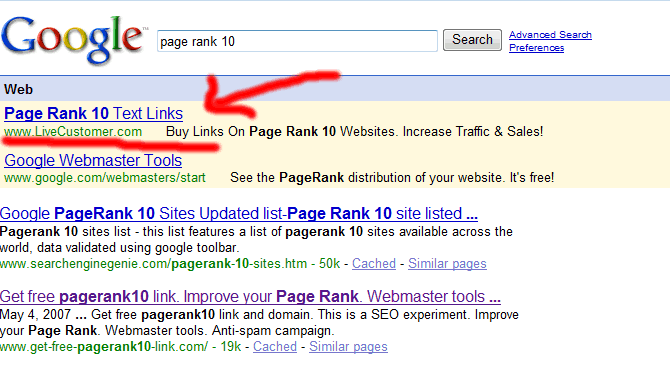
pagerank 10 link claim – fake claim in adwords advertisment
http://www.w3.org/
http://www.macromedia.com/
http://www.energy.gov/
http://www.nasa.gov/
http://www.google.com/
http://www.nsf.gov/
http://www.whitehouse.gov/
http://www.real.com/
http://www.usa.gov/index.shtml
http://www.doe.gov/
I dont think any of the above sites are willing to sell text link on their website, US government website, Department of energy, science foundation , white house, real player site, adobe all these guys done need to make money selling text links. So you figure out what these guys are upto,
Cloaking still works in Google Blog search – cloaking in Google
I was surprised to see Cloaking still works in Google or atleast in Google blog search, When I was searching today for our blog post which usually features in Google blog search as as we make an entry we came across a really weird site, It showed some snippet in search results which was very interesting to click but when we click on the site it redirects to a via-gra spam site
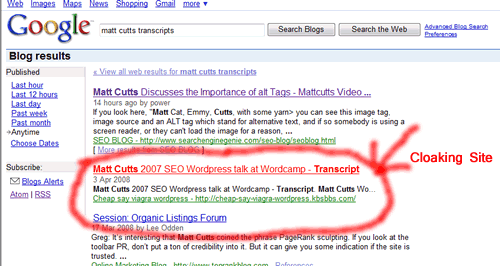 This is the spammer’s website check the redirected and cloaked URL,
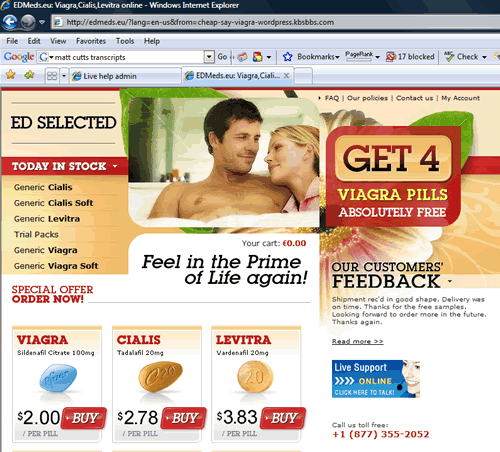
So how will Google stop spamming and cloaking in blog search
Got to wait and see,
Search Engine Genie.
How to stop my site from showing up on non-US Google results
When I was going through webmaster world Google forum I saw this weird post
How to stop my site from showing up on non-US Google results
Wow one second it took me by surprise I seriously want to checkout why someone really wants to block access to their site from non-Google results. Here is the post from that person
“First, I want to make clear, I am not worried about bringing my page rank up at
all, I just want to stop showing up on non-US google results. So this isn’t
about SEO.
I have a site serving the SE United States. However, 80% of my
visitors come from Ireland, Israel, China, Japan, Italy, South America, and of
all places, Botswana?
I used some google tool (I can’t remember which) that
showed my page rank on non US google indexes varies from 4 to as high as 7.
That would explain the off-continent percentage, because I have a white bar
/ page rank 0 here. So…
1. Is there really a different feed for different
countries?
2.Can I keep google indexing for US users but not others?
3.Is it one googlebot gathering data for all places, or are there different
ones? (That would explain why there is some google-thing on my msg boards every
day. Or there is one google bot and he lives at my place.)
4.To block them
or it, do I have to know the name of every bot and spider by IP or nickname or
whatever?
5.Is that done by htaccess or robots.txt?
“
From reading the post it looks the poster really wants to stop traffic from all countries other than Google. I don’t think this is possible since google.com results are served in almost all countries though ranking might vary.
A good response by senior member lammert was made which was very informative
“Geographic targetting boosts ranking in one region compared to others, but it
doesn’t remove a site from foreign search results. My experience is that it has
no greater power than a country TLD like .de for Germany or .fr for France, or
hosting your site on an IP address which is locate in the country to target.
1. Is there really a different feed for different countries?
No, every
Google datacenter can produce the results for all countries and languages in the
world by just changing a few parameters in the search URL. Google tries to sort
the results based on relevancy, matching languages and geographic origin of
incoming links to a site, but in principle every URL can appear in every SERP on
every visitors location. There is no such thing as totally separate feeds.
2.Can I keep google indexing for US users but not others?
3.Is it one
googlebot gathering data for all places, or are there different ones? (That
would explain why there is some google-thing on my msg boards every day. Or
there is one google bot and he lives at my place.)
There is just one
Googlebot crawling for all countries and data centers. If you are on one Google
data center, you are practically speaking in all, because they exchange pages on
the fly. There is even data sharing behind the scenes between different Google
spider technologies. If Googlebot doesn’t visit a specific URL but Mediabot
which is used for AdSense ad matching is, the pages fetched by Mediabot may be
examined and used by Googlebot.
There is no way you can block your site from
showing up in Google results for one country and not for others, unless your
site is China related and happens to trigger a filter in Google’s China
firewall.
The only way to tackle this reliably is to block the foreign
visitors at your door, i.e. use some form of geo targeting where you map the IP
address of the visitor to a geographical location and allow or deny access based
on that. But geo targeting is not 100% reliable, especially with some larger
ISPs like AOL which use a handful of proxies for all their customers and you may
end up with some foreign visitors slipping through, and worse, a number of
legitimate visitors who can’t connect anymore.
My advice is not to fight the
battle against foreign visitors, but to monetize the traffic. Many people are
fighting for traffic and you–wanting to kill 80% of your traffic because it
doesn’t match the current content of the site–are really an exception. Why not
monetize this traffic in some way instead of blocking people? This is free
traffic which is in principal targeted audience, based on that they found you
through Google search, and not some form of shady traffic generation scheme.
“
In my view there is no use blocking users from other countries they can be a valuable resource at times our site www.searchenginegenie.com gets about 50% of the traffic outside US and we really enjoy that traffic as much as the US traffic we get. Traffic from France, Germany , Spain are very useful traffic since they love Search Engines and Search Engine Optimization a lot. There are some french forums which send us traffic to our tools or blog posting, traffic is sometimes 10 times more than the traffic sent to us by active forums like searchengine watch, Digitial point forums etc. This shows their passion towards online business, Search engine optimization and the art of making money online.
Blogroll
Categories
- 2016 SEO trends predictions
- AI for eCommerce
- AI Search & SEO
- author rank
- Authority Trust
- Bing search engine
- blogger
- CDN & Caching.
- Content Strategy
- Core Web Vitals
- eCommerce Growth
- Experience SEO
- Fake popularity
- gbp-optimization
- Google Adsense
- Google Business Profile Optimization
- google fault
- google impact
- google Investigation
- google knowledge
- Google panda
- Google penguin
- Google Plus
- Google Search Console
- Google Search Updates
- Google webmaster tools
- google-business-profile
- google-maps-ranking
- Hummingbird algorithm
- infographics
- link building
- Local SEO
- local-seo
- Mattcutts Video Transcript
- Microsoft
- Mobile Performance Optimization
- Mobile SEO
- MSN Live Search
- Negative SEO
- On-Page SEO
- Page Speed Optimization
- pagerank
- Paid links
- Panda and penguin timeline
- Panda Update
- Panda Update #22
- Panda Update 25
- Panda update releases 2012
- Penguin Update
- Performance Optimization
- Sandbox Tool
- search engines
- SEO
- SEO Audits
- SEO Audits & Monitoring
- SEO cartoons comics
- seo predictions
- SEO Recovery & Fixes
- SEO Reporting & Analytics
- seo techniques
- SEO Tips & Strategies
- SEO tools
- SEO Trends 2013
- seo updates
- Server Optimization
- Shopify Optimization
- Shopify SEO
- Shopify Services
- Small Business Marketing
- social bookmarking
- Social Media
- SOPA Act
- Spam
- Technical SEO
- Uncategorized
- User Experience (UX)
- Webmaster News
- website
- Website Security
- Website Speed Optimization
- Yahoo