




Technical SEO
What Is Internal Linking and Why Is It Important for SEO?
 Internal linking is one of the simplest SEO techniques, but it is often overlooked. A well-planned internal linking structure can help visitors discover more useful content, make important pages easier to find, and help search engines understand how different pages on your website are connected.
Unlike backlinks, which come from other websites, internal links connect pages within your own website. When used naturally, they can improve navigation, strengthen important pages, and create a clearer structure for both users and search engines.
What Is Internal Linking?
Internal linking means adding links from one page of your website to another page on the same website.
For example, a blog post about keyword research might link to another article about search intent. A service page about technical SEO might link to a blog explaining website indexing problems.
These links help visitors move naturally through related content instead of reaching the end of a page and leaving the website.
Internal links can appear inside blog posts, navigation menus, category pages, related-content sections, service pages, and other areas of a website. The most useful internal links are usually those that connect closely related topics and give readers a logical next step.
Why Internal Links Matter for SEO
Internal linking helps search engines discover pages and understand which content is important.
When several relevant pages link to another page, it gives search engines additional context about that page and its relationship to the rest of the website.
Internal links can also help distribute authority across a site. A strong page that already attracts traffic or backlinks can link to another relevant page and help make that content easier for search engines and users to discover.
From a visitor’s perspective, internal links improve the browsing experience. Someone reading about one SEO topic may naturally want to learn about another related topic. Giving them a useful link keeps them engaged with the website instead of forcing them to search elsewhere.
How Internal Linking Helps Google Understand Your Website
A website should have a clear structure rather than a collection of isolated pages.
Internal links help create that structure by showing how different topics relate to each other. For example, a main SEO guide might connect to individual articles about technical SEO, backlinks, search intent, internal linking, and keyword research.
This creates a logical relationship between the main topic and its supporting content.
Descriptive anchor text also provides useful context. Instead of linking vague words such as “click here,” a natural phrase like “technical SEO audit” gives visitors and search engines a better idea of what they will find on the linked page.
A clear internal structure can also reduce the chances of important content becoming difficult to discover.
How to Build a Better Internal Linking Structure
Good internal linking should feel natural. Links should be added where they genuinely help readers understand a topic or discover useful related information.
When publishing a new blog post, look for older relevant articles that can link to the new content. At the same time, check whether the new article can link to existing pages.
Important service pages and high-value content should receive internal links from relevant sections of the website. However, links should not be forced into unrelated content simply for SEO purposes.
It is also useful to review older posts regularly. As a website grows, new linking opportunities appear. Updating older content with relevant internal links can strengthen the overall structure without creating completely new pages.
Common Internal Linking Mistakes
One common mistake is adding too many links without considering whether they are useful. A page filled with unnecessary links can become distracting and reduce the value of each recommendation.
Another problem is using the same generic anchor text repeatedly. Clear and descriptive wording usually creates a better experience.
Broken internal links should also be fixed quickly. If a page has been removed or its URL has changed, links pointing to the old address can frustrate visitors and make the website harder to navigate.
Some websites also focus heavily on their newest content while leaving older pages isolated. Valuable evergreen articles should continue receiving relevant internal links when appropriate.
Final Thoughts
Internal linking is a simple SEO strategy that can make a meaningful difference to how visitors and search engines understand a website.
The goal is not to add as many links as possible. It is to create useful connections between related pages.
A strong internal linking structure helps users discover more content, gives important pages greater visibility, and creates a clearer path through your website.
When publishing new content, take a moment to ask which existing pages should link to it and which useful pages the new article should reference. That small habit can gradually build a much stronger website structure.
What Are Backlinks and Why Do They Matter for SEO?
Backlinks are an important part of SEO, but the idea behind them is actually very simple.
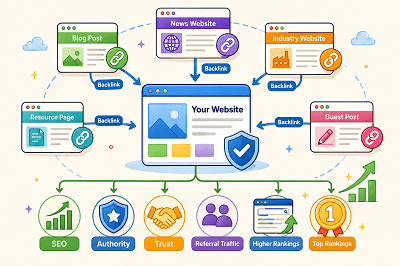
A backlink is a link from another website that points to your website.
For example, if another blog mentions your business and links to one of your pages, your website has received a backlink.
 What Is a Backlink?
Backlinks connect one website to another.
Imagine you publish a useful guide on your website. Another website finds that guide helpful and links to it in one of its articles.
That link becomes a backlink to your website.
Backlinks can send visitors directly to your site and can also help search engines discover your pages.
Why Do Backlinks Matter for SEO?
Backlinks can act as signals that other websites find your content useful or worth mentioning.
When reputable and relevant websites link to your pages, it can help strengthen your website’s authority and visibility in search results.
However, quality is more important than quantity.
One useful backlink from a trusted website can be more valuable than many links from low-quality or unrelated websites.
What Makes a Good Backlink?
A good backlink usually comes from a website that is relevant to your industry, trusted, and publishing useful content. The link should also appear naturally within the content instead of being forced. For example, if you run a digital marketing website, a backlink from a respected marketing or technology blog would usually be more valuable than a link from an unrelated website.
Are All Backlinks Good?
Not all backlinks are helpful. Some may come from spammy, low-quality, or unrelated websites, and these links may provide little value. Buying large numbers of backlinks or creating links only to manipulate rankings can also lead to SEO problems. A better approach is to focus on earning natural links from relevant and trustworthy websites.
How Can You Get Backlinks?
You can earn backlinks by creating useful content that other websites want to mention or share. This may include helpful guides, original research, industry articles, useful resources, or content that solves a common problem. You can also reach out to relevant websites or look for broken-link opportunities. The main goal is to create something valuable enough that another website has a genuine reason to link to it.
Backlinks vs Internal Links
Backlinks and internal links are different.
A backlink comes from another website to your website.
An internal link connects one page of your own website to another page on the same site.
Both are useful for SEO, but they serve different purposes.
Backlinks can help build your website’s authority, while internal links help users and search engines navigate your website.
Backlinks remain an important part of SEO because they can help search engines discover content and understand which pages other websites consider useful. Instead of chasing as many links as possible, focus on earning relevant, trustworthy, and natural backlinks by publishing genuinely useful content.
Why Your Website Traffic Is Dropping and How to Fix It
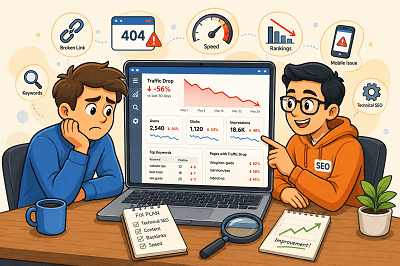
Seeing your website traffic suddenly fall can be worrying. But a traffic drop does not always mean your SEO has failed.
Rankings, technical issues, competitors, seasonal searches, and outdated content can all affect your visitor numbers. The key is finding out where the drop started and what caused it.
First, Find Out Where the Traffic Dropped
Before changing your website, check Google Search Console and Google Analytics.
Look for:
- Pages that lost the most visitors
- Keywords receiving fewer clicks
- Changes in impressions
- Traffic drops from specific devices or countries
Once you know where the decline happened, finding the cause becomes much easier.
Did Your Google Rankings Fall?
A ranking drop is one of the most common reasons for losing organic traffic.
Check whether your important pages and keywords have moved lower in Google. If they have, review the pages ranking above you and improve your content, headings, internal links, and overall usefulness.
Is Your Content Getting Old?
Content that performed well a year ago may no longer provide the best answer.
Update old statistics, replace outdated information, improve weak sections, and add useful new details. Sometimes refreshing an existing page is more valuable than publishing another similar article.
Are Technical Problems Hurting Your Site?
A broken page, indexing issue, server problem, or incorrect redirect can quietly reduce traffic.
Check important pages in Google Search Console and make sure Google can crawl and index them correctly. Also look for broken links and pages returning errors.
Have Your Competitors Improved?
Sometimes your traffic falls even when you haven’t changed anything.
Competitors may have published better content, improved their websites, or earned stronger backlinks. Compare the pages ranking above yours and look for areas where your page can offer something more useful.
Has Search Demand Changed?
Not every traffic decline is an SEO problem.
Some searches are seasonal. Others become less popular as customer interests change.
Compare traffic with the same period from the previous year before assuming something is wrong. Google Trends can also help you understand whether interest in a topic has changed.
Is Your Website Slow or Difficult to Use?
Slow pages and poor mobile experiences can frustrate visitors.
Make sure your website loads quickly, works properly on mobile devices, and makes important information easy to find.
Website traffic can drop for many reasons, so avoid making random SEO changes immediately. Start with your data, identify which pages or keywords lost traffic, and then investigate the cause. Once you understand what changed, you can focus on the improvements that matter most.
Why Is My Website Not Showing Up on Google? 7 Common SEO Problems
If your website does not show up on Google, there might be some reasons.
At times, it is because Google has not indexed your website. It may be the case that Google has indexed your website but your site is ranking very low.
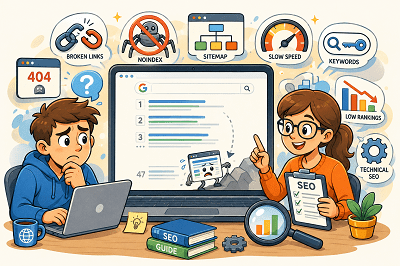
Here are the seven most common SEO issues:
1. Google Has Not Indexed Your Website
In order to show your web pages on Google, first, Google needs to crawl them.
Fix: Configure Google Search Console, submit your sitemap, and use URL Inspection tool.
2. Your Website Is Blocking Google
You have set noindex on your website or you have blocked your site by using a robots.txt file.
Fix: Make sure that you are not blocking Google in any way.
3. Your Website Has Technical SEO Issues
It may happen due to various technical issues such as broken links, server errors, incorrect redirects, and duplicate pages.
Fix: Do an SEO audit and correct any technical issues that might hinder crawling and indexing.
4. The Information Provided by Your Content Is Inadequate
Pages that have very little information can fail to rank.
Google loves content that is valuable, clear, and user-focused.
Fix: Make sure you create valuable content that clearly communicates your products, services, or topic.
5. You are Using the Wrong Keywords
Your site may fail to show up if you don’t target the terms used by people searching.
Fix: Make sure you use the right keywords within your title, headings, and body copy.
6. You Have Bad Internal Linking
Pages that have no or few internal links are less likely to be found by Google.
Fix: Make sure you link your pages and blog posts to each other for easy navigation by visitors and search engines.
7. Your Website Has a Low Rank
Your website might already be indexed but ranks below your competitors.
This is often due to the better content, backlinks, or SEO of competing sites.
Fix: Improve your website and its SEO over time.
Google Search Console can help you check whether your pages are indexed and identify possible SEO problems. If your website is not showing up on Google, start by checking indexing, then review your technical SEO, content, keywords, and internal links. Fixing these basic issues can help Google better understand your website and improve its chances of appearing in search results.
Why Isn’t Google Indexing Your WordPress Website? 15 Common Causes and Fixes
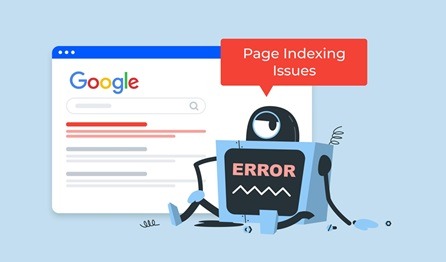
It can be disappointing to launch a WordPress website and realize it’s not appearing in Google search results. Since Google needs to index your pages before they can rank, any indexing problem can make it harder for people to discover your business online.
The good news is that most WordPress indexing issues are easier to fix than you might think. In this guide, we’ll walk you through 15 common reasons why Google may not be indexing your WordPress website and show you practical steps to get your pages discovered and appearing in search results.
Signs Google Isn’t Indexing Your WordPress Website
Some common signs include:
- Your website doesn’t appear when searching your business name.
- New pages aren’t showing in Google search results.
- Google Search Console reports indexing issues.
- Organic traffic remains extremely low.
- Pages remain in “Discovered – Currently Not Indexed” status.
If you notice any of these issues, it’s worth investigating the causes outlined below.
What Does It Mean When Google Isn’t Indexing Your Website?
Before your website can rank in search results, Google must first discover, crawl, and index your pages.
Indexing is the process by which Google stores information about your website in its search database. If a page isn’t indexed, it won’t appear in search results, regardless of how valuable the content may be.
To check whether your website is indexed, search Google for:
site.com
If few or no pages appear, your website may be experiencing indexing issues.
You can also verify indexing status using Google Search Console, which provides detailed reports about your website’s visibility and crawl activity.
1. Search Engine Visibility Settings Are Enabled
One of the most common reasons a WordPress website doesn’t appear in Google search results is a simple setting within the WordPress dashboard.
WordPress includes a feature called Search Engine Visibility, which allows website owners to discourage search engines from indexing their site. This option is often used while a website is being built or redesigned to prevent unfinished pages from appearing in search results.
However, it’s surprisingly easy to forget to disable this setting after launch. When it’s enabled, Google may avoid crawling and indexing your website, making it virtually invisible in search results.
How to Check This Setting
- Log in to your WordPress dashboard.
- Go to Settings → Reading.
- Scroll down to Search Engine Visibility.
- Make sure the checkbox labeled “Discourage search engines from indexing this site” is unchecked.
- Click Save Changes.
If this setting was enabled, turning it off can often resolve indexing issues and allow Google to start crawling your website again. After making the change, it’s a good idea to submit your website through Google Search Console and request indexing to help speed up the process.
2. Noindex Tags Are Blocking Your Pages
Another common reason Google may not be indexing your WordPress website is the presence of a noindex tag.
A noindex tag is a piece of code that tells search engines not to include a specific page in their search results. While this can be useful for thank-you pages, admin pages, or duplicate content, it can become a problem if it’s accidentally applied to important pages or blog posts.
Many WordPress SEO plugins, such as Rank Math, Yoast SEO, and All in One SEO, allow users to control indexing settings. During website updates or SEO configuration changes, it’s possible to accidentally set a page to “noindex” without realizing it.
How to Check for Noindex Tags
- Open the page or post in WordPress.
- Scroll down to your SEO plugin settings.
- Look for the indexing option.
- Make sure the page is set to Index rather than No Index.
- Save your changes and request indexing through Google Search Console if needed.
If important pages are marked as noindex, Google will ignore them completely, preventing them from appearing in search results even if the content is valuable and well-optimized.
3. Your Robots.txt File Is Restricting Google
The robots.txt file is a small but important file that tells search engines which parts of your website they can and cannot crawl. While it’s useful for controlling access to certain pages, an incorrect robots.txt configuration can accidentally prevent Google from accessing important content on your website.
This issue often occurs after website migrations, redesigns, or when developers temporarily block search engines during the development phase and forget to remove the restriction before launch.
For example, a directive such as:
Disallow: /
can block search engines from crawling your entire website, making it impossible for Google to discover and index your pages.
How to Check Your Robots.txt File
- Visit:
yourdomain.com/robots.txt - Review the file for any restrictive directives.
- Make sure important sections of your website are not being blocked.
- Use the robots.txt Tester in Google Search Console to identify potential issues.
If Googlebot is restricted from accessing your content, your pages may never be crawled or indexed, regardless of how well-optimized they are. Regularly reviewing your robots.txt file can help ensure search engines can properly access and understand your website.
4. Your XML Sitemap Is Missing or Incorrect
An XML sitemap acts like a roadmap for your website, helping search engines discover and understand the pages you want to appear in search results. Without a sitemap, Google can still find your content, but the process may take longer, especially for new websites or pages that don’t have many internal links.
If your XML sitemap is missing, outdated, or contains errors, Google may struggle to crawl and index your content efficiently. This can result in important pages being overlooked or taking much longer to appear in search results.
Fortunately, most WordPress SEO plugins, including Rank Math, Yoast SEO, and All in One SEO, automatically generate XML sitemaps for your website.
How to Check Your XML Sitemap
- Visit
yourdomain.com/sitemap.xml - Confirm that your sitemap loads correctly.
- Check whether important pages and posts are included.
- Look for any errors or broken URLs.
- Submit the sitemap through Google Search Console.
To submit your sitemap:
- Open Google Search Console.
- Select your website property.
- Navigate to Indexing → Sitemaps.
- Enter your sitemap URL.
- Click Submit.
Regularly reviewing your XML sitemap helps ensure Google can discover your latest content quickly and index important pages more efficiently. For larger websites, a properly configured sitemap can significantly improve crawlability and search visibility.
5. Your Website Is Too New
If you’ve recently launched your WordPress website, there’s a good chance Google simply hasn’t discovered it yet. Unlike popular websites that are crawled frequently, new websites typically have little to no authority, backlinks, or search engine history, which can slow down the indexing process.
Many website owners expect their pages to appear in Google immediately after publishing, but indexing doesn’t happen overnight. Depending on your website’s structure, content quality, and online presence, it can take anywhere from a few days to several weeks for Google to crawl and index a new site.
How to Speed Up the Indexing Process
- Verify your website in Google Search Console.
- Submit your XML sitemap.
- Use the URL Inspection Tool to request indexing.
- Create internal links to new pages.
- Share your content on social media and other online platforms.
- Build quality backlinks from relevant websites.
The more signals Google receives about your website, the faster it can discover and evaluate your content. While patience is often required for new websites, following these steps can help speed up the indexing process and improve your chances of appearing in search results sooner.
6. Poor Internal Linking Structure
Internal links play a crucial role in helping Google discover, crawl, and understand the content on your website. When pages are properly connected, search engines can easily navigate your site and identify which pages are most important.
However, if important pages aren’t linked from other sections of your website, they can become difficult for Google to find. These are often referred to as orphan pages, and they may take longer to get indexed or may not be indexed at all.
For example, if you publish a new blog post but don’t link to it from related articles, category pages, or your homepage, Google may have trouble discovering it quickly.
Best Practices for Internal Linking
Make sure to create relevant links between:
- Blog posts
- Service pages
- Category pages
- Product pages
- Important landing pages
When adding internal links, use descriptive anchor text that clearly explains what the linked page is about. This helps both users and search engines understand the relationship between your content.
A well-structured internal linking strategy not only improves indexing but also enhances user experience, distributes page authority throughout your website, and increases the chances of your important pages ranking higher in search results.
7. Thin or Low-Quality Content
Even if your website is technically optimized, Google may choose not to index pages that offer little value to users. Search engines aim to provide the best possible results, so pages with thin, outdated, duplicate, or low-quality content often struggle to get indexed and ranked.
For example, a page containing only a few sentences, generic information, or content copied from another source may not provide enough value for Google to include it in its search results. Similarly, pages that fail to answer user questions or provide a poor user experience may be overlooked.
How to Improve Content Quality
To increase your chances of getting indexed, focus on creating content that is:
- Original and unique
- Helpful and informative
- Well-structured with clear headings
- Easy to read and understand
- Supported by examples, images, or screenshots
- Designed to answer common user questions
Instead of publishing short articles with limited information, aim to create comprehensive content that thoroughly covers a topic. The more useful and relevant your content is, the more likely Google will crawl, index, and rank your pages.
Remember, quality content isn’t just important for SEO—it also helps build trust with your audience and encourages visitors to spend more time on your website.
8. Duplicate Content Issues
Duplicate content is another common reason why Google may struggle to index your WordPress website properly. When multiple pages contain identical or very similar content, search engines can become confused about which version should be crawled, indexed, and displayed in search results.
This issue is particularly common on WordPress websites due to automatically generated pages, category archives, tag archives, filtered URLs, and duplicate product descriptions. In some cases, the same content may be accessible through multiple URLs, making it difficult for Google to determine the preferred version.
Common sources of duplicate content include:
- Category pages
- Tag pages
- Filtered or parameter-based URLs
- Duplicate product descriptions
- HTTP and HTTPS versions of the same page
- WWW and non-WWW versions of a website
How to Fix Duplicate Content Issues
To minimize duplicate content problems:
- Use canonical tags to identify the preferred page version.
- Avoid creating unnecessary tag and category pages.
- Consolidate similar content where possible.
- Set up proper redirects for duplicate URLs.
- Regularly audit your website for duplicate pages.
Canonical tags are especially important because they tell Google which version of a page should be indexed and ranked. By implementing them correctly, you can help search engines understand your website structure and avoid indexing conflicts.
Taking the time to address duplicate content issues can improve crawl efficiency, strengthen your SEO efforts, and increase the likelihood of your most important pages being indexed correctly.
9. Crawl Errors in Google Search Console
Google can only index pages that it can successfully access and crawl. If search engine bots encounter errors while trying to visit your pages, those pages may not be indexed or may eventually be removed from Google’s index.
Fortunately, Google Search Console makes it easy to identify crawl-related issues through the Pages report. Regularly monitoring this report can help you spot problems before they impact your search visibility.
Some of the most common crawl errors include:
- 404 Errors – Pages that no longer exist or have been deleted.
- Server Errors (5xx) – Issues caused by hosting or server failures.
- Redirect Loops – Pages that continuously redirect between URLs.
- Broken Links – Internal or external links pointing to unavailable pages.
- Blocked Resources – Important files that Google cannot access.
How to Identify Crawl Errors
- Log in to Google Search Console.
- Select your website property.
- Navigate to Indexing → Pages.
- Review any pages listed under errors or warnings.
- Investigate and fix the reported issues.
For example, if a page returns a 404 error, you may need to restore the page, update the link, or set up a proper redirect. Similarly, server-related errors may require assistance from your hosting provider.
By regularly checking Google Search Console and fixing crawl issues as they arise, you can improve your website’s crawlability and increase the chances of your pages being indexed and ranked successfully.
10. Slow Website Speed
Website speed plays a crucial role in both user experience and search engine optimization. If your WordPress website loads slowly, it can negatively affect how users interact with your content and how efficiently Google crawls your pages.
Google allocates a limited crawl budget to every website. When pages take too long to load, search engine bots may crawl fewer pages during each visit, which can slow down the indexing process. In some cases, important pages may remain undiscovered for longer than necessary.
Slow website performance can be caused by several factors, including large image files, poor hosting, excessive plugins, unoptimized code, and unnecessary scripts running in the background.
How to Improve Website Speed
Here are some effective ways to improve your website’s performance:
- Compress and optimize images before uploading them.
- Enable browser caching and page caching.
- Minimize JavaScript and CSS files.
- Use a Content Delivery Network (CDN).
- Remove unnecessary plugins and themes.
- Upgrade to a reliable hosting provider.
- Enable lazy loading for images and videos.
You can also use tools such as Google PageSpeed Insights, GTmetrix, or Google Search Console’s Core Web Vitals report to identify performance issues affecting your website.
A faster website not only helps Google crawl and index your content more efficiently but also improves user engagement, reduces bounce rates, and creates a better overall experience for visitors.
11. Incorrect Canonical Tags
Canonical tags help search engines understand which version of a page should be treated as the primary version when multiple URLs contain similar or identical content. They are an important part of technical SEO and can prevent duplicate content issues when used correctly.
However, if canonical tags are configured incorrectly, they can create serious indexing problems. For example, a page may mistakenly point to another URL as the preferred version, causing Google to ignore the page you actually want to rank. As a result, valuable content may not be indexed or may disappear from search results altogether.
This issue often occurs after website redesigns, theme updates, plugin changes, or SEO migrations where canonical settings are modified without proper testing.
How to Check Canonical Tags
- Open the page you want to review.
- View the page source in your browser.
- Search for rel=”canonical”.
- Verify that the canonical URL matches the page you want Google to index.
- Check your SEO plugin settings if the canonical URL appears incorrect.
Popular WordPress SEO plugins such as Rank Math and Yoast SEO automatically generate canonical tags, but it’s still important to review them periodically to ensure they are working as intended.
Proper canonical tag implementation helps Google understand your website structure, avoid duplicate content issues, and index the correct pages in search results.
12. Orphan Pages
Orphan pages are pages on your website that have no internal links pointing to them. In other words, they exist on your website but aren’t connected to your site’s navigation, blog posts, category pages, or other content.
Since Google primarily discovers new content by following links, orphan pages can be difficult for search engines to find and crawl. Even if these pages contain valuable information, they may remain unindexed because Google has no clear path to discover them.
This issue commonly occurs when website owners publish new pages but forget to link to them from other areas of the website. It can also happen after website redesigns, content migrations, or when older pages are removed without updating internal links.
How to Find and Fix Orphan Pages
To identify orphan pages:
- Review your XML sitemap and compare it with indexed pages in Google Search Console.
- Use SEO tools such as Screaming Frog, Ahrefs, or Semrush to detect orphaned URLs.
- Check recently published pages to ensure they are linked from relevant sections of your website.
To fix orphan pages:
- Add links from related blog posts.
- Include them in category pages or navigation menus.
- Link to them from important landing pages where relevant.
- Update older content with contextual internal links.
A strong internal linking structure helps Google discover your content more efficiently and improves the chances of important pages being crawled, indexed, and ranked in search results.
13. Hosting and Server Problems
Your hosting environment plays a major role in how search engines crawl and index your website. Even if your content is well-optimized, frequent server issues can prevent Google from accessing your pages and negatively impact your site’s visibility in search results.
When Google’s crawlers visit your website, they expect pages to load quickly and consistently. If your server is frequently unavailable or returns errors, Google may reduce its crawl rate and revisit your site less often. Over time, this can delay indexing and make it harder for new content to appear in search results.
Common hosting and server-related issues include:
- Frequent website downtime
- Slow server response times
- Server timeout errors
- Shared hosting resource limitations
- Misconfigured server settings
- DNS configuration problems
How to Check for Server Issues
- Review the Pages report in Google Search Console.
- Look for server-related errors (5xx errors).
- Monitor your website’s uptime using tools like UptimeRobot or Pingdom.
- Check your hosting provider’s performance reports.
- Test your website speed using Google PageSpeed Insights.
If server errors occur regularly, consider upgrading your hosting plan or switching to a more reliable hosting provider. Investing in quality hosting can improve website performance, increase crawl efficiency, and help ensure that Google can consistently access and index your content.
Reliable hosting is one of the foundations of good SEO, as it supports both user experience and search engine accessibility.
14. Security Issues or Malware
Website security is often overlooked when troubleshooting indexing problems, but it can have a significant impact on how Google views and crawls your website. If your site is hacked, infected with malware, or compromised by malicious code, search engines may limit its visibility to protect users.
Google’s primary goal is to provide safe and trustworthy search results. When security issues are detected, Google may take actions that affect your website’s ability to appear in search results.
For example, Google may:
- Remove affected pages from its index
- Display security warnings in search results
- Reduce crawl activity on your website
- Flag your site as potentially harmful to visitors
Common causes of security-related issues include outdated WordPress versions, vulnerable plugins, weak passwords, and unsecured hosting environments.
How to Check for Security Problems
- Review the Security Issues report in Google Search Console.
- Scan your website using security tools such as Wordfence or Sucuri.
- Check for unusual redirects, spam pages, or unauthorized content.
- Ensure WordPress core files, themes, and plugins are up to date.
- Monitor user accounts and remove any suspicious access.
Taking proactive steps to secure your website can help prevent indexing issues, protect your visitors, and maintain your search engine visibility. Regular updates, strong passwords, security plugins, and routine malware scans are essential for keeping your WordPress website safe and accessible to both users and search engines.
15. Manual Actions from Google
In some cases, your WordPress website may not be indexed because Google has applied a manual action against it. A manual action occurs when Google’s review team determines that a website has violated its Search Essentials (formerly Webmaster Guidelines) and takes action to reduce or remove its visibility in search results.
Unlike algorithm updates, manual actions are applied by a human reviewer and can significantly impact your website’s rankings and indexing status.
Common reasons for manual actions include:
- Spammy or unnatural backlinks
- Hidden text or hidden links
- Cloaking (showing different content to users and search engines)
- Keyword stuffing
- Thin or automatically generated content
- User-generated spam
- Misleading or deceptive practices
How to Check for Manual Actions
- Log in to Google Search Console.
- Select your website property.
- Navigate to Security & Manual Actions → Manual Actions.
- Review any warnings or penalties listed.
If Google has applied a manual action, the report will usually explain the reason and provide guidance on how to fix the issue. After addressing the problem, you can submit a Reconsideration Request asking Google to review your website again.
The best way to avoid manual actions is to follow Google’s guidelines, focus on creating high-quality content, and avoid manipulative SEO tactics. Maintaining a clean, user-focused website can help protect your search visibility and ensure your pages remain eligible for indexing and ranking.
How to Request Indexing in Google Search Console
Once you’ve fixed any indexing issues on your WordPress website, the next step is to let Google know that your page is ready to be crawled and indexed. While Google will eventually discover changes on its own, manually requesting indexing can often speed up the process.
Google Search Console provides a simple tool that allows website owners to submit individual URLs for indexing.
Steps to Request Indexing
- Log in to your Google Search Console account.
- Select your website property.
- Click on the URL Inspection Tool at the top of the page.
- Enter the URL you want Google to index.
- Wait for Google to analyze the page.
- If the page is eligible, click Request Indexing.
After submitting the request, Google will add the page to its crawl queue. While this doesn’t guarantee immediate indexing, it signals to Google that the page has been updated or is ready for review.
Quick WordPress Indexing Checklist
Before publishing a new page or blog post, take a few minutes to review the following checklist. These simple checks can help ensure your content is accessible to search engines and has the best chance of being indexed quickly.
✔ Search Engine Visibility is disabled in WordPress
✔ XML Sitemap is generated and submitted to Google Search Console
✔ Important pages and posts are set to “Index”
✔ Robots.txt is not blocking important content
✔ Internal links point to the new page
✔ Website speed is optimized for both users and search engines
✔ No crawl errors are reported in Google Search Console
✔ Canonical tags are configured correctly
✔ Security issues or malware warnings have been resolved
✔ Google Search Console is connected and verified
By following this checklist before publishing, you can avoid many common indexing issues and help Google discover, crawl, and index your content more efficiently.
Shopify Store Not Showing on Google? 10 Common Indexing Problems and Their Fixes
If your Shopify store is not showing on Google, you’re missing out on valuable organic traffic, potential customers, and sales opportunities. Many store owners invest heavily in store design, products, and marketing but overlook the technical SEO factors that affect search engine visibility. Google must first crawl and index your website before your product pages, collection pages, blog posts, and other content can appear in search results. Unfortunately, several Shopify indexing issues can prevent this from happening, including crawl errors, sitemap problems, duplicate content, broken links, slow website speed, and poor site architecture. These technical obstacles can negatively impact your Shopify SEO, reduce your rankings, and limit your store’s ability to attract customers from Google Search. By identifying and fixing common indexing problems, businesses can improve their Shopify Google rankings, increase organic traffic, enhance search visibility, and maximize sales growth. Whether you’re dealing with products not appearing on Google, pages excluded from indexing, or technical SEO errors, understanding these issues is essential for long-term eCommerce success.
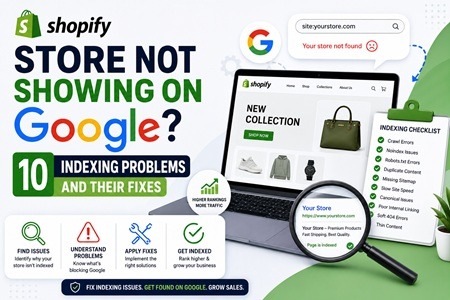 1. Noindex Tags Preventing Page Indexing
When important product pages, collection pages, or blog posts contain noindex directives, Google is instructed to exclude them from search results. Removing unnecessary noindex tags and resubmitting pages through Google Search Console can help restore visibility and improve Shopify search engine indexing.
2. Missing or Unsubmitted XML Sitemap
An XML sitemap helps Google discover and crawl your website efficiently. If your Shopify sitemap has not been submitted to Google Search Console, search engines may take longer to find and index new content. Proper sitemap management is a key component of Shopify SEO services.
3. Robots.txt Blocking Search Engine Crawlers
Incorrect robots.txt configurations can prevent Google from accessing critical pages. Reviewing crawl restrictions and allowing search engines to access valuable content improves crawlability and helps resolve Shopify indexing problems.
4. Duplicate Content Affecting Search Rankings
Duplicate product URLs, collection filters, and tag pages can create multiple versions of the same content. Implementing canonical tags correctly helps consolidate ranking signals and prevents duplicate content issues that often hurt Shopify SEO optimization.
5. Broken Links and 404 Errors
Broken links create poor user experiences and waste Google’s crawl budget. Regularly auditing your website and setting up proper 301 redirects helps maintain a healthy site structure and improves Shopify technical SEO performance.
6. Slow Shopify Store Speed
Website speed is a confirmed ranking factor. Large images, excessive apps, and unoptimized code can slow down your store and negatively affect indexing. Investing in Shopify speed optimization services can improve Core Web Vitals, user experience, and search engine crawl efficiency.
7. Thin Content on Product and Collection Pages
Pages with little or duplicate content often struggle to rank. Creating unique product descriptions, optimized collection content, FAQs, and informative blog articles helps improve Shopify SEO rankings and increases indexing opportunities.
8. Poor Internal Linking Structure
A weak internal linking strategy makes it difficult for Google to discover important pages. Adding strategic links between products, collections, blogs, and category pages strengthens site architecture and improves Shopify search visibility.
9. New Pages Not Indexed by Google
Newly published products and pages may not appear immediately in search results. Submitting URLs manually through Google Search Console and ensuring they are included in your sitemap can speed up the indexing process.
10. Google Search Console Coverage Errors
Coverage issues such as crawl anomalies, redirects, server errors, and excluded pages can prevent important content from being indexed. Regular monitoring of Google Search Console helps identify and resolve these technical SEO issues before they impact traffic and rankings.
If your Shopify website is not showing on Google, the problem is often related to technical SEO and indexing rather than the quality of your products. Addressing these common Shopify indexing issues, improving crawlability, fixing broken links, optimizing site speed, and maintaining a strong SEO foundation can dramatically improve your store’s online visibility. Professional Shopify Indexing Fixing Services, Shopify SEO Technical Fixes, and ongoing SEO audits can help ensure your products, collections, and pages are properly indexed, rank higher in Google Search, and generate more organic traffic and sales for your business.
20 On-Page SEO Techniques for Better Google Rankings
Search Engine Optimization (SEO) helps websites appear higher on search engines like Google. One of the most important parts of SEO is On-Page SEO, which focuses on improving individual web pages to make them more helpful for both users and search engines.
Good On-Page SEO helps websites get more visibility, attract more visitors, and improve user experience. Even small improvements can help websites perform better over time.
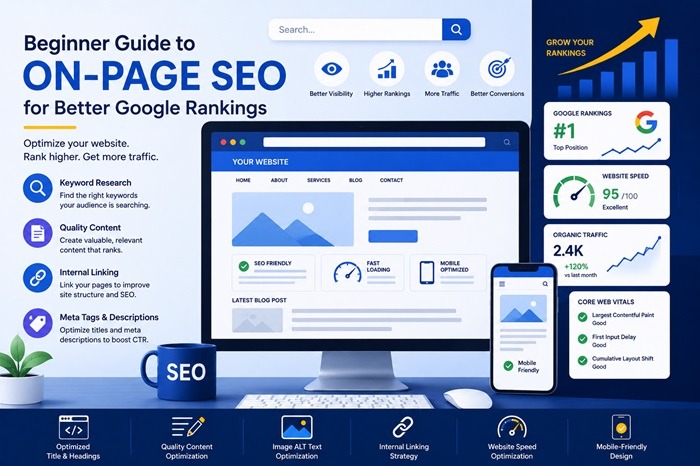
Here are 20 simple and beginner-friendly On-Page SEO tips every website owner should know.
1) Use Simple and Clear Page Titles:
Your page title should clearly explain what the page is about. Clear titles help people understand your content quickly and encourage more clicks from search results.
2) Add Keywords Naturally:
Use important keywords naturally throughout your content so search engines can understand your topic without making the content feel forced or repetitive.
3) Write Helpful Content for Readers:
Focus on creating useful content that answers questions, solves problems, and gives visitors the information they are looking for.
4) Organize Content with Headings:
Using headings helps break content into sections, making pages easier to read and helping visitors quickly find important information.
5) Write Good Meta Descriptions:
Meta descriptions are short summaries shown in Google search results. Clear descriptions can encourage more people to click your website.
6) Make Your Website Load Faster:
Fast websites create better experiences for visitors and help keep people from leaving your website too quickly.
7) Make Your Website Mobile-Friendly:
Most people browse websites on phones, so your website should look good and work properly on all screen sizes.
8) Add Links to Other Pages on Your Website:
Internal links help visitors explore more content and help search engines understand your website structure more clearly.
9) Use Optimized Images:
Large image files can slow down your website, so use properly sized and compressed images to improve loading speed.
10) Add Descriptions to Images:
Image alt text helps search engines understand your images and improves accessibility for users with screen readers.
11) Use Clean and Simple URLs:
Short and readable URLs make pages easier for users and search engines to understand.
12) Keep Paragraphs Short and Easy to Read:
Small paragraphs and simple language improve readability and help visitors stay engaged longer on your website.
13) Update Old Content Regularly:
Refreshing older pages with updated information helps keep your website relevant and useful for visitors.
14) Avoid Copying Content from Other Websites:
Original and unique content helps build trust and improves your chances of ranking better on search engines.
15) Secure Your Website with HTTPS:
Secure websites help protect visitor information and create more trust for both users and search engines.
16) Improve Overall User Experience:
Easy navigation, clear layouts, and fast-loading pages help visitors use your website more comfortably.
17) Use Attention-Grabbing Headlines:
Interesting headlines attract readers and encourage more people to click and continue reading your content.
18) Provide Valuable Information:
Content that teaches, helps, or answers questions creates better experiences for visitors and improves SEO performance.
19) Remove Unnecessary Plugins and Features:
Too many plugins or extra features can slow down your website and create a poor browsing experience.
20) Stay Consistent with SEO Improvements:
Regularly improving your website, updating content, and maintaining quality helps build long-term SEO success over time.
Why Your Website Is Slow on Mobile (15 Fixes for Mobile Performance & Speed)
A slow mobile website is one of the fastest ways to lose traffic, rankings, and customers. Today’s users expect pages to load in seconds—and Google expects the same. If your site feels sluggish on mobile, chances are it’s hurting both your SEO performance and your conversions.
The good news? Most mobile speed issues are common and fixable. Below are 15 real reasons why websites are slow on mobile—and what you can do to fix them.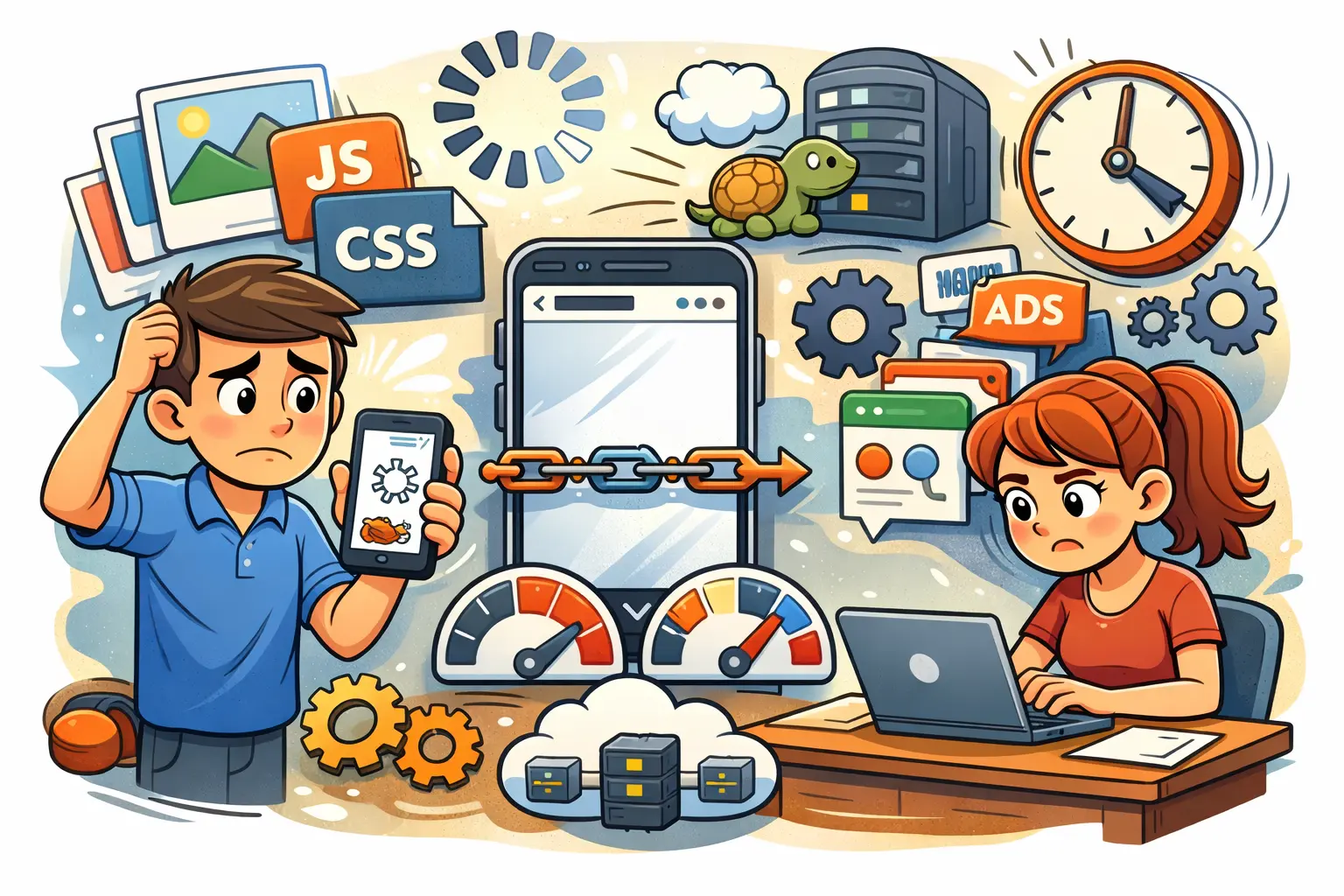
1) Images are too large:
Big image files are the most common reason a site feels slow on mobile. When images aren’t compressed, phones have to download heavier files over weaker networks, which delays the full page load. Fix this by compressing images, switching to WebP/AVIF where possible, and serving responsive image sizes so mobile users don’t download desktop-sized images.
2) No lazy loading for images:
If your page loads every image at once—especially below-the-fold images—your mobile load time increases immediately. This makes the first screen slower and can increase bounce rate. Enable lazy loading so images load only when the user scrolls, improving the initial load speed and making the page feel faster.
3) Too much JavaScript:
Heavy JavaScript can block the page from rendering and delay user interactions like scrolling, clicking, or opening menus. On mobile devices with less processing power, this problem becomes even worse. Reduce unused scripts, defer non-critical JavaScript, and limit unnecessary features that add extra JS.
4) Heavy CSS files:
Large CSS files slow down how quickly the browser can paint the page on mobile. This can make your website feel like it’s “loading forever” even if the server is fine. Minify CSS, remove unused styles, and prioritize critical CSS so the top section of the page displays quickly.
5) Slow server response time:
Even if your site is well-designed, it will still be slow on mobile if your hosting/server takes too long to respond. A slow TTFB (time to first byte) delays everything else that happens after. Improve this by upgrading hosting, enabling server-side caching, and optimizing your database and backend performance.
6) No browser caching:
Without browser caching, mobile visitors have to download the same files every time they visit your site. This makes repeat visits slower and wastes bandwidth, which can frustrate users. Set proper cache headers so browsers store common assets (CSS, JS, images) and load them instantly on return visits.
7) Too many third-party scripts:
Tracking pixels, ad scripts, chat tools, heatmaps, and embedded widgets can easily slow mobile pages because they create extra requests and often load late. On mobile networks, this can be a major performance killer. Remove what you don’t truly need and load essential third-party scripts asynchronously.
8) Fonts loading incorrectly:
Custom fonts can delay text from appearing, which makes users feel the site is slow even if the page is partially loaded. Multiple font weights and large font files also increase load time. Reduce font variations, preload key fonts, use font-display settings properly, or choose fast system fonts where appropriate.
9) Layout shifts while loading:
When elements jump around while a page loads, it creates a poor mobile experience and makes the site feel unstable. This often happens when images or ads don’t have fixed dimensions. Prevent layout shifts by setting image width/height, reserving space for banners, and avoiding late-loading elements that push content down.
10) No CDN (Content Delivery Network):
If your files are served from one server location, visitors far away will experience slower load times—especially on mobile. A CDN stores and delivers your content from the nearest location, reducing delay. Using a CDN also helps handle traffic spikes and improves overall consistency across regions.
11) Poor mobile theme or template:
Some themes look attractive but are built with heavy scripts, sliders, and unnecessary design elements that slow down mobile performance. This often leads to slower load times and a worse user experience. Switching to a lightweight, mobile-first theme can instantly improve performance without sacrificing quality.
12) Too many plugins (WordPress sites):
Each plugin can add extra files, database requests, and background scripts that slow your website on mobile. Even a few heavy plugins can significantly reduce performance. Remove unused plugins, replace heavy tools with lightweight alternatives, and avoid installing plugins for features that can be done with simple code.
13) Redirect chains:
Redirects add extra steps before the browser can load the final page, and multiple redirects can make mobile users wait longer than necessary. This often happens with outdated URLs or poor site migrations. Fix redirect chains by updating internal links and ensuring old URLs point directly to the final destination.
14) Not optimized for mobile-first indexing:
If your mobile site is missing content, internal links, or structured data that exists on desktop, Google may not fully understand your pages. That can reduce rankings and visibility in mobile search. Make sure the mobile version contains the same essential content and SEO signals as the desktop version.
15) No regular speed testing:
Websites naturally slow down over time as new plugins, scripts, and content get added. Without testing, you won’t notice the problem until rankings or conversions drop. Run regular checks using PageSpeed Insights and Search Console, and fix issues early before they affect traffic and leads.
Mobile SEO Checklist (2026): Improve Rankings, Speed & Core Web Vitals
Mobile SEO is no longer optional. With Google fully focused on mobile-first indexing and user experience, your website’s mobile performance directly impacts rankings, traffic, and conversions. In 2026, businesses that ignore mobile SEO risk losing visibility to competitors with faster, smoother, and more user-friendly mobile sites.
This checklist covers the most important mobile SEO factors you need to focus on to improve rankings, page speed, and Core Web Vitals.

1. Optimize for Mobile-First Indexing
Google primarily evaluates the mobile version of your website for ranking. Make sure your mobile site contains the same important content as desktop, including text, images, internal links, and structured data.
Avoid hiding content on mobile and ensure your navigation is simple and crawlable.
2. Improve Mobile Page Speed
Speed is critical for both rankings and user experience. Slow-loading mobile pages lead to higher bounce rates and lost leads.
Focus on compressing images, reducing unused JavaScript and CSS, enabling browser caching, and using modern image formats like WebP. A fast site keeps users engaged and signals quality to Google.
3. Fix Core Web Vitals for Mobile
Core Web Vitals remain a key ranking factor in 2026, especially on mobile devices.
LCP (Largest Contentful Paint): Ensure main content loads quickly by optimizing images, fonts, and server response times.
FID (First Input Delay): Improve interactivity by reducing heavy JavaScript, minimizing third-party scripts, and ensuring pages respond instantly when users tap, click, or scroll on mobile.
CLS (Cumulative Layout Shift): Prevent layout shifts by defining image sizes and avoiding late-loading elements.
A strong Core Web Vitals score improves both rankings and real user experience.
4. Ensure Mobile-Friendly Design & UX
Your website should be easy to use on small screens. Buttons must be easy to tap, text should be readable without zooming, and layouts should adapt smoothly across devices.
Avoid intrusive pop-ups and make key actions—like calls or form submissions—simple and accessible.
5. Optimize Images for Mobile SEO
Images play a huge role in mobile performance. Large, unoptimized images slow pages down and hurt rankings.
Use proper file names, descriptive alt text, responsive image sizes, and lazy loading. Optimized images improve speed, accessibility, and visibility in Google Images.
6. Strengthen Mobile Local SEO Signals
Most mobile searches have local intent. Make sure your Google Business Profile is fully optimized, NAP details are consistent, and local keywords are included naturally on mobile pages.
Click-to-call buttons and location-based content help turn mobile traffic into real leads.
7. Test and Monitor Regularly
Mobile SEO isn’t a one-time fix. Use tools like Google Search Console, PageSpeed Insights, and real-device testing to monitor performance.
Regular testing helps you catch issues early and stay ahead of algorithm updates.
In 2026, winning at SEO means winning on mobile first. By following this mobile SEO checklist—focusing on speed, Core Web Vitals, user experience, and mobile-first optimization—you can improve rankings, attract more traffic, and convert more visitors.
Magento High TTFB Fix: How to Improve Server Response Time
Time to First Byte (TTFB) is a critical performance metric for Magento websites, and a slow TTFB is one of the most common reasons Magento stores fail Core Web Vitals tests. TTFB measures how quickly your server responds to a browser request before any content is loaded. When Magento’s TTFB is high, pages feel sluggish, bounce rates increase, and Google may lower rankings due to poor user experience. Since server response time is a direct SEO factor, reducing TTFB in Magento is essential for improving both search visibility and conversion rates.

One of the biggest causes of slow TTFB in Magento is poor hosting and server configuration. Shared hosting, low PHP workers, outdated PHP versions, and missing server-level caching can significantly delay the first byte. Magento performs best on optimized VPS or cloud hosting with sufficient CPU, RAM, and fast storage (NVMe SSDs). Using the latest stable PHP version supported by Magento, enabling OPcache, and configuring proper memory limits can drastically reduce Magento server response time.
Another major factor affecting Magento TTFB is database and application-level inefficiencies. Large databases with unused tables, logs, and expired sessions slow down backend processing. Regular database cleanup, optimized indexing, and proper cron configuration help Magento respond faster. In addition, enabling Magento production mode, compiling dependency injection, and disabling unused modules reduce backend execution time, which directly improves Time to First Byte.
Implementing full-page caching and a Content Delivery Network (CDN) is also critical for reducing TTFB in Magento. Magento’s built-in Full Page Cache (Varnish) significantly reduces server processing for repeat requests. When combined with a CDN like Cloudflare or Fastly, cached pages are delivered from locations closer to users, dramatically lowering TTFB globally. Proper CDN configuration ensures static assets and even HTML responses are served faster without hitting the origin server repeatedly.
Finally, ongoing monitoring and performance tuning are essential to keep Magento TTFB low. Regularly test your store using tools like Google PageSpeed Insights, GTmetrix, and WebPageTest to track server response time. Remove heavy third-party extensions, audit custom code, and monitor slow database queries. Reducing TTFB in Magento is not a one-time fix—it requires consistent optimization, security updates, and infrastructure improvements. A fast Magento store not only ranks better but also converts more visitors into customers.
Blogroll
Categories
- 2016 SEO trends predictions
- AI for eCommerce
- AI Search & SEO
- author rank
- Authority Trust
- Bing search engine
- blogger
- CDN & Caching.
- Content Strategy
- Core Web Vitals
- eCommerce Growth
- Experience SEO
- Fake popularity
- gbp-optimization
- Google Adsense
- Google Business Profile Optimization
- google fault
- google impact
- google Investigation
- google knowledge
- Google panda
- Google penguin
- Google Plus
- Google Search Console
- Google Search Updates
- Google webmaster tools
- google-business-profile
- google-maps-ranking
- Hummingbird algorithm
- infographics
- link building
- Local SEO
- local-seo
- Mattcutts Video Transcript
- Microsoft
- Mobile Performance Optimization
- Mobile SEO
- MSN Live Search
- Negative SEO
- On-Page SEO
- Page Speed Optimization
- pagerank
- Paid links
- Panda and penguin timeline
- Panda Update
- Panda Update #22
- Panda Update 25
- Panda update releases 2012
- Penguin Update
- Performance Optimization
- Sandbox Tool
- search engines
- SEO
- SEO Audits
- SEO Audits & Monitoring
- SEO cartoons comics
- seo predictions
- SEO Recovery & Fixes
- SEO Reporting & Analytics
- seo techniques
- SEO Tips & Strategies
- SEO tools
- SEO Trends 2013
- seo updates
- Server Optimization
- Shopify Optimization
- Shopify SEO
- Shopify Services
- Small Business Marketing
- social bookmarking
- Social Media
- SOPA Act
- Spam
- Technical SEO
- Uncategorized
- User Experience (UX)
- Webmaster News
- website
- Website Security
- Website Speed Optimization
- Yahoo