Google AI Mode is changing how local customers discover businesses, and it’s important to understand what that means before your calls and enquiries start dropping. In the classic version of local search, people typed “plumber near me” or “best dentist in Dubai” and then chose from the Local Pack (map results), websites, and reviews. With AI Mode, Google can summarize options, suggest businesses, and guide decisions faster-sometimes before a user even scrolls to the usual results. For local business owners, this isn’t the end of local SEO, but it is a shift: you need to make your business easier for Google’s AI to understand and easier for customers to trust at a glance.
In the AI Mode layout, you’ll often see two major areas: an AI-style overview at the top (summary, recommendations, and context) and the familiar Local Pack underneath. That AI overview may pull information from Business Profiles, websites, reviews, and other sources to create quick answers like “top-rated nearby,” “best for families,” or “open now.” This means your visibility is no longer only about ranking #1 in the map results-it’s also about whether your business details are strong enough to be “featured” in the AI summary. If your profile is incomplete, inconsistent, or outdated, Google’s AI has fewer reasons to include you.
To increase your chances of appearing in these AI-driven summaries, start with the fundamentals that the AI can read clearly. Your Google Business Profile should have the right categories, complete services, accurate hours, fresh photos, and consistent contact details. Your website should clearly explain what you offer, where you serve, and what makes you different, using simple headings and service pages that match real search intent. Reviews matter more than ever because AI summaries often reflect reputation signals-rating, recency, keywords in reviews, and how you respond. A business with clear services, strong review activity, and up-to-date information becomes an easy “yes” for the AI to recommend.
AI Mode also changes how customers make decisions. People will compare businesses faster because the AI overview can highlight key differences like pricing style, availability, specialties, or “popular for” use cases. That’s why your content must be direct and conversion-friendly: add pricing ranges (or “starting from”), include quick FAQs, and place strong CTAs like “Call now,” “WhatsApp us,” or “Book online.” If your website is slow or confusing on mobile, you’ll lose users who clicked from AI or Local Pack results. Improving speed (Core Web Vitals), compressing images, and making your contact options obvious can make the difference between “clicked” and “converted.”
If you want a simple plan to stay ahead of Google AI Mode, focus on three things: trust, clarity, and activity. Keep your GBP active with regular updates and photos, build a steady stream of reviews, and make sure your website is structured around services + city intent. Track what matters-calls, messages, direction requests, and form leads-so you can see whether AI-driven changes affect your enquiries.
Tags: ai-search, google-business-profile, google-maps-ranking, local-seo
If your business isn’t showing up on Google when people search for your services-or you’re not getting enough calls, WhatsApp messages, or direction requests from search-it’s usually not because SEO “doesn’t work.” In most cases, you are doing marketing-just missing a few key local SEO signals that Google uses to decide which businesses to rank and which to skip. Even small issues like an incomplete Google Business Profile, inconsistent phone number, weak location pages, or slow mobile speed can quietly reduce your visibility and cost you leads.
The good news is: these problems are common, and they’re also fixable. Once you know what to check, you can make improvements that help Google trust your business more, show you for the right local searches, and increase real enquiries (calls, forms, walk-ins). Below are the 7 biggest local SEO mistakes businesses make-and the exact actions you can take to improve rankings, visibility, and conversions.
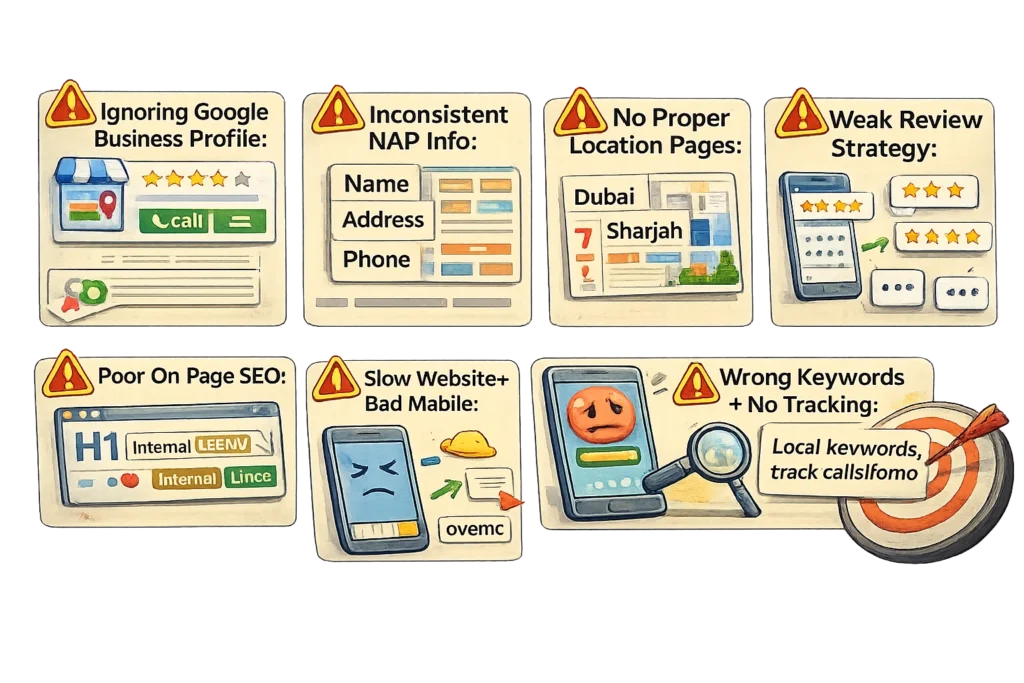
The first mistake is ignoring Google Business Profile (GBP) optimization. Many businesses create a profile once and never update it, but GBP is one of the strongest factors for local rankings. To fix this, choose the correct primary category, add all services, update business details, upload real photos regularly, and use posts to show offers, updates, or new work. Keeping your profile active and complete helps Google trust your business and show it more often.
The second mistake is inconsistent NAP information (Name, Address, Phone) across the web. Google cross-checks your business details on your website, directories, and other listings, and even small differences can reduce trust. The fix is simple: make sure your name, address format, and phone number are exactly the same on your website contact page, GBP, and major directories. Consistency helps Google confirm your business is real and accurate.
The third mistake is not having proper location pages, or having thin pages with almost no useful content. Many businesses try to rank in multiple cities using one generic page, which usually won’t work in competitive areas. The fix is to build dedicated pages for each main city or service area you target and make them unique with relevant service details, local proof (testimonials or results), FAQs, and clear calls-to-action. Location pages help Google match your business to specific searches like “service in [city].”
The fourth mistake is having a weak review strategy or not replying to reviews. Reviews directly impact trust, click-through rate, and conversions-and they can influence local pack visibility too. Fix this by asking every happy customer for a review (WhatsApp is perfect), keeping reviews consistent over time, and replying to every review-positive or negative. Responses show activity, build trust, and can naturally include your service + location.
The fifth mistake is poor on-page SEO, especially title tags, headings, and internal links. If Google can’t clearly understand what your page is about and where you serve, your rankings will suffer. The fix is to use strong title tags like “Service + City + Benefit,” add one clear H1 that matches the page topic, and include internal links to your key pages like services, locations, and contact. Clean structure makes your pages easier for Google to read and users to convert.
The sixth mistake is a slow website or poor mobile experience. Local searches are mostly mobile, and slow pages cause people to leave fast-hurting leads and rankings. Fix this by compressing images (prefer WebP), enabling caching, using a CDN like Cloudflare, and improving Core Web Vitals. A fast site keeps visitors engaged and helps Google trust your user experience.
The seventh mistake is targeting the wrong keywords and not tracking results. Many businesses chase broad terms like “best company” instead of high-intent searches like “service in [city]” or “near me,” and then they don’t measure calls, forms, or GBP actions. The fix is to target keywords with clear buying intent, set up tracking for calls/forms/WhatsApp clicks, and monitor GBP insights (calls, direction requests). When you track the right metrics, you can focus on what actually brings leads.
Tags: google-business-profile, google-maps-ranking, local-search-ranking, local-seo