




search engines
Malware attack warning in firefox by Google
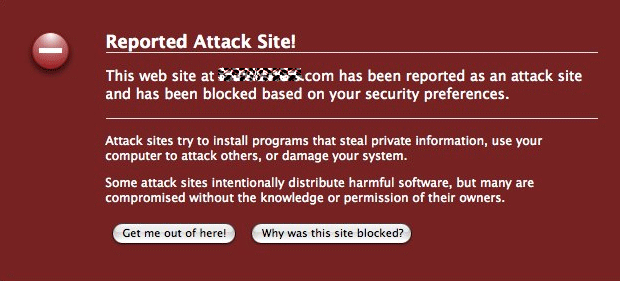
My platform is Mac, FF, with Addons; NoScript, MacAfee SiteAdvisor, and AdBlock Plus.
I was NOT using any Google site or feature, but tried to visit two sites I regularly go to +from a bookmarks page on my desktop+.
The first was a Formula One news site, the other a cycling enthusiast site, nothing dodgy at either usually.
However, a semi-opaque interstitial warning page covered my browser view warning me that the site I’m trying to visit may harm my computer, and according to my setting I am being warned, proceed or not?
Instead of visiting, I clicked on the “More info” link and was taken to a Google url (sorry I didn’t save the url) with data on the site’s malware problem, and last 90 days scanning results. It seems they had some harmful script inserted in their ads by a third party.
I removed those sites from my bookmarks page.
What concerns me, is that later I realized that I hadn’t used any Google feature to visit those sites, so how did G know I was going to them?
I didn’t go through G search, or a G bookmark. I went through a simple homemade bookmarks page on my desktop.
I have a Google account that I remain logged into most of the time. I use it for sitemaps, and the Google removal tool, G alerts, and of course G search.
However when I looked in my G account settings for anything remotely like, “Warn me if I ever try to visit a dodgy site”, and there’s nothing there remotely like that. I use the default “moderate” setting to stop filth showing in the serp.
So, how come G popped the interstitial, when I wasn’t using any G site feature I’m aware of? Too spooky.
All I can guess is that McAfee are collaborating with G on the Site Advisor feature, and extending it’s reach beyond the G serp? Or perhaps it is the NoScript addon people who G are collaborating with?
Normally when the McAfee addon warns you about a dodgy site it will point you to an info page on the McAfee domain, not the Google domain.
Anyone else seen this recently? Was it a test run, a slip-up, or old news?
Interestingly, I visited the same F1 site today using the same method, and got no warning interstitial, nor did the G serp listing of this site have any warning note. “
Your own website against you – nice writeup
A nice writeup by incredible bill of webmasterworld about lawyers using your own site information against you.
“ITFALLS OF SAVING YOUR SITE FOR POSTERITY
Search engines automatically cache your pages and something called the Internet Archive, or Wayback Machine, also comes along and makes a permanent copy of your site for “posterity”. The problem starts when you realize you may have content on your web site that could result in legal issues. You may act quickly to resolve those issues yet the problems still remain without your knowledge because you didn’t act as quickly as all the robots crawling your site.
Unfortunately, legal beagles love that your site was saved for “posterity” when gearing up to file a lawsuit so although you’ve already done the right thing by cleaning potentially harmful things off your site, the tireless automatons crawling the internet have made sure there’s plenty of evidence and the next thing you know, you’re about to get hung out to dry.
If you think the lawyers aren’t technically savvy, think again:
|
http://www.law.com/jsp/legaltechnology/pubArticleLT.jsp?id=1202422968612
Not only can they find your content, they do it under cloak without your knowing about it!
|
You can forget your rights, just throw them out the window, because the history of your website is already busy squealing on you without your knowledge or permission.
HOW DO YOU PROTECT YOUR SITE FROM HISTORICAL SNOOPING?
Obviously the simplest way is to keep your nose clean so nobody has a reason to be snooping in the first place.
However, this is the internet and you have to OPT-OUT of things to protect your rights.
Here’s a few preventative ways to stop your website from being archived and being used as a snitch:
USE NOARCHIVE
Make sure you include the NOARCHIVE meta tag in each web page so that there is no cache in any of the major search engines.
USE ROBOTS.TXT
Block all of the archive site spiders, such as used by the Internet Archive, in your site’s robots.txt file with an entry as follows:
|
The [url=http://crawler.archive.org/]Heritrix software[/url] used by the Internet Archive is Open Source which means there are more archives out there and possibly using deviations of Heritrix that ignore robots.txt and cloak their access to your site.
HELP FOR HOSTED BLOGGER ISSUES
If you’re running a blog hosted on a 3rd party service like Blogger or WordPress, your options may be limited to just embedding NOARCHIVE which the Internet Archive ignores, meaning anyone running stock Heritrix code would also ignore by default.
The only way you can exclude your site, [url=http://www.archive.org/about/exclude.php]according to their site[/url], is to contact them directly. Obviously an insufficient amount of businesses and sites in general are aware of the perils posed by the Internet Archive or they would honor the NOARCHIVE tag for those sites with limited access and no robots.txt just to avoid a flood of emails.
OTHER POTENTIAL RISKS
Snap.com has taken screen shots of every web page, then Ask started taking limited screenshots as well as a some new completely graphical search engines like SearchMe. Some screen shots have minimal resolution too tiny to read but others, like Snap and SearchMe, are big enough you can read, and these too are called evidence in a lawsuit. Even the tiniest thumbnail can still show a licensed trademark being used without permission.
Some of the social bookmarking sites that allow large chunks of content to be copied such as Kaboodle, Jeteye, Eurekster, some using tools like Heritrix (see above), to make small archive copies of specific content.
SUMMARY
Obviously there’s no way you can completely stop anyone from making copies of your site but it may pay by being diligent in keeping many of these technologies off your site that provide any form of archives.
This is just another form of insurance that could, in the end, save your business, your house, your car, your family… “
Search engines allowing promotion of sex selection in India
Google , Yahoo and MSN have been accused of allowing sex selection ads in their sponsored results. Dr. Sabu Mathew George filed a writ petition highlighting the violation of Preconception and Prenatal Diagnostic Techniques Act by the websites. Particularly Yahoo, Google and MSN were accused of allowing ads to run despite of repeated warning notice sent to them.
As per the article
“The Supreme Court on Wednesday issued notice to the Centre, Google India, Yahoo India and Microsoft Corporation on a petition seeking a ban on popular online search engines promoting sex selection techniques.
A three-Judge Bench of Chief Justice K.G. Balakrishnan and Justices P. Sathasivam and J.M. Panchal issued notice on a writ petition filed by Dr. Sabu Mathew George highlighting the violation of Preconception and Prenatal Diagnostic Techniques Act by the websites.
Counsel Sanjay Parikh submitted that despite bringing the websites to the notice of the departments concerned, no steps were taken to block them. He said the petition was filed for full and effective implementation of the Act.
He sought a direction to the Centre to block all websites, including those of Google, Yahoo and Microsoft, that violated the Act.
Dr. George wanted a direction to the Centre to take punitive and deterrent action against these three companies. “
source: hindu.com/2008/08/14/stories/2008081459841300.htm
Publicis to buy performics from Google
Performics a search marketing firm and formerly a part of Double click is now being sold to Publicis for an undisclosed amount. Industry experts had been debating about a potential buy out performics due to the conflict of interest of Google’s polices. Google has the policy Dont be evil and if they run performics many of the other companies will complain that performics customers will get a boost from Google.
Also Search Engine Experts believe if Google runs performics some employees in performics will learn the GOogle search ranking algorithm and this will make their life easier in ranking their client sites.
Washington post reports
“Publicis, which aims to generate 25 percent of its sales from the Internet by
2010, said it would acquire Chicago-based Performics Search Marketing from
Google for an undisclosed amount.
The unit will boost Publicis’s strategic
entity unveiled in June called Vivaki, aimed at spurring growth at its digital
advertising units such as Digitas and Zenith-Optimedia.
In a statement,
Publicis quoted the research house Jupiter Media saying the global search market
was worth an estimated $9.9 billion in 2008 and is projected to grow at 12
percent compound annual growth rate through 2012. “
Google knows the web is big – a informative post in Google blog,
Google is one of the biggest website. We’ve known it for a long time that the web is big. The first Google index in 1998 already had 26 million pages, and by 2000 the Google index reached the one billion mark. Over the last eight years, they’ve seen a lot of big numbers about how much content is really out there. Recently, even their search engineers stopped in awe about just how big the web is these days when their systems that process links on the web to find new content hit a milestone1 trillion-unique URLs on the web at once! So how many unique pages does the web really contain?? No one knows how many it contains but the number of pages out there is infinite! We don’t index every one of those trillion pages, many of them are similar to each other, or represent auto-generated content. But Google is proud to have the most comprehensive index of any search engine, and there goal is always been to index the entire world’s data. To keep up with this volume of information, their systems have come a long way since the first set of web data Google processed to answer queries. Then they did everything in batches- one workstation could compute the Pagerank graph on 26 million pages in a couple of hours, and that set of pages would be used as Google’s index for a fixed period of time. Today, Google downloads the web continuously, collecting updated page information and re-processing the entire web-link graph several times per day. This graph of one trillion URLs is similar to a map made up of one trillion intersections. So multiple times every day, they do the computational equivalent of fully exploring every intersection of every road in the United States. Google’s distributed infrastructure allows applications to efficiently traverse a link graph with many trillions of connections, or quickly sort petabytes of data, just to prepare to answer the most important question- your next Google search.
http://googleblog.blogspot.com/2008/07/we-knew-web-was-big.html
Cuil Potential google competitor or an other major failure
cuil.com a new search engine released today claims to overtake Google. It is co-founded by former Google employee . Google’s Anna petterson is the co-founder of Cuil.
“In her two years at Google, Anna Patterson helped design and build some of the pillars of the company’s search engine, including its large index of Web pages and some of the formulas it uses for ranking search results. Skip to next paragraph
The makers of the Cuil search engine say it should provide better results and show them in a more attractive manner.
Now, along with her husband, Tom Costello, and a few other Google alumni, she is trying to upstage her former employer.
On Monday, their company, Cuil, is unveiling a search engine that they promise will be more comprehensive than Google’s and that they hope will give its users more relevant results.”
Due to too much bragging Cuil is down now,
I get the following message:
“We’ll be back soon…
Due to overwhelming interest, our Cuil servers are running a bit hot right now. The search engine is momentarily unavailable as we add more capacity.
Thanks for your patience.
They are not even ready for 1% of load Google gets but they want to beat Google lets see.
nytimes.com/2008/07/28/technology/28cool.html
Spammer Gets Jail – AOL user spammer gets jail
A spammer who spammed AOL users badly with his junk pharmacy spam got 26 months of Jail term. I am sure the Jail term he got is something he deserved. I wish all email spammers in this world gets Live jail terms. They are terrible low lifes.

YAHOO ANOUNCES SETTLEMENT WITH CARL ICAHN
YAHOO ANOUNCES SETTLEMENT WITH CARL ICAHN
Yahoo who is a leading global Internet company announced that it has reached an agreement with Carl Icahn to settle their pending proxy contest related to the Company’s 2008 annual meeting of stockholders. Under the terms of the settlement agreement, eight members of Yahoo’s current Board of Directors will stand for re-election at the 2008 annual meeting. In view of the settlement agreement with Mr. Icahn, and the termination of the proxy contest, Robert Kotick who is one of the board members has decided not to stand for re-election to the Board at the 2008 annual meeting & following 2008 annual meeting Yahoo board will be expanded to 11 members. Carl Icahn will be appointed to the Board. As part of the settlement agreement, Mr. Icahn, who owns an aggregate of 68,786,320 shares, or 4.98% of Yahoo common stock, has agreed to withdraw his nominees for consideration at the annual meeting and to vote his Yahoo shares in support of the Board’s nominees. Yahoo chairman told that they are gratified to have reached this agreement, which serves the best interests of all Yahoo Stockholders. And they look forward to work productively with Carl and the new members of the Board in continuing to improve the Company’s performance and enhancing stockholder value. Co-founder and Chief Executive Officer Jerry Yang told that agreement will not only allow Yahoo to put the distraction of the proxy contest behind us, it will also allow the Company to continue pursuing its strategy of being the starting point for Internet users and a must buy for advertiser. Icahn is very pleased that this settlement will allow him to work in partnership with Yahoo’s Board and management team to help the Company achieve its full potential. He believes that this is a good outcome and he’ll have a strong working relationship going forward. He is also happy that the board has agreed in the settlement agreement that any meaningful transaction, including the strategy in dealing with that transaction, will be fully discussed with the entire board before any final decision is made. On the whole both the parties are ready for this agreement & yahoo being a world-class company with an extremely bright future, and collaborating together, I believe, the Company achieves its ambitious goals.
How to submit a re-inclusion request Google’s official video – transcripted by SRequesting reconsideration in Google how to remove banned site – Video
Requesting reconsideration in Google how to remove banned site – Video transcript
Posted by Mariya Moeva, Search Quality Team
Hai I am Mariya Moeva from the Google Search Quality Team and I like to talk to you about reconsideration requests. In this video we will go over one how to submit a reconsideration request for your site. Lets take a webmaster lady here as an example. Ricky a hard working webmaster who works on his ancient politics blog everyday lets call it example.com one day he checks and sees that his site no longer appears in Google search results. Lets see some things to know whether he needs to submit reconsideration requests. First he needs to check whether his sites disappearance from the index may be caused by access issues. You can do that too by logging into your webmaster tools account on the overview page you will be able to see when was the last time Google-bot successfully accessed your webpage. Here you can also check whether there are any crawling errors for example if your server was busy or unavailable when we try to access your site you would get an URL unreachable message alternatively there will be URLs on your site blocked by your robots.txt file you can see this by URLs restricted by robots.txt.
If these URLs are not what you expected you can go to tools and select analyze robots.txt here you can see whether you robots.txt file is properly formatted and only blocking parts of your site that you don’t want Google to crawl. If google has no problems accessing your site check to see if there is a message waiting for you in the message center of your webmaster tools account. This is the place where Google uses to communicate with you an put information to you on webmaster tools account in the sites that you manage. If we see that there is something wrong with your site we may send you a message there detailing things you need to fix to get back your site in compliance with Google webmaster guidelines. Ricky logs into his webmaster tools account and checked that there are no new messages. He doesn’t find any messages if you don’t find any message in the message center check to see if your site has been on is in violation on Google’s webmaster guidelines you can find that in the help center under the topic creating a Google friendly site how to make my site perform best in Google. If you are not sure why Google is not including your site a great place to look for help is our Google webmaster help group there you will find many friendly and knowledgeable webmasters and Googler’s who will be happy to look at your site and give suggestions on what you might need to fix,
You can find links to both the help center and the Google help group at Google.com/webmasters to get to the bottom of why his site has disappeared from the index Ricky opens the webmaster guidelines and starts reading. In quality guidelines we specifically mention completing avoiding hidden text or hidden links on the page. He remember that at one point he hired a friend named Liz who claimed to say he knows something about web design and that he can make the site rank better in Google. Then he scans his site completely and finds blocks of hidden text on footer of all his pages. IF your site is in violation of Google webmaster guidelines and if you think this might have affected the way your site is ranked in Google now will be a good time to submit a reconsideration request. But before you do that make changes to your site so that it falls between the Google
S webmaster guidelines. Ricky removed all the hidden text from his pages now he can go ahead and submit a request for reconsideration. Login to your webmaster tools account under tools click on request reconsideration and follow the steps make sure you explain what you did wrong with your site and what steps you have taken to fix it.
Once you have submitted a request you will receive a message from us in the message center confirming that we have received it. We will then review for compliance with the Google webmaster guidelines. So that’s an overview of how to submit a reinclusion and reconsideration request. Thanks for watching and Good luck with web mastering and ranking.
Search engine optimization URL change is it recommended?
Search Engine optimization URL change from static to Dynamic
Many have asked the question what happens if the URL is changed from html to PHP or ASP or vice versa. Well in Search engine optimization URLs shouldnt be changed often. Search engines recognize a page based on the URLs so once they are indexed its not recommended to play with them much. Google assigns pagerank to individual URLs based on backlinks to that page from other pages from the site or from external sites. So if a Url is changed it will affect Search engine optimization. The pagerank of that page is lost and Google also have to drop that page from the index. Also till the page is dropped you need to wait or Google will index the new page with the new URL which will result in lots of confusion happening. Duplicate pages will be created and at times the version you want to have will drop off. So its important to decide which version of urls you want to use whether php or asp or html or htm or what ever decide before you start designing the site. There is no difference between a PHP url and a html URL so if you think in future there will be dynamic contents in the page better name it PHP or ASp or any dynamic extension of the code you want to use.
Ok if you have unavoidable reasons where you want to change the page extensions then make sure the old pages are 301 redirected to the new pages that are created that way you won’t loose the value of the old page. 301 redirect for all coding is available online you can use it.
Best recommendation don’t change URLs unless you have unavoidable reasons. That is the best for Search engine optimization purposes.
Blogroll
Categories
- AI Search & SEO
- author rank
- Authority Trust
- Bing search engine
- blogger
- CDN & Caching.
- Content Strategy
- Core Web Vitals
- Experience SEO
- Fake popularity
- gbp-optimization
- Google Adsense
- Google Business Profile Optimization
- google fault
- google impact
- google Investigation
- google knowledge
- Google panda
- Google penguin
- Google Plus
- Google Search Console
- Google Search Updates
- Google webmaster tools
- google-business-profile
- google-maps-ranking
- Hummingbird algorithm
- infographics
- link building
- Local SEO
- local-seo
- Mattcutts Video Transcript
- Microsoft
- Mobile Performance Optimization
- Mobile SEO
- MSN Live Search
- Negative SEO
- On-Page SEO
- Page Speed Optimization
- pagerank
- Paid links
- Panda and penguin timeline
- Panda Update
- Panda Update #22
- Panda Update 25
- Panda update releases 2012
- Penguin Update
- Performance Optimization
- Sandbox Tool
- search engines
- SEO
- SEO Audits
- SEO Audits & Monitoring
- SEO cartoons comics
- seo predictions
- SEO Recovery & Fixes
- SEO Reporting & Analytics
- seo techniques
- SEO Tips & Strategies
- SEO tools
- SEO Trends 2013
- seo updates
- Server Optimization
- Small Business Marketing
- social bookmarking
- Social Media
- SOPA Act
- Spam
- Technical SEO
- Uncategorized
- User Experience (UX)
- Webmaster News
- website
- Website Security
- Website Speed Optimization
- Yahoo