




Website not getting crawled due to potential history of penalty:

We have this question asked by few of our website visitors, does a site stop getting crawled if Googlebot detects any previous penalty or ban on that website. I would say yes we have seen this being reported by some of our potential clients or by people in forums. I assume Google has a list of all sites that was previously blacklisted in Google rankings. When Googlebot detects a link to a website that was previously blacklisted then it will first take that link and will store in a database. Later Google’s algorithm will decide whether that link is crawl worthy and then Google crawler will be sent to crawl and index that website.
Best way to see if your site has any historical spam flag is to check in archive.org. Archive way back machine will have your old pages indexed if it ever existed. If you are sure what is the problem with your website then explain that carefully in a re-inclusion request and I am sure Google will accept your website.
Penalties apply to Google too:
2 months back Google.co.jp , Google’s japan domain was penalized for buying pay per post promotional links from leading Pay per post agency cyberbuzz.com . A visible example of Google Japan’s penalty can been seen if you have Pagerank enabled in Google toolbar. Google Japan has a pagerank of 5 now compared to pagerank 9 it previously had.
An extract from their promotional campaign:
“The Google Hot Keywords blog widget [link to Google’s page] can show you what is in fashion now, and what other people are interested in.
It’s appealing that you can view buzzwords from the previous day or the previous week. I am sometimes surprised to see that such words are so popular! Personally, I like the “fortune-teller” feature from the previous week’s ranking. When I click on a keyword, I am quickly taken to Google’s result page and so I enjoy the feature.
I might not have noticed them by myself, but now I understand that these things are what people care about.
I am participating in CyberBuzz’s campaign.
“
After realizing their problem and other bloggers reporting the problem with them, here is the apology from their official blog:
“”Google Japan is running several promotional activities to let people know more about our products.
It turns out that using blogs on the part of the promotional activities violates Google’s search guidelines, so we have ended the promotion. We would like to apologize to the people concerned and to our users, and are making an effort to make our communications more transparent in order to prevent the recurrence of such an incident.”
Stealth links and Googlebot :
Webmaster world owner and senior webmaster Brett Tabke posted an interesting thread what he calls stealth links in Google. Links that are not the same HREF links but still seem to count in Google. He calls them stealth links according to him following are some prominent stealth links:
- another site links to your graphics (img src)
- a site links to your javascript files
- a site links to your css files?
- rss feeds and other xml feeds that people can link to without notice or referrals necc being generated.
- links in email that some se’s can read (yahoo mail, hotmail, Gmail)
- links marked with noindex
- links marked with nofollow
- urls within javascript or js comments
- raw urls within css or css comments
- urls within meta data of graphics and video files
- urls within html comments
- urls within the head section or meta data of a html page
- links or pages that maybe surfed while visitor has page rank engaged on the toolbar
- the target of a constructed, obfuscated, or encrypted js url (hidden until executed)
- links behind pay walls that Google can spider via webmaster tools
- Domains that have been 301’d with links.
- Links in Flash movies (games, quizzes, etc).
- non href’ed url’s. (raw url on page http://www.webmasterworld.com)
- Links in any documents other than web pages e.g. .doc, .pdf, .txt, etc.
- blocking a page in robots.txt should make it blocked from bots, but they still spider it.
According to me most of links from the above sources are not counted by Google atleast for ranking purposes. Brett came up with the above list because of the discussion that was started in another thread about pages getting pagerank without any external links. I feel most of the people who are complaining about pages getting pagerank without external links either don’t know to check backlinks or just rely on yahoo and Google backlink data which is totally unreliable.
CNN a PR 10 now:
After a long stay in Pagerank 9, CNN has finally got a full Pagerank 10 from Google. We have the most updated list of Pagerank 10 sites available in internet now http://www.searchenginegenie.com/pagerank-10-sites.htm . CNN was PR 10 before a year now they retained their PR 10. Though pagerank is just a number it’s a ultimate symbol of quality in Google’s point of view. There is just a handful list of sites with Pagerank 10 and CNN is one among them. Also Adobe flash player page and acrobat page got pagerank 10 which is again good news.
Pagerank obsession had been in existence for more than 8 years. From the day Google came into existence pagerank fever grabbed many search engine lovers and followers.
Does Protected Whois affect Google rankings?
Many of us prefer to protect our whois data to avoid spammers and scammers getting our email addresses for potential abuse. We protect our privacy on some of our sites though we don’t do it on our company website. Many of us know Google uses whois data in for search engine rankings. They primarily use this to avoid spammers capturing expired domains and using the backlink power of those domains and use it for their own website.
This Google patent already describes Google’s usage of whois for ranking purposes.
(http://appft1.uspto.gov/netacgi/nph-Parser?Sect1=PTO2&Sect2=
HITOFF&p=1&u=%2Fnetahtml%2FPTO%2Fsearch-bool.html&r=
1&f=G&l=50&co1=AND&d=PG01&s1=20050071741&OS=20050071741&RS=20050071741 )
Some extra from that Google patent:
1. A geographic information system (GIS) comprising information about a plurality of geospatial entities and configured to prioritize the geospatial entities according to a ranking mechanism.
2. The system of claim 1, wherein the ranking mechanism uses data about a meta attribute of a geospatial entity to determine the geospatial entity’s priority.
3. The system of claim 2, wherein the meta attribute comprises one of: quality of information available about the geospatial entity, an attribute of a description of the geospatial entity, and an attribute of a definition of the geospatial entity.
4. The system of claim 2, wherein the meta attribute comprises an indicator of the geospatial entity’s popularity.
5. The system of claim 2, wherein the meta attribute comprises one of: an age attribute, a stature attribute, and an importance attribute.
6. The system of claim 2, wherein the meta attribute comprises a relationship of a geospatial entity to its place in a hierarchy of geospatial entities.
7. The system of claim 1, wherein an entity of the plurality of entities comprises a collection of geospatial objects and wherein the priority of the entity is determined responsive to a characteristic of the collection of geospatial objects.
8. The system of claim 1, wherein an entity of the plurality of entities comprises a geospatial entity defined in an on-line forum and wherein the ranking mechanism uses data generated in the on-line forum to determine the rank of the geospatial entity.
9. The system of claim 1, wherein the ranking mechanism uses data harvested from a website on the internet about a geospatial entity to determine the geospatial entity’s priority.
10. The system of claim 1, wherein the ranking mechanism determines a geospatial entity’s priority from a combination of weighted data from a plurality of meta attributes of the geospatial entity.
11. A computer-implemented method for ranking geospatial entities, the method comprising: receiving geospatial entity data; evaluating attributes of geospatial entities included in the received geospatial entity data; ranking the geospatial entities based on the evaluation; and storing the ranked geospatial entity data.
12. The method of claim 11, wherein the geospatial entity data comprises data generated in a community forum.
13. The method of claim 11, wherein the geospatial entity data comprises data associated with a specific user and further comprising using the ranked geospatial entity data to generate a map for the specific user.
14. The method of claim 11, further comprising selecting geospatial entities for a geographical display based on the rankings of the geospatial entities.
15. The method of claim 11, further comprising providing the ranked geospatial entity data to a map system configured to generate a map that includes ranked geospatial entities and unranked geospatial entities.
16. The method of claim 11, further comprising selecting geospatial entities to include in navigation instructions based on rankings of the geospatial entities.
17. The method of claim 11, further comprising selecting a geospatial entity to associate with an advertising term based on the geospatial entity’s ranking.
18. The method of claim 11, further comprising providing the ranked geospatial entity data to an application for generating a search result based on the ranked geospatial entity data.
19. The method of claim 11, wherein evaluating is performed responsive to user instructions for providing personalized geospatial entity rankings.
20. The method of claim 19, wherein the user instructions comprise a weighting to be applied to an attribute of a geospatial entity identified in the geospatial entity data.
21. A system for ranking geospatial entities, the system comprising: an interface for receiving ranking data about a plurality of geospatial entities; an entity ranking module for generating place ranks for geospatial entities according to a ranking mechanism based on the ranking data; and a database for storing ranked entity data generated by the entity ranking module.
22. The system of claim 21, wherein the interface is configured to provide the ranked entity data to a requesting application.
23. The system of claim 21, wherein the entity ranking module is configured to evaluate a plurality of diverse attributes to determine a total score for a geospatial entity.
24. The system of claim 21, wherein the entity ranking module is configured to organize ranked entity data into placemark layers.
25. The system of claim 24, wherein each placemark layer corresponds to at least one of: a level of detail, a density, an altitude, and an entity category.
26. The system of claim 21, wherein the requesting application is a map server system configured to use the ranked entity data to generate a map including entities selected on the basis of place ranks.
27. The system of claim 26, wherein the entity ranking module is hosted on the map server system.
28. An entity ranking module hosted on a client device, the module for generating rankings for a plurality of geospatial entities and the module comprising: an interface for receiving entity data that defines a plurality of geospatial entities and ranking data that describes the plurality of geospatial entities; and a ranking engine for generating rankings for the geospatial entities, wherein the rankings are used to select which of the geospatial items to include in a map to be displayed on the client device.
29. The module of claim 28, further comprising a memory for storing data about a user of the client device and wherein the ranking engine is configured to apply a ranking mechanism responsive to the user data.
30. The module of claim 29, wherein the user data comprises user preferences about the relative weightings of attributes evaluated by the ranking engine.
31. The module of claim 29, wherein the user data comprises a user defined geospatial entity.
32. The module of claim 29, wherein the user data comprises an indication of a user’s interest in a geospatial entity and wherein the ranking mechanism assigns a rankings premium to the geospatial entity based on the user’s interest.
What I am trying to say is you need to be careful when changing whois info or trying to suddenly protect your privacy by hiding your whois data. If there is sudden change you can expect some sort of problem but if done correctly I am sure you wont have any problem with whois privacy protection.
Mini sitelinks a copycat idea from yahoo and MSN
Google has now introduced / testing mini site links. Sitelinks are links that are below a website which is felt authority for a particular keyword. If you search for your domain name you can see sitelinks in Google results. Now Google has copied the idea MSN and yahoo had been using for a long time. They are integrating site links inside the snippets displayed.
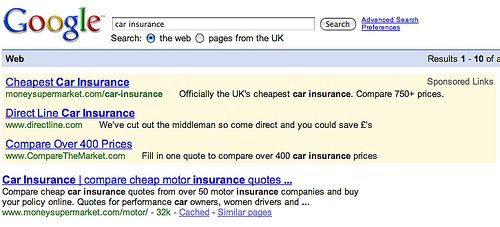
Google has copied this idea from Yahoo and MSN. Internet is fully of copy cats and Google is no exception I feel.
Signature in forum profile – Is it a sort of spam?

Getting backlinks from forum signatures is in existence from the day forums came into existence and had the feature to have backlinks. Is it still a good strategy I fear no. Forums are meant for quality discussions getting solutions for problems that you cannot find anywhere else in internet. Using such a wonderful resource for the same of spamming the search engines for backlinks is not a good idea.
I am personally not against it but if you see forums like digital point forums they allow forum signatures in exchange for minimum amount of postings and this actually helps the spammers more. I have seen many just start useless repeat threads or one do one line posts just to create an extra page with backlink. Digital point forum is a typical example of forum spamming most people who visit there are lacking of any SEO knowledge and this leads them to wrong assumptions on forum signatures.
There are discussions here just to know what keyword to use in forum signature, which page to link to, whether multiple pages from same sites can be linked, Is text required besides anchor text etc. I feel all these are just waste of time people can rather spend their time usefully than spamming forums for signature links. I request leave the forums alone they are very useful places for getting quality information.
Webmaster claims in webmasterworld yahoo directory listing stays free
Some webmasters have noticed their sites not removed even after 3 years unpaid. When first they made the inclusion they paid for the listing later they never renewed but it continued to remain in yahoo directory for free. I am sure this is great for everyone desperate to get into yahoo directory. For a fee of 300$ you can get a potential lifetime free listing.
Here are a few tips for evaluating a Yahoo directory listing:
1. Do a Y! directory search first to find the most appropriate category for your listing. Don’t choose the one you want because of PR or how high up it is, because the editor will probably place your site in the most appropriate category.
2. Ask yourself – how many other sites are listed in this category? Is my link likely to be buried on Page 2 or 3, or is it more likely to be near the top of page 1? Does the category itself have any Google search rankings for keywords relevant to your site? If so you may be able to get traffic from it.
3. From an SEO perspective, does the category have PageRank? Usually top tier categories have some decent PageRank, but as you go down deeper into the directory they don’t. Number of outgoing links in a category is an issue here too. If you’re likely to be buried on the 2nd or 3rd category page there will be less value.
4. From an SEO perspective relevance is important – how relevant is this directory category to my keywords?
5. Trust factors – is that category linking out to other good sites, or linking out to some expired domains or bad neighborhoods? Y! directory is one of the oldest most trusted web directories so there is usually some trust value associated with a link from here.
So as you can see, there are some instances where a Y! directory link will be valuable and others where it won’t, it just depends on your niche.
Does Googlebot crawl videos:

Recently I have noticed surge in videos from YouTube ranking for competitive phrases. If you see YouTube page all you see is a video without proper text, few comments shown and all other are just junk data. So here are my questions?
1. How a video ranks on top of Google results when it doesn’t have any proper optimization done or it just has keywords in title.
2. How does Google determine the content of a video? Does it have a program that somehow analyzes the video and evaluates its content, even when there are no spoken or written words, as in this case. Or does a Google employee actually watch the video and personally evaluate its content?,
Doing a bit of more searches I feel Google will be seeing the popularity of the video, real backlinks coming to the video, no of instances the video has been embedded etc.
Google can also see the comments and valuate the quality of the video some videos attract 1000s of comments so I feel Google will have ability to crawl all the comments though many contents are hidden.
Also the quality of the domain itself matters youtube.com is PR 9 domain which signals very high level importance and popularity in Google’s eyes. You can expect pages under youtube.com to rank because of the quality of YouTube domain.
Video views can also signal Google that the video is important.
In fact only Google knows the algorithm behind ranking YouTube videos. I will leave it to them.
Removing advertising or not advertising will show credibility:

Advertising on a new site is self-defeating. Shouldn’t you be highlighting the quality of the content to show why your site is linkworthy? Removing ads shifts the focus to your content and why someone should link to the site.
In my experience it helps the link building process to remove advertising from a new site because webmasters like to link to quality information that is free. A lack of advertising presents a more positive face because some people tend to overlook the high quality of the content because of the ads, not even give the content a chance. Leaving out the ads puts your content front and center, there’s nothing to distract from it. Even Google didn’t have advertising when it first started.
New sites with advertising are a turnoff
I receive many requests to link to new sites. Number one reason I’ll decline is advertising. It’s poison. Advertising sends the message that the reason this person wants my link is so they can make a buck off my traffic. Why should I link to that?
What is the point of trying to monetize a new site with a trickle of traffic? Advertising revenue depends on traffic. Shouldn’t you focus on building traffic first then monetizing the site after it’s acquired?
Works for older sites with low traffic
Sites that have been around awhile but aren’t performing well should be considered candidates for removal of advertising. What you have to gain long term may outweigh what little earnings you’ll lose while you focus on building traffic to the site.
Works on established sites, too
Even established sites can benefit from temporarily removing advertising. If a sub-section is not performing well because of a lack of links/traffic, you may want to consider temporarily removing advertising in order to boost the success rate of your link building effort.
Personally I like sites which are ad-free, if you want to have a site link worthy don’t show your visitors that you are madly money minded. Looking to always make money through advertising will spoil the trend to attract backlinks to your website. If you want quality links you need to back off on strong advertising on your website.
Pagerank update – April 2009
Google is updating its toolbar pagerank data, its confirmed and we have PR data for almost all of our websites changed. You can check your altered pagerank here:
http://www.searchenginegenie.com/future-pagerank-checking.html
Blogroll
Categories
- 2016 SEO trends predictions
- AI for eCommerce
- AI Search & SEO
- author rank
- Authority Trust
- Bing search engine
- blogger
- CDN & Caching.
- Content Strategy
- Core Web Vitals
- eCommerce Growth
- Experience SEO
- Fake popularity
- gbp-optimization
- Google Adsense
- Google Business Profile Optimization
- google fault
- google impact
- google Investigation
- google knowledge
- Google panda
- Google penguin
- Google Plus
- Google Search Console
- Google Search Updates
- Google webmaster tools
- google-business-profile
- google-maps-ranking
- Hummingbird algorithm
- infographics
- link building
- Local SEO
- local-seo
- Mattcutts Video Transcript
- Microsoft
- Mobile Performance Optimization
- Mobile SEO
- MSN Live Search
- Negative SEO
- On-Page SEO
- Page Speed Optimization
- pagerank
- Paid links
- Panda and penguin timeline
- Panda Update
- Panda Update #22
- Panda Update 25
- Panda update releases 2012
- Penguin Update
- Performance Optimization
- Sandbox Tool
- search engines
- SEO
- SEO Audits
- SEO Audits & Monitoring
- SEO cartoons comics
- seo predictions
- SEO Recovery & Fixes
- SEO Reporting & Analytics
- seo techniques
- SEO Tips & Strategies
- SEO tools
- SEO Trends 2013
- seo updates
- Server Optimization
- Shopify Optimization
- Shopify SEO
- Shopify Services
- Small Business Marketing
- social bookmarking
- Social Media
- SOPA Act
- Spam
- Technical SEO
- Uncategorized
- User Experience (UX)
- Webmaster News
- website
- Website Security
- Website Speed Optimization
- Yahoo