




Top 10 Global brands – rated 2008 rankings for top brands globally.
1. Coca-Cola – The Coca-Cola Company (NYSE: KO) is the world’s largest beverage company, largest manufacturer, distributor and marketer of non-alcoholic beverage concentrates and syrups in the world, and one of the largest corporations in the United States. The company is best known for its flagship product Coca-Cola, invented by pharmacist John Stith Pemberton in 1886. The Coca-Cola formula and brand was bought in 1889 by Asa Candler who incorporated The Coca-Cola Company in 1892. Besides its namesake Coca-Cola beverage, Coca-Cola currently offers nearly 400 brands in over 200 countries or territories and serves 1.5 billion servings each day.[2]
The company operates a franchised distribution system dating back to 1889 where The Coca-Cola Company only produces syrup concentrate which is then sold to various bottlers throughout the world who hold an exclusive territory.
The Coca-Cola Company is headquartered in Atlanta, Georgia. Its stock is listed on the NYSE and is part of DJIA and S&P 500. Its current president and CEO is Muhtar Kent.
2. IBM – The character of a company — the stamp it puts on its products, services and the marketplace — is shaped and defined over time. It evolves. It deepens. It is expressed in an ever-changing corporate culture, in transformational strategies, and in new and compelling offerings for customers. IBM’s character has been formed over nearly 100 years of doing business in the field of information-handling. Nearly all of the company’s products were designed and developed to record, process, communicate, store and retrieve information — from its first scales, tabulators and clocks to today’s powerful computers and vast global networks.
IBM helped pioneer information technology over the years, and it stands today at the forefront of a worldwide industry that is revolutionizing the way in which enterprises, organizations and people operate and thrive.
The pace of change in that industry, of course, is accelerating, and its scope and impact are widening. In these pages, you can trace that change from the earliest antecedents of IBM, to the most recent developments. You can scan the entire IBM continuum from the 19th century to the 21st or pinpoint — year-by year or decade-by-decade — the key events that have led to the IBM of today. We hope that you enjoy this unique look back at the highly textured history of the International Business Machines Corporation.
3. Microsoft – Microsoft Corporation is an American multinational computer technology corporation, which rose to dominate the home computer operating system market with MS-DOS in the mid-1980s, followed by the Windows line of operating systems.
Throughout its history the company has been the target of criticism for various reasons, including monopoly status and anti-competitive business practices including refusal to deal and tying. The U.S. Justice Department and the European Commission, among others, have ruled against Microsoft for various antitrust violations.[8][9]
It develops, manufactures, licenses, and supports a wide range of software products for computing devices.[10][7] Microsoft’s best-selling products are the Microsoft Windows operating system and the Microsoft Office suite of productivity software.
4. GE – The General Electric Company, or GE (NYSE: GE) is a multinational American technology and services conglomerate incorporated in the State of New York.[5] In terms of market capitalization as of 30th June 2008, GE is the world’s sixth largest company and also second in the BrandZ ranking. In the 1960s, aspects of U.S. tax laws and accounting practices led to a rise in the assembly of conglomerates. GE, which was a conglomerate long before the term was coined, is arguably the most successful organization of this type.
5. Nokia – Nokia is a Finnish multinational communications corporation, headquartered in Keilaniemi, Espoo, a city neighbouring Finland’s capital Helsinki. Nokia is focused on wireless and wired telecommunications, with 112,262 employees in 120 countries, sales in more than 150 countries and global annual revenue of 51.1 billion euros and operating profit of 8.0 billion as of 2007.[1][3] It is the world’s largest manufacturer of mobile telephones: its global device market share was about 40% in Q2 of 2008, up from 38% in Q2 2007 and up from 39% sequentially.[2] Nokia produces mobile phones for every major market segment and protocol, including GSM, CDMA, and W-CDMA (UMTS). Nokia’s subsidiary Nokia Siemens Networks produces telecommunications network equipments, solutions and services.
6. Toyota – Toyota Motor Corporation (トヨタ自動車株式会社, Toyota Jidosha Kabushiki-gaisha?) (pronounced [to-yo-ta]) is a multinational corporation headquartered in Japan, and is currently the world’s largest automaker.[3][4]
In 1934, while still a department of Toyota Industries, it created its first product Type A engine and in 1936 its first passenger car the Toyota AA. The company was eventually founded by Kiichiro Toyoda in 1937 as a spinoff from his father’s company Toyota Industries to create automobiles. Toyota currently owns and operates Lexus and Scion brands and has a majority shareholding stake in Daihatsu Motors,[5] and minority shareholdings in Fuji Heavy Industries Isuzu Motors, and Yamaha Motors. The company includes 522 subsidiaries.[6]
Toyota is headquartered in Aichi, Nagoya and in Tokyo. In addition to manufacturing automobiles, Toyota provides financial services through its division Toyota Financial Services and also creates robots. Toyota Industries and Finance divisions form the bulk of the Toyota Group, one of the largest conglomerates in the world
7. Intel – Intel Corporation (NASDAQ: INTC; SEHK: 4335) is the world’s second largest semiconductor company and the inventor of the x86 series of microprocessors, the processors found in most personal computers. Founded on July 18, 1968 as Integrated Electronics Corporation and based in Santa Clara, California, USA, Intel also makes motherboard chipsets, network cards and ICs, flash memory, graphic chips, embedded processors, and other devices related to communications and computing. Founded by semiconductor pioneers Robert Noyce and Gordon Moore, and widely associated with the executive leadership and vision of Andrew Grove, Intel combines advanced chip design capability with a leading-edge manufacturing capability. Originally known primarily to engineers and technologists, Intel’s successful “Intel Inside” advertising campaign of the 1990s made it and its Pentium processor household names.
Intel was an early developer of SRAM and DRAM memory chips, and this represented the majority of its business until the early 1980s. While Intel created the first commercial microprocessor chip in 1971, it was not until the success of the personal computer (PC) that this became their primary business. During the 1990s, Intel invested heavily in new microprocessor designs and in fostering the rapid growth of the PC industry. During this period Intel became the dominant supplier of microprocessors for PCs, and was known for aggressive and sometimes controversial tactics in defense of its market position, as well as a struggle with Microsoft for control over the direction of the PC industry.[5][6] The 2007 rankings of the world’s 100 most powerful brands published by Millward Brown Optimor showed the company’s brand value falling 10 places – from number 15 to number 25.[7]
8. McDonald’s – McDonald’s Corporation (NYSE: MCD) is the world’s largest chain of fast food restaurants, serving nearly 47 million customers daily.[3] McDonald’s primarily sells hamburgers, cheeseburgers, chicken products, French fries, breakfast items, soft drinks, milkshakes and desserts. More recently, it has begun to offer salads, wraps and fruit. Many McDonald’s restaurants have included a playground for children and advertising geared toward children, and some have been redesigned in a more ‘natural’ style, with a particular emphasis on comfort: introducing lounge areas and fireplaces, and eliminating hard plastic chairs and tables.
In addition to its signature restaurant chain, McDonald’s Corporation holds minority interest in Pret A Manger (a UK-based sandwich retailer), and owned the Chipotle Mexican Grill until 2006 and the restaurant chain Boston Market until 2007.[4] The company has also expanded the McDonald’s menu in recent decades to include alternative meal options, such as salads and snack wraps, in order to capitalize on growing consumer interest in health and wellness.
Each McDonald’s restaurant is operated by a franchisee, an affiliate, or the corporation itself. The corporations’ revenues come from the rent, royalties and fees paid by the franchisees, as well as sales in company-operated restaurants. McDonald’s revenues grew 27% over the three years ending in 2007 to $22.8 billion, and 9% growth in operating income to $3.9 billion.[5]
9. Disney – The Walt Disney Company (NYSE: DIS) is one of the largest media and entertainment corporations in the world. Founded on October 16, 1923, by brothers Walt and Roy Disney as an animation studio, it has become one of the biggest Hollywood studios, and owner of eleven theme parks and several television networks, including ABC and ESPN. Disney’s corporate headquarters and primary production facilities are located at The Walt Disney Studios in Burbank, California. The company is a component of the Dow Jones Industrial Average.
10. Google – Google Inc. is an American public corporation, earning revenue from advertising related to its Internet search, e-mail, online mapping, office productivity, social networking, and video sharing services as well as selling advertising-free versions of the same technologies. The Google headquarters, the Googleplex, is located in Mountain View, California. As of 30 June 2008 the company has 19,604 full-time employees.[
webmaster central tools now in other languages,
According to Google webmaster central blog, Now we have webmaster central tools in other languages,
“We’re always working for new ways to make life a bit easier for webmasters. We’ve had great feedback to many of the initiatives that have taken place in Webmaster Tools and beyond, but given the complex nature of managing a website, there are some questions regarding the tools that come up quite often across the Webmaster Help Groups. This got us thinking: how can we best address these questions? Well, if you’re like me, then you find it a lot easier to learn how to use something if you actually get to see someone else doing it first; with that in mind, we’ll launch a series of six video tutorials in French, German, Italian and Spanish over the next couple of months. The videos will take you through the basics of Webmaster Tools as well as how to use the information in the tools to make improvements to your site and hence your site’s visibility in Google’s index. Our first video provides an overview of the different information you can access depending on whether you’ve verified ownership of your site in Webmaster Tools. We’ll also explain the different verification methods available. And just to whet your appetite, here are the topics covered in the series: Video 1: Getting started, signing in, benefits of verifying a siteVideo 2: Setting preferences for crawling and indexingVideo 3: Creating and submitting SitemapsVideo 4: Removing and preventing your content from being indexedVideo 5: Utilizing the Diagnostics, Statistics and Links sectionsVideo 6: Communicating between Webmasters and Google”
Google now provides webmaster tools in
Italian, french, spanish and other languages,
How google evaluates search – Google engineer talks
How google evaluates search:
Scott of Google has given a good insight of how Google evaluates search results: Look at this to get a good idea on how Google handles search evaluation:
“Evaluating search is difficult for several reasons.
- First, understanding what a user really wants when they type a query — the query’s “intent” — can be very difficult. For highly navigational queries like [ebay] or [orbitz], we can guess that most users want to navigate to the respective sites. But how about [olympics]? Does the user want news, medal counts from the recent Beijing games, the IOC’s homepage, historical information about the games, … ? This same exact question, of course, is faced by our ranking and search UI teams. Evaluation is the other side of that coin.
- Second, comparing the quality of search engines (whether Google versus our competitors, Google versus Google a month ago, or Google versus Google plus the “letter T” hack) is never black and white. It’s essentially impossible to make a change that is 100% positive in all situations; with any algorithmic change you make to search, many searches will get better and some will get worse.
- Third, there are several dimensions to “good” results. Traditional search evaluation has focused on the relevance of the results, and of course that is our highest priority as well. But today’s search-engine users expect more than just relevance. Are the results fresh and timely? Are they from authoritative sources? Are they comprehensive? Are they free of spam? Are their titles and snippets descriptive enough? Do they include additional UI elements a user might find helpful for the query (maps, images, query suggestions, etc.)? Our evaluations attempt to cover each of these dimensions where appropriate.
- Fourth, evaluating Google search quality requires covering an enormous breadth. We cover over a hundred locales (country/language pairs) with in-depth evaluation. Beyond locales, we support search quality teams working on many different kinds of queries and features. For example, we explicitly measure the quality of Google’s spelling suggestions, universal search results, image and video searches, related query suggestions, stock oneboxes, and many, many more.”
Source: Google Blog: http://googleblog.blogspot.com/2008/09/search-evaluation-at-google.html
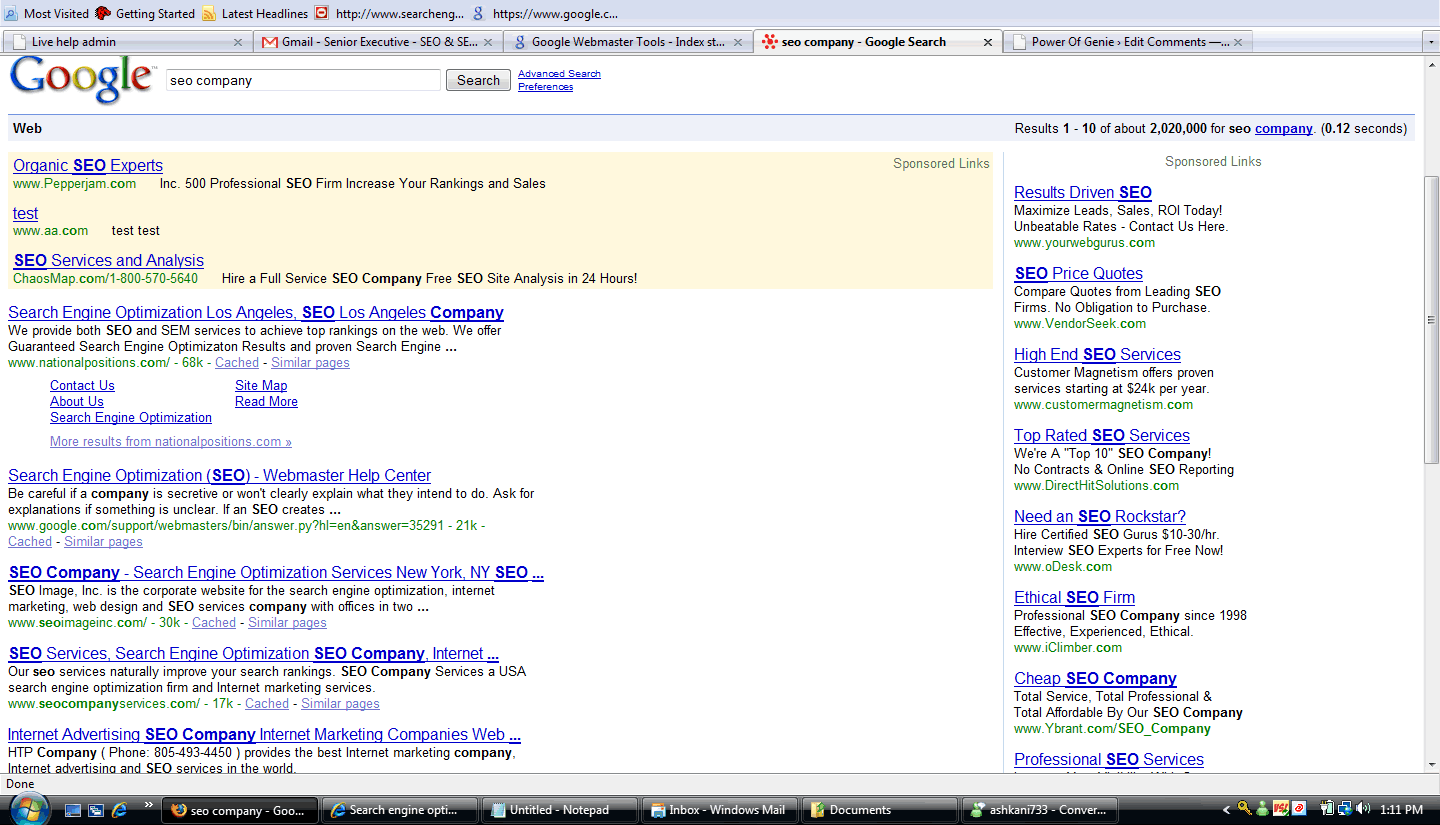
Google testing or Adwords hacked ?
When i was recently doing some queries related to our site i saw a weird adwords result right on top of the page.
2nd result from the top had something which said test and the URL as aa.com i haven’t seen this before i wonder why Google is testing on live adwords results or whether the adwords results had been hacked. When i clicked on the results it actually went to aa.com so it mostly looks like some sort of testing.
Did anyone else notice it look at this screen shot:
Apologies to our users for Badware attack on our site.
We recently had our site being attacked by a virus injection code due to the vulnerability on our server. Older version of IE was responsible for this code injection and since it happened in a weekend we were unable to fix it immediately. We got a warning note from Google but our tech guy was there to fix the site by sunday afternoon. Monday morning Google removed the warning message from its search results after we cleaned the site for potential badware and filed a review. Google was very quick to fix the results and we are very much thankful to Google.
Now we have our guys monitoring the site 24 hours a day 7 days a week for potential problems they will be able to fix it immediately if there is any sort of problem. I once again apologize to our dear website users. We get more than 10,000 users a day and if anyone’s system got affected we apologize for it and will make sure this will never happen again.
Our site is a safe site and will remain to be safe now and for ever,
Unfortunately we have the following message in Google safe browsing diagnostic. Google has all the rights to protect its users from malicious codes we will make sure this never happens with our site again.
“What is the current listing status for www.searchenginegenie.com/?
This site is not currently listed as suspicious.
What happened when Google visited this site?
Of the 105 pages we tested on the site over the past 90 days, 2 page(s) resulted in malicious software being downloaded and installed without user consent. The last time Google visited this site was on 09/14/2008, and the last time suspicious content was found on this site was on 09/13/2008.
Malicious software includes 2 exploit(s). Successful infection resulted in an average of 1 new processes on the target machine.
Malicious software is hosted on 1 domain(s), including :::::::::.com.
1 domain(s) appear to be functioning as intermediaries for distributing malware to visitors of this site, including ******.cn.
Has this site acted as an intermediary resulting in further distribution of malware?
Over the past 90 days, www.searchenginegenie.com did not appear to function as an intermediary for the infection of any sites.
Has this site hosted malware?
No, this site has not hosted malicious software over the past 90 days.
“
Duplication problem with Google – how Google handle duplicates.
Official Google webmaster central blog has an interesting post on how Google handles duplicates.
Susan of webmaster central team state:
“When we detect duplicate content, such as through variations caused by URL parameters, we group the duplicate URLs into one cluster.
We select what we think is the “best” URL to represent the cluster in search results.
We then consolidate properties of the URLs in the cluster, such as link popularity, to the representative URL.
Here’s how this could affect you as a webmaster:
In step 2, Google’s idea of what the “best” URL is might not be the same as your idea. If you want to have control over whether www.example.com/skates.asp?color=black&brand=riedell or www.example.com/skates.asp?brand=riedell&color=black gets shown in our search results, you may want to take action to mitigate your duplication. One way of letting us know which URL you prefer is by including the preferred URL in your Sitemap.
In step 3, if we aren’t able to detect all the duplicates of a particular page, we won’t be able to consolidate all of their properties. This may dilute the strength of that content’s ranking signals by splitting them across multiple URLs.
In most cases Google does a good job of handling this type of duplication. However, you may also want to consider content that’s being duplicated across domains. In particular, deciding to build a site whose purpose inherently involves content duplication is something you should think twice about if your business model is going to rely on search traffic, unless you can add a lot of additional value for users. For example, we sometimes hear from Amazon.com affiliates who are having a hard time ranking for content that originates solely from Amazon. Is this because Google wants to stop them from trying to sell Everyone Poops? No; it’s because how the heck are they going to outrank Amazon if they’re providing the exact same listing? Amazon has a lot of online business authority (most likely more than a typical Amazon affiliate site does), and the average Google search user probably wants the original information on Amazon, unless the affiliate site has added a significant amount of additional value.
Lastly, consider the effect that duplication can have on your site’s bandwidth. Duplicated content can lead to inefficient crawling: when Googlebot discovers ten URLs on your site, it has to crawl each of those URLs before it knows whether they contain the same content (and thus before we can group them as described above). The more time and resources that Googlebot spends crawling duplicate content across multiple URLs, the less time it has to get to the rest of your content.
In summary: Having duplicate content can affect your site in a variety of ways; but unless you’ve been duplicating deliberately, it’s unlikely that one of those ways will be a penalty. This means that:
You typically don’t need to submit a reconsideration request when you’re cleaning up innocently duplicated content.
If you’re a webmaster of beginner-to-intermediate savviness, you probably don’t need to put too much energy into worrying about duplicate content, since most search engines have ways of handling it.
You can help your fellow webmasters by not perpetuating the myth of duplicate content penalties! The remedies for duplicate content are entirely within your control. Here are some good places to start.
“
Yahoo search engine update – Yahoo! Search Index Update
Yahoo recently made an update to their index and ranking algorithm. We did see a lot of movement for our sites and our client sites.
As per the official yahoo search blog:
“We’ll be rolling out some changes to our crawling, indexing and ranking algorithms over the next few days and expect the update will be completed soon. As you know, throughout this process you may see some ranking changes and page shuffling in the index. “
www.ysearchblog.com/archives/000625.html
If you notice changes to your website please post in comments
How To Write Winning Meta Titles:write great titles to keep your the best converting one
How To Write Winning Meta Titles:
There are many tips to write good Meta titles. A Meta title is a title, or name of your page. The title is shown by the browser, usually at the top of your computer screen, and tells a reader what page they are on. Meta titles are “read” by search engine robots, and viewed by site visitors.
The metal title is very vital for helping the page rank high in search engine returns and should be written to cater to search engine robots – not to site visitors. Meta titles should make sense to the reader, but the wording should be related to keyword search popularity and relevance to the rest of the web page plus other meta data and content.
The four most awful mistakes you can make when creating a meta title for your page are:
Not creating any title at all;
Naming your page the identical/same names as your website;
Naming all your pages the same name, or something similar to each other; and
Naming the page without linking it to your content and other Meta data.
Be certain to use keyword selector tools and keyword density tools to help you write your Meta title.
Examples of “Bad” Meta Titles:
The following instance Meta titles are too vague and do not give either robots or site readers enough information:
Flowers
Examples of Good Meta Titles:
· Flowers – How to Plant Flowers
· Population Statistics – 2008 United Kingdom Population Statistics
· Dessert Recipes – Best pudding Recipes
· Tax Tips – tips on how to pay less amount of tax
The above Title tags accomplish three things:
· they assist robots understand what is most important about the content on the page by repeating part of the keyword phrases that would be found in article titles and content;
· They make logic to people reading them; and
· By using plurals when prudent, it allows more possible keyword searchers (both on singular and plural or major keywords).
How Long Should a Meta Title Be in Length?
Normally, a title should be long enough to be clear; short enough to avoid being “truncated.” Truncation happens when a title is very long. Search engine robots will only read so much character then move on. Different search engines read different numbers of characters but if you keep your titles less than 150 characters you will keep most vital search engine robots happy.
Tips on How to Create Meta Titles
When creating Meta titles:
Always replicate keyword phrases;
Do tie these phrases to your content and other meta data;
Do use plurals when doable;
Do bound the use of punctuation; and
Do use initial caps all through the title.
Seven Building Blocks of a Destination Website-Trust & Creditability
Seven Building Blocks of a Destination Website-Trust & Creditability:
The initial six building blocks in creating a Destination Website; proficient information, usability, website design, distinctive value proposition, time and presence, and voice are all things that we, more or less, have straight control over. The exemption is time. We don’t control time but we do control how we build up our presence over time.
Trust and credibility are also partly in our control but also two of the hardest things to attain. We find out whether we move forward in a reliable way, and whether or not to act in a plausible manner, but no matter how hard we try, we cannot wish those two things into existence. We cannot force someone else to believe us. We cannot tell someone to find us plausible and expect them to do so on our word.
We can go about doing all we can to build both trust and credibility, but, in the end, whether we are trusted or not lie not with our individual efforts but other people’s perceptions. If you spend months and years showing you can be trusted and proving that you’re plausible, but one knows or believes it to be true, then you just aren’t. These are not physical things that can be touched; they simply must be understood to be factual.
How to build trust and credibility:
Answer phone calls and return emails:
I’m astounded at how often I run across businesses that don’t do this. You would think that this is one of the fundamental no-brainers of doing business. Heck, if you can’t return a call or reply to an email, what signals are you sending to the prospective customer? First question: are you a lawful business? Second question: if I have a problem, which’s going to be there to help me out?
It’s bad enough that prospective customers call and get a voice mail during business hours. Shoddier when those calls are not returned. Rule of thumb, you have about 24 hours to reply to messages and emails before your trustworthiness is questioned. However, if you really want the customer, you should reply much faster. Twenty-four hours is a long time on the web and if you wait too long, you very soon might have lost them to a competitor.
Keep information secure:
Security is vital to conveying trust. Whether you are selling products or just capturing leads, visitors need to know that their information is going to be kept safe and it won’t be used for nefarious purposes. Using trust symbols such as Thawte, Better Business Bureau, and HackerSafe can all provide further feelings of trust. Linking to solitude and security policies from your forms can help as well.
Open communication:
Keeping communication open between you and your clients is crucial. This is more than just returning calls, but its dynamic participation. Both in meeting customer’s needs but also in foreseeing them. It means finding where your audience is and engaging with them in discussion, chat rooms, blogs and the like. Keeping communication open gives you opportunity to be truthful with your shortfalls, own up to your mistakes, and to present yourself as you truly are, a real person who cares genuinely about the needs of your audience.
Put the customer first:
We’ve all heard it said that “the consumer is always right.” Now I don’t certainly believe that’s true in all situations, but the point is, to survive in a consumer oriented business, we have to put the customer first. This means going out of your way to make certain the customer is satisfied with their purchase and transaction and if not, finding out what areas they are displeased in and provide a solution to make them satisfied.
Exceed expectations:
One of the best ways to build hope and trustworthiness is to simply exceed the expectations of your audience. This can be both easy and hard. It’s easy to find little ways to go the extra mile. To give a little extra service or extra benefit. It can be difficult, however, if you over-sell yourself. If you do that then you make it hard enough just to meet expectations. Look for opportunities to do something your clients or prospects don’t expect. Ways to prove to your customers that they are special to you.
Of course, all this isn’t just about building perceptions, but proving those perceptions to be factual. Creating a perception of trust, only to have it proven fake is far worse then never having built the aura of trust to begin with. If you fool visitors into thinking you’re plausible, they’ll soon find out you’re not. Both are difficult to rebuild than to build in the first place.
Putting them all together:
When building a Destination Website, all six other building blocks can be in place, but without this seventh one the first six are futile. Usability, voice, design, expert information, etc., all just become part of the hoax. But, if you are really building up trust that can be trusted and credibility that is credible, the first six building blocks all lend a hand to that end. They all play a role at helping to establish and prove your credibility.
Very unbeaten businesses, both on-and offline have been built on this last building block alone. In fact, only this last one is necessary for success, though all seven are essential to build a Destination Website. Like any good foundation, all seven building blocks provide support for the other six, with faith and credibility being the most vital piece of the pie.
SEO and flash never go together
We frequently deal with clients that are planning to “revamp” their sites with Flash, with SEO having already generated incredible gains in their sales. The thing that we most dread to hear is that they’ve hired a skilled “Flash designer” that will be taking their websites to the “next level.” unluckily, that “next level” is often the basement – at least in terms of SEO results.
The bottom line here is that a site built entirely in Flash still faces huge hindrances. While there have been current moves from Google and Yahoo! to try to index the content from pooled Flash/SEO sites, those moves have not yet, from my experience, translated into SEO results or success (at least when compared to html sites).
We should make a difference here between embedded Flash and sites built entirely from Flash. For instance, a site that has Flash elements but still contains basic html elements will not overly suffer, as the Flash element (usually a movie in a box on the homepage or elsewhere) is externalized. A search engine spider will generally not try to parse through any files that have been externalized in the code – they will only index the code that is readily evident on the source page.
On the other hand, from an SEO results perspective, there are still major issues with sites that are built entirely in Flash, and SEO is in general the first thing that suffers. First of all, the URL normally never changes no matter where people navigate on the site. As any well-mannered SEO practitioner will tell you, every page of your site is a potential entry page for a search engine. With a site built in Flash, SEO suffers even more as you only have one potential entry page, which is the main URL. This cuts off dozens, hundreds, or thousands of potential pages that could be indexed in Google and Yahoo! (and all other engines). When your only prospective entry page in the search engine listings is your home page, it is quite hard to target a wide assortment of key phrases, potentially eliminating SEO results or rankings.
Content is another very big issue. Search engines rank pages based upon a number of criteria, but one of the most significant to SEO results is the text that they can “understand” on individual pages. At present, search engines read first and foremost html text (although some also read text in the PDF format) – which means that if you decide that you want to use a uncommon and fancy font that must be displayed in graphic form the engine will not read the text and therefore will not know what the page is about, which could harm SEO results. Naturally, this also includes any of the text included in Flash. While Yahoo! and Google have just announced improved capabilities in reading content within Flash, I have not personally seen that translate into great SEO results for competitive key phrases.
One other emerging feature is that as search evolves, more and more people are looking for information while they are away from their computers. Many mobile devices are currently inept of displaying Flash content, although recent moves by Adobe to make “Flash Lite” available may change this. However, it remains to be seen whether people that are seeking information on a mobile device will even want to find the way through Flash, especially if they can get the information that they seek from a fast-loading html page. In my view, lean html content will be at a premium when a company is trying to target a mobile audience.
In spite of the difficulties, it is not the intent of this article to declare that Flash and SEO will always be incompatible – merely that it is the state of the current situation. You can find many differing opinions on mixing Flash and SEO on the internet, but the true test is to try to find a Flash site (that is to say, a site built entirely in Flash) that you esteem and see if it ranks well in SEO results for 50+ competitive terms that are associated to the specific business (in Google or Yahoo!). In my experience, such sites that combine Flash and SEO are nearly not possible to find.
Flash can be, and repeatedly is, used for great effect on the internet, in interactive kiosks, and in further applications. I’m not from the “any Flash is bad” school, although I do think that many Flash practitioners tend to get a little carried away and often disregard basic usability issues. However, sites built entirely in Flash with SEO elements are still, again in my opinion, like oil and water – Flash and SEO are evidently alone useful, but they don’t mix well. Until they do, I will continue to advise my clients not to build sites completely out of Flash – or, at the very least, to have an alternate html option for search engine and user preference purposes. At the end of the day, many clients are astonished to find out how many visitors actually prefer “old school” html.
Blogroll
Categories
- AI Search & SEO
- author rank
- Authority Trust
- Bing search engine
- blogger
- CDN & Caching.
- Content Strategy
- Core Web Vitals
- Experience SEO
- Fake popularity
- gbp-optimization
- Google Adsense
- Google Business Profile Optimization
- google fault
- google impact
- google Investigation
- google knowledge
- Google panda
- Google penguin
- Google Plus
- Google Search Console
- Google Search Updates
- Google webmaster tools
- google-business-profile
- google-maps-ranking
- Hummingbird algorithm
- infographics
- link building
- Local SEO
- local-seo
- Mattcutts Video Transcript
- Microsoft
- Mobile Performance Optimization
- Mobile SEO
- MSN Live Search
- Negative SEO
- On-Page SEO
- Page Speed Optimization
- pagerank
- Paid links
- Panda and penguin timeline
- Panda Update
- Panda Update #22
- Panda Update 25
- Panda update releases 2012
- Penguin Update
- Performance Optimization
- Sandbox Tool
- search engines
- SEO
- SEO Audits
- SEO Audits & Monitoring
- SEO cartoons comics
- seo predictions
- SEO Recovery & Fixes
- SEO Reporting & Analytics
- seo techniques
- SEO Tips & Strategies
- SEO tools
- SEO Trends 2013
- seo updates
- Server Optimization
- Small Business Marketing
- social bookmarking
- Social Media
- SOPA Act
- Spam
- Technical SEO
- Uncategorized
- User Experience (UX)
- Webmaster News
- website
- Website Security
- Website Speed Optimization
- Yahoo