Google doesn’t always display the exact title you set in HTML or your SEO plugin. Sometimes it rewrites your title in search results to better match what the user searched, to make the snippet clearer, or to remove duplication and keyword stuffing. This post is for business owners, bloggers, and local service companies who want higher clicks (CTR) and more leads from Google-especially if your titles are getting changed in search and your rankings or traffic feel “stuck.” If you’re seeing a different title on Google than the one you wrote, don’t panic-understanding how Google chooses titles helps you fix the cause and regain control.
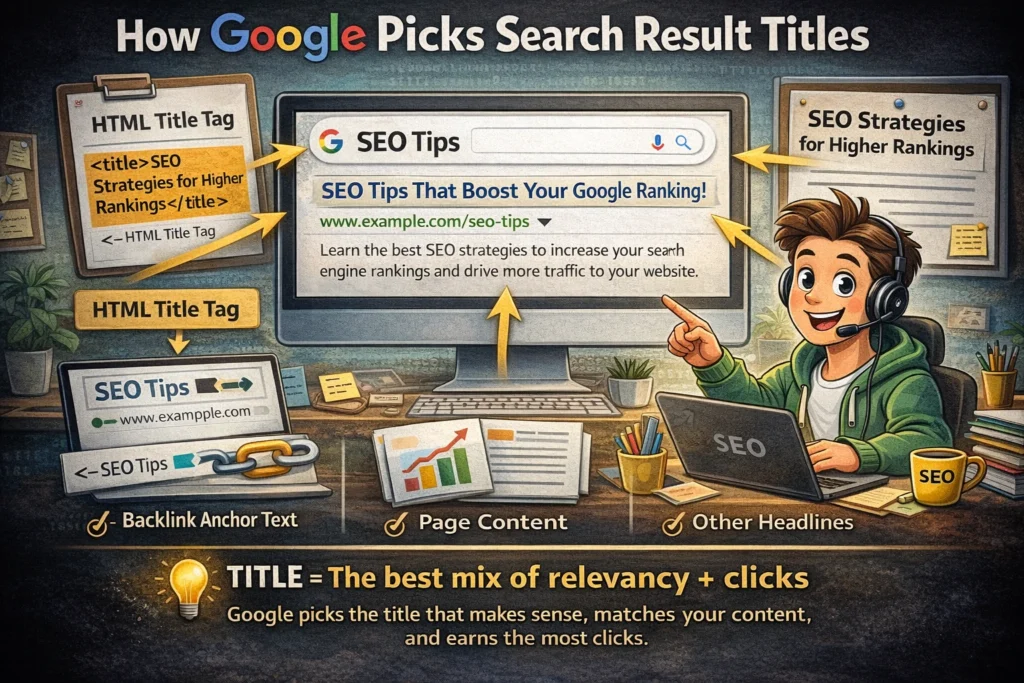
First, Google usually starts with your HTML title tag (the title you set in RankMath/Yoast or inside your page settings). This is still the most important “title source,” but it works best when it’s clean and accurate. If your title is too long, stuffed with keywords, or doesn’t match the page content, Google may rewrite it using other on-page signals. A strong title tag is simple: keep it around 50-60 characters, put the main keyword near the front, add a clear benefit, and avoid repeating the same words or city names. For local pages, use a natural format like “SEO Services in Dubai – More Leads & Rankings | Search Engine Genie” instead of “SEO Dubai, SEO Company Dubai, Best SEO Dubai, Dubai SEO Agency.”
Next, Google looks at your on-page headings, especially the H1 (your main page heading) and important H2/H3 subheadings. If your H1 is clearer than your title tag-or if your title tag looks templated across many pages-Google may pull your H1 as the search title. That’s why your title tag and H1 should match in meaning even if the wording is slightly different. Your headings should also be easy to skim: use short sections, bullet points, and “quick answer” style lines so Google and users understand the page fast. A good structure includes what you offer, who it’s for, what’s included, service areas, and proof (case studies, testimonials, results).
Google also uses page content and the search query itself to decide what title best fits. If someone searches “local SEO audit for car rental company” but your title is generic like “Home” or “Services,” Google might replace it with a line from your content that better matches the query. To reduce rewrites, keep the page focused on one main intent, mention your primary keyword naturally in the first 100 words, and support it with related phrases. For example, target one main keyword like “SEO Services for Car Rental Companies” and support it with phrases like “increase car rental bookings,” “local SEO,” “Google Maps ranking,” and “airport car rental keywords.”
Another influence many people miss is backlink anchor text-the words other websites use when linking to your page. If multiple sites link using a phrase like “car rental SEO agency,” Google may treat that as a clue about your page topic and sometimes reflect that language in your snippet title. This is one reason why quality links matter beyond ranking alone: they also shape how Google interprets your content. A smart local angle is to strengthen relevance through your Google Business Profile (GBP) and Google Maps signals. If you serve multiple cities, build location pages (example: “SEO Services in Dubai,” “SEO Services in Sharjah”) and connect them with GBP services, posts, and consistent NAP citations-this improves both map visibility and organic click-through.
Now for the “do this next” part: audit your top pages where Google rewrites titles, then align your title tag + H1 + page intro so they all communicate the same promise. Add one supportive image or screenshot (your title tag settings in WordPress, plus a “before/after” search snippet example), compress images to WebP to keep the page fast, and internally link to your key services like GBP optimization, SEO services, Core Web Vitals/PageSpeed optimization, and security audits. If you want, send your website URL and your target city, and I’ll suggest optimized title tags and H1s that are more likely to stick in Google and drive more clicks.
Tags: google-title-rewrite, meta-title, serp-optimization, title-tag
When it comes to SEO best practices, even the smallest details matter—especially how you structure your URLs. For years, SEOs have debated whether underscores (_) or hyphens (-) are better, and while Google has clarified this multiple times, confusion still remains. The truth is your URL is more than just an address; it acts as a signal for users and search engines. Clean, descriptive URLs can improve click-through rates, help search engines understand what a page is about, and create a better user experience. For example, a URL like (www.example.com/seo-tips-for-beginners) is clearer and more readable than something messy like (www.example.com/seotipsforbeginners123), which is where the hyphen vs underscore discussion becomes important.
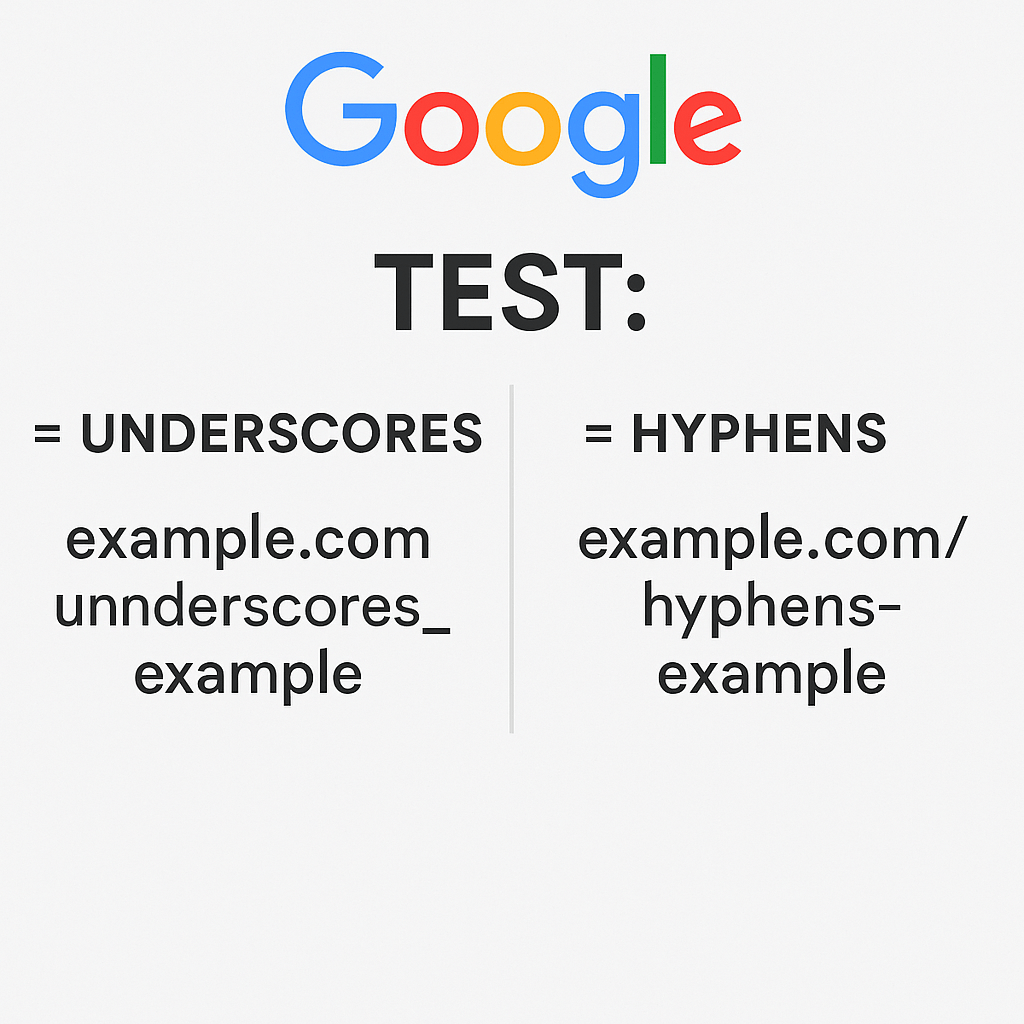
Google’s official position is straightforward: hyphens are treated as word separators, while underscores are treated as word joiners. In practical terms, best-seo-tools is understood as “best seo tools,” but best_seo_tools may be read as “bestseotools” as if it’s one combined word. That’s why hyphens are considered more SEO-friendly—they make it easier for Google to parse a URL into meaningful words. Even though modern search engines have improved and can often interpret both formats, Google still recommends hyphens because they improve readability, provide clearer keyword separation, and reduce ambiguity that underscores can sometimes create.
If you want your URLs to perform well in 2025, the best approach is to keep them short, descriptive, and easy to read, while using hyphens as your default separator. Avoid unnecessary numbers, extra words, or messy parameters, stick to lowercase letters, and don’t change old URLs unless it’s absolutely necessary—if you do, use proper redirects. A simple comparison makes the point clear: www.example.com/mens-suits-charcoal-grey is more readable and keyword-friendly than www.example.com/mens_suits_charcoal_grey. Both can rank, but the hyphen version is typically clearer for users and search engines, which can help improve CTR and overall SEO performance.
We are all familiar with Google’s dominance in the search engine landscape, holding approximately 80% of all organic searches. This makes it convenient for search engine optimization (SEO) specialists to primarily focus on optimizing for Google. However, changes are on the horizon, with Yahoo! transitioning to Inktomi results and potentially incorporating AltaVista results. MSN is also becoming a more significant player as Microsoft invests heavily in developing its own search engine.

The technology behind Ask Jeeves, is gaining attention, and FastSearch, which powers AllTheWeb and Lycos, is another contender. As these alternatives gain traction, Google’s market share is expected to decline. With Yahoo! shifting to new organic results, I anticipate Google’s market share to reduce significantly. MSN, Teoma, and FastSearch are likely to impact Google’s standing, with searchers becoming more aware of the available options.
Based on these considerations, my prediction for Google’s market share by Q1 of 2005 is around 30%, assuming AOL and Netscape continue to use Google. Yahoo! is expected to hold about 30%, MSN 25%, and the remaining share distributed among other search engines. These are personal predictions and opinions, not guaranteed outcomes. Comments and discussions are welcome.
Back in 2005, the internet was booming, search engines were battling for market share, and yet one company stood tall above the rest: Google. With its clean interface, fast results, and innovative ranking algorithms, Google quickly became the world’s dominant search engine, leaving rivals like Yahoo, MSN, and AOL struggling to keep up.
1. Google’s Market Share in 2005
By 2005, Google had already established itself as the go-to search engine, capturing more than 50% of U.S. search traffic. Its competitors lagged far behind:
This dominance was the result of Google’s relentless focus on speed, relevance, and simplicity.
2. Why Google Maintained Its Lead
Several factors contributed to Google’s continued rise in 2005:
Superior search algorithms: Google’s PageRank technology delivered more accurate results.
Minimalist design: While rivals cluttered their homepages with ads, Google kept it clean.
Innovation: Launches like Google Maps, Gmail (beta), and Google Earth made the ecosystem stickier.
Global reach: Expanding to multiple languages cemented Google’s worldwide footprint.
3. Competitors Struggle to Catch Up
Despite massive budgets, Yahoo, MSN, and AOL couldn’t match Google’s user trust and brand strength. Their search engines lacked the same accuracy and speed, causing many users to switch to Google permanently.
4. The Legacy of 2005
Google’s dominance in 2005 set the stage for its future empire. Today, with products spanning from Android to AI-powered search assistants, it’s clear that Google’s early victory was a turning point in the digital age.
In 2005, Google didn’t just compete — it defined the future of search. By focusing on users first, Google secured a dominance that shaped the internet as we know it today.