




Google 3rd quarter results summary,
GOOGLE ANNOUNCES THIRD QUARTER 2008 RESULTS
MOUNTAIN VIEW, Calif. – October 16, 2008 – Google Inc. (NASDAQ: GOOG) today announced financial results for the quarter ended September 30, 2008.
“We had a good third quarter with strong traffic and revenue growth across all of our major geographies thanks to the underlying strength of our core search and ads business. The measurability and ROI of search-based advertising remain key assets for Google,” said Eric Schmidt, CEO of Google. “While we are realistic about the poor state of the global economy, we will continue to manage Google for the long term, driving improvements to search and ads, while also investing in future growth areas such as enterprise, mobile, and display.”Q3 Financial Summary Google reported revenues of $5.54 billion for the quarter ended September 30, 2008, an increase of 31% compared to the third quarter of 2007 and an increase of 3% compared to the second quarter of 2008. Google reports its revenues, consistent with GAAP, on a gross basis without deducting traffic acquisition costs (TAC). In the third quarter of 2008, TAC totaled $1.50 billion, or 28% of advertising revenues.
Google reports operating income, net income, and earnings per share (EPS) on a GAAP and non-GAAP basis. The non-GAAP measures, as well as free cash flow, an alternative non-GAAP measure of liquidity, are described below and are reconciled to the corresponding GAAP measures in the accompanying financial tables.
GAAP operating income for the third quarter of 2008 was $1.74 billion, or 31% of revenues. This compares to GAAP operating income of $1.58 billion, or 29% of revenues, in the second quarter of 2008. Non-GAAP operating income in the third quarter of 2008 was $2.02 billion, or 37% of revenues. This compares to non-GAAP operating income of $1.85 billion, or 34% of revenues, in the second quarter of 2008.
GAAP net income for the third quarter of 2008 was $1.35 billion as compared to $1.25 billion in the second quarter of 2008. Non-GAAP net income in the third quarter of 2008 was $1.56 billion, compared to $1.47 billion in the second quarter of 2008.
GAAP EPS for the third quarter of 2008 was $4.24 on 318 million diluted shares outstanding, compared to $3.92 for the second quarter of 2008 on 318 million diluted shares outstanding. Non-GAAP EPS in the third quarter of 2008 was $4.92, compared to $4.63 in the second quarter of 2008.
Non-GAAP operating income, non-GAAP operating margin, non-GAAP net income, and non-GAAP EPS are computed net of stock-based compensation (SBC). In the third quarter of 2008, the charge related to SBC was $280 million as compared to $273 million in the second quarter of 2008. Tax benefits related to SBC have also been excluded from non-GAAP net income and non-GAAP EPS. The tax benefit related to SBC was $63 million in the third quarter of 2008 and $48 million in the second quarter of 2008. Reconciliations of non-GAAP measures to GAAP operating income, operating margin, net income, and EPS are included at the end of this release.
"Results 1 to 35 of about 4" – what causes it ?
Interesting post by a senior member in webmaster world
“Two days ago a new CMS went live that replaces an old one that had loads of canonical problems. Some content pages had upwards of 4 or 8 different URLs indexed, and some content pages could be returned for a near infinite number of different URLs.
The old CMS used horrible dynamic parameter-driven URLs and the new one uses short folder-like URL formats, and *all* canonicalization factors have been taken into account.
There are a lots of sites to be moved over to the new CMS, but we started with the smallest — so small that it doesn’t really need a CMS (except that using the CMS has made it very easy for the owner to keep it updated).
The site was already fully indexed, and some content pages show under multiple URLs, because basic non-www to www canonicalisation and so on was only added a few months ago. Many of the really old non-canonical URLs are also still listed.
Now that the new CMS has been installed, and the old content reinstated, most of the old URLs in the SERPs (actually all except domain root) are now 301 redirects (from long and horrible dynamic, to short folder-look alike URLs).
Last night Google reported “1 to 35 of about 8” for a site:domain.com search.
Today it shows “1 to 35 of 4”. None of the new URLs are showing up yet (I expect they will in the next 24 to 36 hours).
So, their internal system “knows” that most of the URLs they already had are now redirects, and it seems that those URLs aren’t now included as a part of the “site count” (the “of nnn” number).
I would guess that the URLs that now redirect are already moved over to Supplemental.
Hence… “1 to 35” – what we are showing you “of 4” – how many URLs that we think are “real” (200 OK).
Now I understand a bit more, I think.
I would expect the new URLs for content to start appearing tomorrow, or soon after. “
Vulnerable sites Alert letter from Google now shown in Google webmaster tools
Google now shows security hole / vulnerable site warning mails in webmaster blog itself.
According to webmaster blog:
Recently we’ve seen more websites get hacked because of various security holes. In order to help webmasters with this issue, we plan to run a test that will alert some webmasters if their content management system (CMS) or publishing platform looks like it might have a security hole or be hackable. This is a test, so we’re starting out by alerting five to six thousand webmasters. We will be leaving messages for owners of potentially vulnerable sites in the Google Message Center that we provide as a free service as part of Webmaster Tools. If you manage a website but haven’t signed up for Webmaster Tools, don’t worry. The messages will be saved and if you sign up later on, you’ll still be able to access any messages that Google has left for your site.
One of the most popular pieces of software on the web is WordPress, so we’re starting our test with a specific version (2.1.1) that is known to be vulnerable to exploits. If the test goes well, we may expand these messages to include other types of software on the web. The message that a webmaster will see in their Message Center if they run WordPress 2.1.1 will look like this:
Quick note from Matt: In general, it’s a good idea to make sure that your webserver’s software is up-to-date. For example, the current version of WordPress is 2.6.2; not only is that version more secure than previous versions, but it will also alert you when a new version of WordPress is available for downloading. If you run an older version of WordPress, I highly encourage you to upgrade to the latest version.
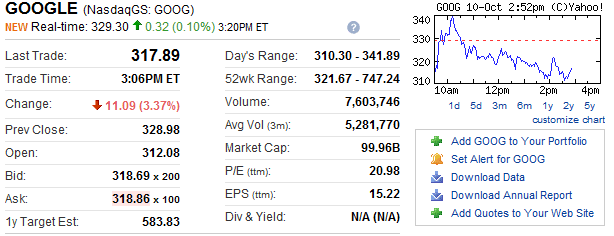
Google value tumbles on US financial crisis
What google uses to crawl websites – Is it something similar to chrome
Is Google using chrome to crawl websites?
An interesting thread in Webmasterworld.com :
webmasterworld.com/google/3760236.htm
Thought i would drop in to report a very interesting Google activity I’ve been observing today.
I have an “who’s online” script running and reporting visitors in real time as they browse the site. The script uses javascript to report referrer and currently viewed page.
One of the visitors today was from 66.249.72.180 [google.com] sucking approx 200 pages in a 15-20 minutes frame and invoking the on page tracking javascript….sending referring page and current URL information (it had to invoke javascript just like a browser would to do that). In other words acting very much like it is a full on browser.
Maybe it is already old news to some, maybe i missed previous topics discussing this. Anyway, it is the first time i see this thing in real time. Very interesting crawl development.
Anyone else noticed this ?
P.S. Page to page browsing was occuring at a very fast rate, could not be human.
Google to Announce Third Quarter 2008 Financial Results
MOUNTAIN VIEW, Calif (October 6, 2008) — Google Inc. (NASDAQ: GOOG) today announced that it will hold its quarterly conference call to discuss third quarter 2008 financial results on Thursday, October 16, 2008 at 1:30 p.m. Pacific Time (4:30 p.m. Eastern Time).
The live webcast of Google’s earnings conference call can be accessed at investor.google.com/webcast. The webcast version of the conference call will be available through the same link following the conference call.
Google blog search gets a new look
Google blogsearch a search engine which monitors blogs now gets a new look,
According to Google official blog
“Did you know that millions of bloggers around the world write new posts each week? If you’re like me, you probably read only a tiny fraction of these in Google Reader. What’s everybody else writing about? Our Blog Search team thought this was an interesting enough question to look into. What we found was a massive mix: entertaining items about celebrities, personal perspectives on political figures, cutting-edge (and sometimes unverified) news stories, and a range of niche topics often ignored by the mainstream media. Today, we’re pleased to launch a new homepage for Google Blog Search so that you too can browse and discover the most interesting stories in the blogosphere. Adapting some of the technology pioneered by Google News, we’re now showing categories on the left side of the website and organizing the blog posts within those categories into clusters, which are groupings of posts about the same story or event. Grouping them in clusters lets you see the best posts on a story or get a variety of perspectives. When you look within a cluster, you’ll find a collection of the most interesting and recent posts on the topic, along with a timeline graph that shows you how the story is gaining momentum in the blogosphere. In this example, the green “64 blogs” link takes you inside the cluster and shows you all the blog posts for a story. We’ve had a great time building the new homepage and we hope you enjoy using it. “
trust and authority two different things in search engines.
A webmaster world thread analyzes the difference between trust and authority in Google. Its a good thread to discuss please join here www.webmasterworld.com/google/3753332.htm
“While studying Google’s recently granted [url=http://patft.uspto.gov/netacgi/nph-Parser?Sect1=PTO2&Sect2=HITOFF&u=%2Fnetahtml%2FPTO%2Fsearch-adv.htm&r=1&p=1&f=G&l=50&d=PTXT&S1=7,346,839.PN.&OS=pn/7,346,839&RS=PN/7,346,839]Historical Data patent[/url], I noticed that the language helps to separate two concepts that we tend to use casually at times: trust and authority.
…links may be weighted based on how much the documents containing the links are trusted (e.g., government documents can be given high trust). Links may also, or alternatively, be weighted based on how authoritative the documents containing the links are (e.g., authoritative documents may be determined in a manner similar to that described in [url=http://patft.uspto.gov/netacgi/nph-Parser?Sect1=PTO2&Sect2=HITOFF&u=%2Fnetahtml%2FPTO%2Fsearch-adv.htm&r=1&p=1&f=G&l=50&d=PTXT&S1=6,285,999.PN.&OS=pn/6,285,999&RS=PN/6,285,999]U.S. Pat. No. 6,285,999)[/url].
Clearly, Google has two different metrics going on. As you can see from the reference to Larry Page’s original patent, authority in Google’s terminology comes from backlinks. When lots of other websites link to your website, you become more and more of an authority.
But that isn’t to say you’ve got trust. So what exactly is trust? Here’s an interesting section from the same patent:
…search engine 125 may monitor one or a combination of the following factors: (1) the extent to and rate at which advertisements are presented or updated by a given document over time; (2) the quality of the advertisers (e.g., a document whose advertisements refer/link to documents known to search engine 125 over time to have relatively high traffic and trust, such as amazon.com, may be given relatively more weight than those documents whose advertisements refer to low traffic/untrustworthy documents, such as a pornographic site);
So we’ve got two references here, government documents and high traffic! From other reading, I’m pretty sure that trust calculations work like this – at least in part. Google starts with a hand picked “seed list” of trusted domains. Then trust calculations can be made that flow from those domains through their links.
If a website has a direct link from a trust-seed document, that’s the next best situation to being chosen as a seed document. Lots of trust flows from that link.
If a document is two clicks away from a seed document, that’s pretty good and a decent amount of trust flows through – and so on. This is the essence of “trustrank” – a concept described in [url=http://dbpubs.stanford.edu:8090/pub/2004-17]this paper by Stanford University and three Yahoo researchers[/url].
This approach to calculating trust has been refined by the original authors to include “negative seeds” – that is, sites that are known to exist for spamming purposes. The measurements are intended to identify artifically inflated PageRank scores. See this pdf document from Stanford: [url=http://dbpubs.stanford.edu:8090/pub/showDoc.Fulltext?lang=en&doc=2005-33&format=pdf&compression=&name=2005-33.pdf]Link Spam Detection[/url]
To what degree Google follows this exact approach for calculating trust is unknown, but it’s a good bet that they share the same basic ideas. “
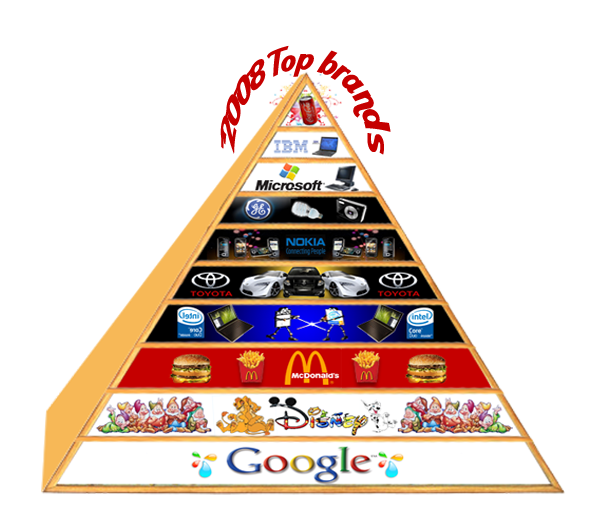
Top 10 brand pyramid – 2008 top brands
How google evaluates search – Google engineer talks
How google evaluates search:
Scott of Google has given a good insight of how Google evaluates search results: Look at this to get a good idea on how Google handles search evaluation:
“Evaluating search is difficult for several reasons.
- First, understanding what a user really wants when they type a query — the query’s “intent” — can be very difficult. For highly navigational queries like [ebay] or [orbitz], we can guess that most users want to navigate to the respective sites. But how about [olympics]? Does the user want news, medal counts from the recent Beijing games, the IOC’s homepage, historical information about the games, … ? This same exact question, of course, is faced by our ranking and search UI teams. Evaluation is the other side of that coin.
- Second, comparing the quality of search engines (whether Google versus our competitors, Google versus Google a month ago, or Google versus Google plus the “letter T” hack) is never black and white. It’s essentially impossible to make a change that is 100% positive in all situations; with any algorithmic change you make to search, many searches will get better and some will get worse.
- Third, there are several dimensions to “good” results. Traditional search evaluation has focused on the relevance of the results, and of course that is our highest priority as well. But today’s search-engine users expect more than just relevance. Are the results fresh and timely? Are they from authoritative sources? Are they comprehensive? Are they free of spam? Are their titles and snippets descriptive enough? Do they include additional UI elements a user might find helpful for the query (maps, images, query suggestions, etc.)? Our evaluations attempt to cover each of these dimensions where appropriate.
- Fourth, evaluating Google search quality requires covering an enormous breadth. We cover over a hundred locales (country/language pairs) with in-depth evaluation. Beyond locales, we support search quality teams working on many different kinds of queries and features. For example, we explicitly measure the quality of Google’s spelling suggestions, universal search results, image and video searches, related query suggestions, stock oneboxes, and many, many more.”
Source: Google Blog: http://googleblog.blogspot.com/2008/09/search-evaluation-at-google.html
Blogroll
Categories
- 2016 SEO trends predictions
- AI for eCommerce
- AI Search & SEO
- author rank
- Authority Trust
- Bing search engine
- blogger
- CDN & Caching.
- Content Strategy
- Core Web Vitals
- eCommerce Growth
- Experience SEO
- Fake popularity
- gbp-optimization
- Google Adsense
- Google Business Profile Optimization
- google fault
- google impact
- google Investigation
- google knowledge
- Google panda
- Google penguin
- Google Plus
- Google Search Console
- Google Search Updates
- Google webmaster tools
- google-business-profile
- google-maps-ranking
- Hummingbird algorithm
- infographics
- link building
- Local SEO
- local-seo
- Mattcutts Video Transcript
- Microsoft
- Mobile Performance Optimization
- Mobile SEO
- MSN Live Search
- Negative SEO
- On-Page SEO
- Page Speed Optimization
- pagerank
- Paid links
- Panda and penguin timeline
- Panda Update
- Panda Update #22
- Panda Update 25
- Panda update releases 2012
- Penguin Update
- Performance Optimization
- Sandbox Tool
- search engines
- SEO
- SEO Audits
- SEO Audits & Monitoring
- SEO cartoons comics
- seo predictions
- SEO Recovery & Fixes
- SEO Reporting & Analytics
- seo techniques
- SEO Tips & Strategies
- SEO tools
- SEO Trends 2013
- seo updates
- Server Optimization
- Shopify Optimization
- Shopify SEO
- Shopify Services
- Small Business Marketing
- social bookmarking
- Social Media
- SOPA Act
- Spam
- Technical SEO
- Uncategorized
- User Experience (UX)
- Webmaster News
- website
- Website Security
- Website Speed Optimization
- Yahoo