




What determines a website size?
Particularly in SEO industry we are used to calling small, medium sized, large and extra large websites. So what determines the size. Well size is a relative word in our industry. It’s important we know the size before quoting for SEO work or starting work on the site.
Small sized sites: Most of the small Business sites that come to us a small. People think just putting one website online is enough to be on top of search engines. Fact its not enough we need to have a quality site to be on top. We say a site is small when it is built completely in flash, or html sites with only 10 to 20 pages ( without any database / products ) , just pages with contact and few other pages, sites that have products but very few like 10 or 20 etc. If sites like these come to us we tell our clients to add blogs, articles, news and all other possible information that helps SEO and helps expand the size of the site.
Medium sized website: Medium sized website sites that has decent amount of pages with articles, good well written information pages, at-least 50 products etc. Medium sized websites are ideal for targeting regional and low competitive keywords. So we prefer to take medium sized sites for SEO for low competitive keywords. To be eligible to be medium sized you can say the site should have at least search engine crawl able pages. We don’t consider flash sites as medium sized even if it has 500 pages embedded into flash. It’s because flash are still not efficiently crawled and it’s difficult for us to optimize a flash website.
Large websites: Large websites are mostly product based websites. We get lots of websites that are product driven for optimization. Some sites have up to 10,000 products. It can range from costumes, cosmetics, tools etc. In rare cases we get large websites that are not product based but still have 1000s of pages. These websites have good contents already and it’s easier to optimize. A large website is mostly database driven and it’s eligible to be called large only if it has 1000s of search engine index-able pages.
Very large websites: These websites are rare but lots of them exist we rarely take these sites for SEO because it contains more than 100,000 products and it’s not easy to optimize these sites. We had a client in medicine industry that had more than 150,000 pages. Optimization was never easy because it’s difficult to funnel PageRank and backlink power to all those pages.
So as you can see from my explanation size is a more relative word. Online marketing industry is the most concerned when it comes to size. We take size seriously. www replica watch shop com tag heuer replica replica watches for men omega replica breitling copy
Is Google penetrating our secret lives?
Many of us are not aware how much we get addicted to Google and its products. I personally use Google search, Gmail, Google reader for reading my favorite blogs, Google images, Product search, Google Maps and much more Google products. Virtually you can say most of my internet experience in around Google search engine. It’s not just because I am Google addict. It’s also because SEO is my lively hood. I spend most of my time in internet and Google.
But doing all these most of us forget, Google is tracking every activity of us using cookies and other technologies. So more we use Google and its products more our privacy is invaded. I suspect a big YES. We all know Google needs to collect information from its visitors to keep its search engine going efficiently, if any of our sites use Google analytics it’s important they track down every detail possible for their Analytics users. Similarly every product has a catch for itself. Google has a reason always to spy on us for each of its products. So is this something to worry about? If someone is spying on you will be happy to let it go? Don’t you think you will get disturbed it’s true that more you use Google products more they spy at you? But it’s their duty you cannot blame them but you need to be aware that Google knows what you are doing.
The most penetrating and efficient Google spy tool is the Google Pagerank display on the Google toolbar. If you enable PageRank display on Google toolbar for each and every web page or website you visit the toolbar needs to query the Google datacenter to get its PageRank. So Google knows each and every page you are visiting. Most of us who are aware of this either turn of the PageRank display or turn off the Toolbar itself when we are surfing for personal or sensitive information. Its not just me who is concerned on Google’s penetration there are lots of discussion on blogs and forums about this issue. Most of the people conclude by saying if you are worried about privacy don’t use products that invade your privacy. That is the reason many corporate don’t allow emails like Gmail, Yahoo Mail, Hotmail etc. Only corporate emails are allowed to be used. Some companies even ban search engine usage to protect privacy. I recently came across an interesting theory in a forum on Google’s privacy invasion. A user posts
“Google’s Algorithm has changed to the point where it now tracks every user by IP address, so for example if you are searching for a specific search term or browsing a website running AdSense ads, then it will log the sites you visit or terms you search for and display matching ads to you regardless of what website you visit. I think this is one of the reasons why people often see irrelevant ads on their websites. Google is refining their technique and logging all of our activity individually. I also believe Google has a way of rating the relevance of each users visit, for example Google might pay AdSense account holders for clicks based on criteria around the kinds of sites a person visits prior to arriving at their site.
I will provide a better example; A person that visits Gamespot.com and then clicks on a link to Netflix from Gamespot might result in a publisher earning .10-.20 cents for that click, however a person that has visited moviereviews.com and then went to Gamespot and then clicked the Netflix link might result in a publisher earning .20-.30 cents for the click since the chance of an actual sale is increased. “
Even he agrees it’s just a theory but it looks dangerous and little bit possible. Also you should look at the most interesting Google flu trends search.
http://www.google.org/flutrends/
Here Google will show the spread of flu in certain parts of the world monitoring the searches arising from those places for flu related keywords. This is one example what Google can do with the data it collects I am sure we can see something similar to this a lot in future.
What I am telling Google users is that be aware that you are being monitored for everything you do in Google. Even if you don’t have cookie enabled still there are lots of ways Google will collect your data. What is important is the awareness that’s required when using internet and Google.
Good Luck.
MSN Vs Yahoo search engine.
We always had the habit of debating Google and Yahoo for a change now let us debate between Yahoo and MSN or Yahoo vs. the new Microsoft Bing Search engine.
Primarily most of us will just conclude Yahoo is the much better compared to MSN. In most cases I agree with that when you see the below image from hit link it shows a clear trend where yahoo is well ahead than MSN.
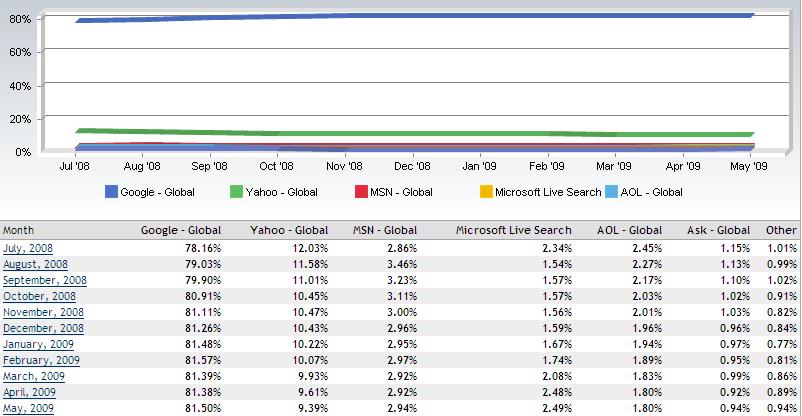
Yahoo was once very dominant and was getting about 30% of search engine traffic. But as Google grew it made it very dominant and much stronger in some places in US market share of Google is well above 90%. 3 years back Yahoo results were powered by Google so virtually Yahoo’s market share is Google’s market share. Now they are an independent search engine and they power a lot of search engines. So I am sure Yahoo is a search engine here to stay.
As a SEO company we monitor a lot of logs of our clients. In most cases we see consistent performances from Yahoo when rankings are similar in all top 3 search engines. So I see no point in comparing who is better Yahoo or MSN. But wait it’s not all over. After years of being an underdog Microsoft cant anymore to get back their search engine market share. They came down with a bang with the search engine called Bing. So did Bing work indeed yes? They excess advertising of Bing and the improved quality of results made Bing instant famous and already a hit. Bing as far as I tested has much better quality results than the MSN live search and MSN Global search. I am sure Bing is here to stay we need to see few more months whether they can steal any percentage of Market share from Google. It’s just 15 days from launch and too early to say whether they will be dominant. But there are early signs it will be a success story.
Wall street Journal reports
“The number of times people clicked on ads listed next to Microsoft Corp. (MSFT) search results jumped about 8% in the week since the software giant released its newly revamped search engine, dubbed Bing, the world’s largest search engine marketing firm said Thursday.”
http://online.wsj.com/article/BT-CO-20090611-716373.html
Bloomberg reports
“Microsoft’s share rose to 11.1 percent in the June 2-6 period, Bing’s first week in operation, from 9.1 percent a week prior, ComScore said on its Web site. Average daily penetration among searchers, a measure of how many people are being reached by the product, rose to 15.5 percent from 13.8 percent.”
http://www.bloomberg.com/apps/news?pid=20601103&sid=a0xxEn3GGCd0
We never know what the future holds for search engines. I am sure there will be some real tough competitors for Google.
Can rel="canonical" index my hostname and not my IP address?
a small question from sweden, anders ask-
will the new canonical tag help with issues where you by accident (stupid editors linking to wrong addresses) have indexed sites by the IP address rather than hostname?
I had the double check that there is the certain things you would like to be able to do it , you would like to take your IP address and put that in to the hostname. neither i am thinking allowed, we make the IP address different from the host name so we have the confirment but we dont think it would hurt to go ahead and have that. And i think that there is certain things when you dont want your IP address to show up, you want your host or domain name to show up instead. So i think that would be a nice thing to do, i m not sure whether we supported
Should I use underscores or hyphens in URLs?
Should I use underscores or hyphens in URLs?
question from tripstar, ontario canada –
underscores vs hyphens in URLS, does it make a difference? my-page vs. my_page?
it doe make a difference, i would go with dashes or hyphens if you can, if you have underscores an things are working fine for you.—- using an underscore is a separate and reason y we typically never talk about the stuff in future is that it gives us the freedom to change your mind infact the people who work in there project worked on a something slightly different for scoring in the URL that has high impact in the much higher event. we might still get reminder for thanks for paying as it focus on the quality trh team hey can we take a fresh look at this. but for time being dashes and hyphens are treated as separate from underscores. that might change in the future but that the way it is now.
Yahoo June 2009 search engine ranking update:
Yahoo updated its search engine index on 2nd of June. I can see a lot of shuffling happening most of our rankings got boosted. This is the 1st update in June 2009 I am happy to see yahoo keeping upto expectations.
Bing replaces Microsoft Live search:
At last Microsoft has come up with a search engine which I feel can be a serious competitor for Google. Results are just amazing from the past 6 years I am with search engines this is the first time MSN has come up with somewhat clean results. It just looks amazing I really appreciate Microsoft for bringing this product.
I just some searches for our websites as well as our client websites and almost all of them are doing well and the results are very similar to Google. There are some areas that needs to be cleaned especially the geo-targeting is too uneasy. I can see a lot of .au domains poping up when I search from India. This is natural when geo targeting exists and I see it visibly. Overall results are far better than MSN live results and I am sure there is some future for Bing search engine. I can see there might be some bugs in search results but its perfectly acceptable since the search engine is very new. Google was terrible when it came out especially with all the spammers ready to exploit Google was bad when it came out but it improved and proved to be a really worthy search engine today. I am sure Bing will one day remove the monopoly of Google in search engine industry. I personally like Google but their decision making is becoming too aggressive and I see lots of innocent sites getting affected due to this aggression. I hope Bing stops this aggression of Google.
Does Google’s crawler active on one day compared to another day?
There are few people who report Google is indexing pages more on weekdays than weekends, also it seems Google’s traffic in much more in first 3 weekdays than towards weekends or Fridays.
I do agree with the traffic point its obvious that weekdays are much more popular than weekends. People tend to use computers more on weekdays especially from work places. We monitor a lot of websites and the pattern remains the same.
But for pages indexed I don’t buy the argument. If you see more pages indexed on some weekdays it could just be a coincidence. What I have seen when Google indexes pages it keeps them in its index for a long time. So when a page is indexed on say Monday it will still remain on Saturday. So the numbers should virtually remain same as of Monday. But from what I have seen, sometimes lot of crawling happens on weekends and sometimes it happens on weekdays. I don’t see much difference; I think it has to be mostly with the person who operates the crawlers.
Google’s influence on Yahoo
Those of us who were in search engine optimization for many years know once yahoo results were completely powered by Google. Google used to have almost 90% market share excluding only MSN and its powered search engines. Where are we now today do we still see any relationships with Google. We recently had a major controversy where Yahoo had a deal with Google to display adwords ads in its search results. But Microsoft was not happy with it.
First we had yahoo make a deal with Google
“Yahoo said it had agreed to let Google put search ads on its site in what it called an $800 million annual revenue opportunity that would boost cash flow by $250 million to $450 million in the first 12 months.
Yahoo’s ads and Google’s would be pitted against each other in an auction style process that could make a deal easier to pass regulatory approval.
“Yahoo is being a reseller of Google whenever it makes sense and that is likely to be a lot of the time given how much more effective Google Web search ads have proven to be,” Global Crown Capital analyst Martin Pyykkonen said.”
http://www.reuters.com/article/topNews/idUSN1247863820080612?feedType=RSS&feedName=topNews
Then Google decided to dump yahoo and the rift began:
“The U.S. Justice Department said on Wednesday it had told Google it planned to file a lawsuit to block the deal, under which Google would have placed its more lucrative ads on Yahoo searches.
“Had the companies implemented their arrangement, Yahoo’s competition likely would have been blunted immediately with respect to the search pages that Yahoo chose to fill with ads sold by Google rather than its own ads,” the government said.
Yahoo regretted Google’s decision, saying it was “disappointed that Google has elected to withdraw from the agreement rather than defend it in court.”
Age of search engine crawlers:
From age old days where the search engine crawlers used to take up to a month to crawl a page and can take another 15 to 30 days to re-crawl the page things have changed a lot. Now search engine crawlers are the best compared to previous years. Lot has changed with search engine crawlers. Due to ever evolving algorithms and new features added to crawlers they tend to crawl a website much easier and faster than ever before.
Way back in 2001 search engine crawlers were not so sophisticated. Most of the crawlers including Googlebot take a lot of time to crawl a page and more time to refresh the data. It slowly evolved over the years and today we have Googlebot picking up pages of millions of websites in minutes sometimes in seconds. Features like RSS, XML feeds atom feeds help Google track blogs and other relevant sites and they crawl the pages as soon as the new pages are live on the blogs. It’s not just blogs Google at times have capabilities to detect changes to a website and if a webpage is added search engines are good enough to detect the new page and crawl it.
I call this the age of Crawlers because they just amaze me with their speed and effectiveness. Imagine millions of WebPages are updated every day but Googlebot is able to detect and spider them immediately. I wonder what the future will be for search engines I don’t see any more improvement to be made lets wait and see.
Blogroll
Categories
- 2016 SEO trends predictions
- AI for eCommerce
- AI Search & SEO
- author rank
- Authority Trust
- Bing search engine
- blogger
- CDN & Caching.
- Content Strategy
- Core Web Vitals
- eCommerce Growth
- Experience SEO
- Fake popularity
- gbp-optimization
- Google Adsense
- Google Business Profile Optimization
- google fault
- google impact
- google Investigation
- google knowledge
- Google panda
- Google penguin
- Google Plus
- Google Search Console
- Google Search Updates
- Google webmaster tools
- google-business-profile
- google-maps-ranking
- Hummingbird algorithm
- infographics
- link building
- Local SEO
- local-seo
- Mattcutts Video Transcript
- Microsoft
- Mobile Performance Optimization
- Mobile SEO
- MSN Live Search
- Negative SEO
- On-Page SEO
- Page Speed Optimization
- pagerank
- Paid links
- Panda and penguin timeline
- Panda Update
- Panda Update #22
- Panda Update 25
- Panda update releases 2012
- Penguin Update
- Performance Optimization
- Sandbox Tool
- search engines
- SEO
- SEO Audits
- SEO Audits & Monitoring
- SEO cartoons comics
- seo predictions
- SEO Recovery & Fixes
- SEO Reporting & Analytics
- seo techniques
- SEO Tips & Strategies
- SEO tools
- SEO Trends 2013
- seo updates
- Server Optimization
- Shopify Optimization
- Shopify SEO
- Shopify Services
- Small Business Marketing
- social bookmarking
- Social Media
- SOPA Act
- Spam
- Technical SEO
- Uncategorized
- User Experience (UX)
- Webmaster News
- website
- Website Security
- Website Speed Optimization
- Yahoo