




Seven Building Blocks of a Destination Website-Trust & Creditability
Seven Building Blocks of a Destination Website-Trust & Creditability:
The initial six building blocks in creating a Destination Website; proficient information, usability, website design, distinctive value proposition, time and presence, and voice are all things that we, more or less, have straight control over. The exemption is time. We don’t control time but we do control how we build up our presence over time.
Trust and credibility are also partly in our control but also two of the hardest things to attain. We find out whether we move forward in a reliable way, and whether or not to act in a plausible manner, but no matter how hard we try, we cannot wish those two things into existence. We cannot force someone else to believe us. We cannot tell someone to find us plausible and expect them to do so on our word.
We can go about doing all we can to build both trust and credibility, but, in the end, whether we are trusted or not lie not with our individual efforts but other people’s perceptions. If you spend months and years showing you can be trusted and proving that you’re plausible, but one knows or believes it to be true, then you just aren’t. These are not physical things that can be touched; they simply must be understood to be factual.
How to build trust and credibility:
Answer phone calls and return emails:
I’m astounded at how often I run across businesses that don’t do this. You would think that this is one of the fundamental no-brainers of doing business. Heck, if you can’t return a call or reply to an email, what signals are you sending to the prospective customer? First question: are you a lawful business? Second question: if I have a problem, which’s going to be there to help me out?
It’s bad enough that prospective customers call and get a voice mail during business hours. Shoddier when those calls are not returned. Rule of thumb, you have about 24 hours to reply to messages and emails before your trustworthiness is questioned. However, if you really want the customer, you should reply much faster. Twenty-four hours is a long time on the web and if you wait too long, you very soon might have lost them to a competitor.
Keep information secure:
Security is vital to conveying trust. Whether you are selling products or just capturing leads, visitors need to know that their information is going to be kept safe and it won’t be used for nefarious purposes. Using trust symbols such as Thawte, Better Business Bureau, and HackerSafe can all provide further feelings of trust. Linking to solitude and security policies from your forms can help as well.
Open communication:
Keeping communication open between you and your clients is crucial. This is more than just returning calls, but its dynamic participation. Both in meeting customer’s needs but also in foreseeing them. It means finding where your audience is and engaging with them in discussion, chat rooms, blogs and the like. Keeping communication open gives you opportunity to be truthful with your shortfalls, own up to your mistakes, and to present yourself as you truly are, a real person who cares genuinely about the needs of your audience.
Put the customer first:
We’ve all heard it said that “the consumer is always right.” Now I don’t certainly believe that’s true in all situations, but the point is, to survive in a consumer oriented business, we have to put the customer first. This means going out of your way to make certain the customer is satisfied with their purchase and transaction and if not, finding out what areas they are displeased in and provide a solution to make them satisfied.
Exceed expectations:
One of the best ways to build hope and trustworthiness is to simply exceed the expectations of your audience. This can be both easy and hard. It’s easy to find little ways to go the extra mile. To give a little extra service or extra benefit. It can be difficult, however, if you over-sell yourself. If you do that then you make it hard enough just to meet expectations. Look for opportunities to do something your clients or prospects don’t expect. Ways to prove to your customers that they are special to you.
Of course, all this isn’t just about building perceptions, but proving those perceptions to be factual. Creating a perception of trust, only to have it proven fake is far worse then never having built the aura of trust to begin with. If you fool visitors into thinking you’re plausible, they’ll soon find out you’re not. Both are difficult to rebuild than to build in the first place.
Putting them all together:
When building a Destination Website, all six other building blocks can be in place, but without this seventh one the first six are futile. Usability, voice, design, expert information, etc., all just become part of the hoax. But, if you are really building up trust that can be trusted and credibility that is credible, the first six building blocks all lend a hand to that end. They all play a role at helping to establish and prove your credibility.
Very unbeaten businesses, both on-and offline have been built on this last building block alone. In fact, only this last one is necessary for success, though all seven are essential to build a Destination Website. Like any good foundation, all seven building blocks provide support for the other six, with faith and credibility being the most vital piece of the pie.
SEO and flash never go together
We frequently deal with clients that are planning to “revamp” their sites with Flash, with SEO having already generated incredible gains in their sales. The thing that we most dread to hear is that they’ve hired a skilled “Flash designer” that will be taking their websites to the “next level.” unluckily, that “next level” is often the basement – at least in terms of SEO results.
The bottom line here is that a site built entirely in Flash still faces huge hindrances. While there have been current moves from Google and Yahoo! to try to index the content from pooled Flash/SEO sites, those moves have not yet, from my experience, translated into SEO results or success (at least when compared to html sites).
We should make a difference here between embedded Flash and sites built entirely from Flash. For instance, a site that has Flash elements but still contains basic html elements will not overly suffer, as the Flash element (usually a movie in a box on the homepage or elsewhere) is externalized. A search engine spider will generally not try to parse through any files that have been externalized in the code – they will only index the code that is readily evident on the source page.
On the other hand, from an SEO results perspective, there are still major issues with sites that are built entirely in Flash, and SEO is in general the first thing that suffers. First of all, the URL normally never changes no matter where people navigate on the site. As any well-mannered SEO practitioner will tell you, every page of your site is a potential entry page for a search engine. With a site built in Flash, SEO suffers even more as you only have one potential entry page, which is the main URL. This cuts off dozens, hundreds, or thousands of potential pages that could be indexed in Google and Yahoo! (and all other engines). When your only prospective entry page in the search engine listings is your home page, it is quite hard to target a wide assortment of key phrases, potentially eliminating SEO results or rankings.
Content is another very big issue. Search engines rank pages based upon a number of criteria, but one of the most significant to SEO results is the text that they can “understand” on individual pages. At present, search engines read first and foremost html text (although some also read text in the PDF format) – which means that if you decide that you want to use a uncommon and fancy font that must be displayed in graphic form the engine will not read the text and therefore will not know what the page is about, which could harm SEO results. Naturally, this also includes any of the text included in Flash. While Yahoo! and Google have just announced improved capabilities in reading content within Flash, I have not personally seen that translate into great SEO results for competitive key phrases.
One other emerging feature is that as search evolves, more and more people are looking for information while they are away from their computers. Many mobile devices are currently inept of displaying Flash content, although recent moves by Adobe to make “Flash Lite” available may change this. However, it remains to be seen whether people that are seeking information on a mobile device will even want to find the way through Flash, especially if they can get the information that they seek from a fast-loading html page. In my view, lean html content will be at a premium when a company is trying to target a mobile audience.
In spite of the difficulties, it is not the intent of this article to declare that Flash and SEO will always be incompatible – merely that it is the state of the current situation. You can find many differing opinions on mixing Flash and SEO on the internet, but the true test is to try to find a Flash site (that is to say, a site built entirely in Flash) that you esteem and see if it ranks well in SEO results for 50+ competitive terms that are associated to the specific business (in Google or Yahoo!). In my experience, such sites that combine Flash and SEO are nearly not possible to find.
Flash can be, and repeatedly is, used for great effect on the internet, in interactive kiosks, and in further applications. I’m not from the “any Flash is bad” school, although I do think that many Flash practitioners tend to get a little carried away and often disregard basic usability issues. However, sites built entirely in Flash with SEO elements are still, again in my opinion, like oil and water – Flash and SEO are evidently alone useful, but they don’t mix well. Until they do, I will continue to advise my clients not to build sites completely out of Flash – or, at the very least, to have an alternate html option for search engine and user preference purposes. At the end of the day, many clients are astonished to find out how many visitors actually prefer “old school” html.
Malware attack warning in firefox by Google
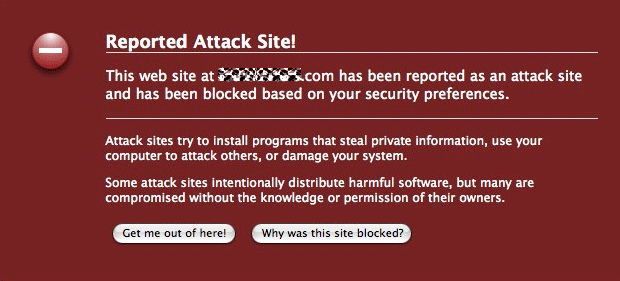
My platform is Mac, FF, with Addons; NoScript, MacAfee SiteAdvisor, and AdBlock Plus.
I was NOT using any Google site or feature, but tried to visit two sites I regularly go to +from a bookmarks page on my desktop+.
The first was a Formula One news site, the other a cycling enthusiast site, nothing dodgy at either usually.
However, a semi-opaque interstitial warning page covered my browser view warning me that the site I’m trying to visit may harm my computer, and according to my setting I am being warned, proceed or not?
Instead of visiting, I clicked on the “More info” link and was taken to a Google url (sorry I didn’t save the url) with data on the site’s malware problem, and last 90 days scanning results. It seems they had some harmful script inserted in their ads by a third party.
I removed those sites from my bookmarks page.
What concerns me, is that later I realized that I hadn’t used any Google feature to visit those sites, so how did G know I was going to them?
I didn’t go through G search, or a G bookmark. I went through a simple homemade bookmarks page on my desktop.
I have a Google account that I remain logged into most of the time. I use it for sitemaps, and the Google removal tool, G alerts, and of course G search.
However when I looked in my G account settings for anything remotely like, “Warn me if I ever try to visit a dodgy site”, and there’s nothing there remotely like that. I use the default “moderate” setting to stop filth showing in the serp.
So, how come G popped the interstitial, when I wasn’t using any G site feature I’m aware of? Too spooky.
All I can guess is that McAfee are collaborating with G on the Site Advisor feature, and extending it’s reach beyond the G serp? Or perhaps it is the NoScript addon people who G are collaborating with?
Normally when the McAfee addon warns you about a dodgy site it will point you to an info page on the McAfee domain, not the Google domain.
Anyone else seen this recently? Was it a test run, a slip-up, or old news?
Interestingly, I visited the same F1 site today using the same method, and got no warning interstitial, nor did the G serp listing of this site have any warning note. “
Google update september 2008 webmasterworld forum discussion.
There is an active forum discussion going on in webmaster world about recent changes in Google. If you want to continue with that discussion please join this thread
A member says
“
I think Google is weeding old or stagnant pages out of the index to make way for new pages, it is the only way they can keep up with the internet IMO. I recently did a search for a topic from 2002 and it was like going back into the stone ages in search. Everything now is what is happening today, not years ago. I don’t know what all your sites are about but even on the top sites it seems they weed the pages.
For example I ran a search for an electronics product from 2000, only 8 years ago. You can barely find traces of it in the sites I searched via Google. Now do the same search from a product from today, say the iphone. There is probably a billion pages on that. Now I am not saying they are doing things wrong, but with the millions of pages added every day to the internet they have to delete or else run out of space perhaps. I just wish they had the ability to search the archives easily for the topics or products that are “old”. Right now you can do that with Google news but not Google search.
Anyway my point is I think Google looks at a site and compares all the content, then keeps some of the most recent content in the results including the higher PR stuff and puts the older stuff in supplemental. That is only a guess but seems to be what is happening.
Since the older stuff I looked for was probably dropped into the deepest parts of these sites I couldn’t find it with Google anymore.
Maybe though this is the way the internet search will be, you use if for todays content only. If they had to archive all our sites I don’t think it is possible, not with all the pages being added.“
http://www.webmasterworld.com/google/3736037.htm
Official statement – what Google feels about hidden text
A nice writing by a Google employee on what they feel about hidden text with examples:
“In our “Popular Picks” thread, Burchman asked for some clarification on what Google considers to be hidden text, as our Webmaster Guidelines explicitly state that you should avoid hidden text or hidden links. We have a few examples of how text can be hidden in this Help Center article: http://www.google.com/support/webmasters/bin/answer.py?answer=66353
As I’ve noticed other users with similar questions in this group, such as “What if my navigation menu uses display:none to hide text until a button is rolled over?” I figured this would be a good topic to cover in “Popular Picks.” The reason we perceive hidden text as a problem is that it serves content to search engines which users don’t see, and presenting different content to search engines and users makes it more difficult to properly rank pages. If we detect that this text is intended to deceive search engines, there could be a negative effect on how your site is indexed and ranked in Google, including removal from our index.
Because such strong action may be taken on sites violating this guideline, it’s understandable that many webmasters have expressed concerns about the possibility of Google incorrectly detecting legitimate content as hidden text. When trying to figure out if a page may have hidden text that Google would consider malicious, start by thinking about why the guideline was written in the first place: Google wants to see what the user sees. If the text that Google sees is the same that a normal user is supposed to see, then you should be good to go. If Google is seeing text that is intentionally hidden from the user in an effort to manipulate search engine rankings, you have some work to do.
Let’s try this approach with a page you may have seen before: http://www.google.com/
In the top-left corner, you’ll see a line of text: “Web Images Video News Maps Gmail more.”
Google sees this text, and so do you, the user. So far, so good.
Next, let’s make sure nobody wrote “search engine search find crawl index rank” in white text on the white background, with the intention of ranking for those terms. Google would see that, but a normal user wouldn’t. Take off your “normal user” hat for a second and do a “Select All” on the page (by hitting CTRL-A on a PC, or COMMAND-A on a Mac, for instance). This will make any white on white text appear. As you can see, no hidden text.
But let’s try one more thing: Render the page again without CSS enabled. The Web Developer extension for Firefox lets you do this pretty easily. Without CSS, you’ll see several words we didn’t see before: “Blog Search Blogger Books Calendar Documents Finance Groups Labs Orkut Patents Photos Products Reader Scholar.”
You may have also noticed that these words appear in Google’s text- only cache of itself, which is a good indication of how Google “sees” a site. But before you blog about your discovery of hidden links on a PR 10 site =), take a look at the page again with CSS enabled. This time, click on the “more” link, and voilà, the no-longer-hidden text appears. This text is part of the page’s functionality, and it is meant for the user to read and use, not just for search engines to index. This text adds value for the user, which Google rewards, so Google would not hurt this site’s ranking or remove it from the index for that reason. Many sites use similar methods for navigational menus and other functional elements, so please rest assured that the existence of display:none on your site is not on its own a one-way ticket out of Google’s index.
When thinking about your own site, ask yourself if all of the text is there for the user. If the answer is “yes,” great job! If the answer is “no,” do your best to change it to a “yes,” and call on your webmaster community (this group!) for advice if you need it. CSS menus and white space without hidden text should not be a cause of concern when it comes to Google indexing and ranking; the only thing you should be concerned about is how they affect your visitors.
In the “Popular Picks” thread we asked for non-site specific questions, but now that this has been separated into its own thread, here’s your chance to ask about a site you are still unsure about. Please also let me know if you would like further clarification on particular aspects this topic. “Source: Google Groups
Is Google.com dropping country specific TLDs .
A webmaster world member has reported seeing Google drop country specific TLDs like transport.co.uk or mobilephones.co.in from their .com search.
He says
“I have noticed that Google.com isn’t showing .co.uk websites in it’s results as often as it used to, in fact .co.uk sites that I have always seen high up in the results seem to have disappeared completely from Google.com results whilst still featuring well in the Google.co.uk results.
Is Google systematically dropping .co.uk domains from it’s main SERPs seeing as Google.co.uk has taken off so well since it’s introduction?
I don’t think I have heard of this happening anywhere else on the web.. so thought I’d mention it 🙂 “
Well i haven’t see this happen atleast from where i see the results. if you notice it please comment in my blog
No Longer Have Badware – Badware reinclusion request
Badware is very harmful as the computer gets infected & for this purpose Google has recommended the following suggestions for people who are dealing with badware:
1) If you have badware, it usually means that your web server, your website, or a database used by your website has been compromised. Google has a nifty post on how to handle being hacked. You should be very careful when inspecting for malware on your site so as to avoid exposing your computer to infection.
2) Once everything is clear and dandy, you can follow the steps in our post about malware reviews via Webmaster Tools. Please note the screen shot on the previous post is outdated, and the new malware review form is on the Overview page and looks as shown below:
(Pic.)
3) Lastly, if you believe that your rankings were somehow affected by the malware, such as compromised content that violated the Webmaster Guidelines [i.e. hacked pages with hidden pharmacy text links], you should fill out a reconsideration request. To clarify, reconsideration requests are usually used for when you notice issues stemming from violations of our Webmaster Guidelines and are separate from malware requests.
If you have any additional queries, you can review their documentation or can post to the discussion group with the URL of your site. This updated feature in webmaster tools is very efficacious in discovering & fixing any malware related problems.
Source: Google Webmaster Central Blog
Your own website against you – nice writeup
A nice writeup by incredible bill of webmasterworld about lawyers using your own site information against you.
“ITFALLS OF SAVING YOUR SITE FOR POSTERITY
Search engines automatically cache your pages and something called the Internet Archive, or Wayback Machine, also comes along and makes a permanent copy of your site for “posterity”. The problem starts when you realize you may have content on your web site that could result in legal issues. You may act quickly to resolve those issues yet the problems still remain without your knowledge because you didn’t act as quickly as all the robots crawling your site.
Unfortunately, legal beagles love that your site was saved for “posterity” when gearing up to file a lawsuit so although you’ve already done the right thing by cleaning potentially harmful things off your site, the tireless automatons crawling the internet have made sure there’s plenty of evidence and the next thing you know, you’re about to get hung out to dry.
If you think the lawyers aren’t technically savvy, think again:
|
http://www.law.com/jsp/legaltechnology/pubArticleLT.jsp?id=1202422968612
Not only can they find your content, they do it under cloak without your knowing about it!
|
You can forget your rights, just throw them out the window, because the history of your website is already busy squealing on you without your knowledge or permission.
HOW DO YOU PROTECT YOUR SITE FROM HISTORICAL SNOOPING?
Obviously the simplest way is to keep your nose clean so nobody has a reason to be snooping in the first place.
However, this is the internet and you have to OPT-OUT of things to protect your rights.
Here’s a few preventative ways to stop your website from being archived and being used as a snitch:
USE NOARCHIVE
Make sure you include the NOARCHIVE meta tag in each web page so that there is no cache in any of the major search engines.
USE ROBOTS.TXT
Block all of the archive site spiders, such as used by the Internet Archive, in your site’s robots.txt file with an entry as follows:
|
The [url=http://crawler.archive.org/]Heritrix software[/url] used by the Internet Archive is Open Source which means there are more archives out there and possibly using deviations of Heritrix that ignore robots.txt and cloak their access to your site.
HELP FOR HOSTED BLOGGER ISSUES
If you’re running a blog hosted on a 3rd party service like Blogger or WordPress, your options may be limited to just embedding NOARCHIVE which the Internet Archive ignores, meaning anyone running stock Heritrix code would also ignore by default.
The only way you can exclude your site, [url=http://www.archive.org/about/exclude.php]according to their site[/url], is to contact them directly. Obviously an insufficient amount of businesses and sites in general are aware of the perils posed by the Internet Archive or they would honor the NOARCHIVE tag for those sites with limited access and no robots.txt just to avoid a flood of emails.
OTHER POTENTIAL RISKS
Snap.com has taken screen shots of every web page, then Ask started taking limited screenshots as well as a some new completely graphical search engines like SearchMe. Some screen shots have minimal resolution too tiny to read but others, like Snap and SearchMe, are big enough you can read, and these too are called evidence in a lawsuit. Even the tiniest thumbnail can still show a licensed trademark being used without permission.
Some of the social bookmarking sites that allow large chunks of content to be copied such as Kaboodle, Jeteye, Eurekster, some using tools like Heritrix (see above), to make small archive copies of specific content.
SUMMARY
Obviously there’s no way you can completely stop anyone from making copies of your site but it may pay by being diligent in keeping many of these technologies off your site that provide any form of archives.
This is just another form of insurance that could, in the end, save your business, your house, your car, your family… “
Is TPR penalty lifted for some sites
Some webmaster world members are noticing that the Toolbar Pagerank penalty is lifted for their sites. Google started imposing Toolbar Pagerank Penalties for sites that sell / buy links around January this year now it seems to be lifted for some sites. Though its being reported in forums we never noticed anything like that across our client sites. Probably its because we don’t sell or buy links for our clients due to our policy.
forum discussion here: http://www.webmasterworld.com/google/3729425.htm
Ways to check backlinks in Google,Yahoo,MSN and other search engines.
I have many question me how to check the backlinks or links coming into their site in various search engines. Well i already wrote an article based on that here. http://www.searchenginegenie.com/backlink-strategies.htm this article isey a bit old but works great still. Today the top 3 search engines are more friendly to webmasters and are willing to share a percentage of what they know about your backlinks.
1. Google: Traditionally Google used to show most of the backlinks to a site ( link: ) but way back in 2002 they broke that comment and started showing backlinks only with PR 4 and above. Then later in 2005 they broke that too and started showing very less sometimes less than 2% of backlinks a site really possesses. This is had been the case for more than 2 years. But in 20o6 started a massive webmaster communication programme. They opened up something called Google sitemaps ( now called Google webmaster central ) . Later they capitalized on that and due to massive support they got from webmasters and now the webmaster tools shows a lot of data very useful for webmasters. One of that is the backlinks to a site/page/from inner pages etc. To check the backlinks what Google shows you need to first verify your website to prove you are the owner. Now we can check backlinks if we login to Google webmaster tools here.
Once logged in and site verified:
We go to Dashboard >> Links and we can check backlinks what Google shows.
Remember even this is not accurate here google shows atleast 25% backlinks so you can count that what they are showing is somewhat correct.
Yahoo: Yahoo is the only search engine who never hesitated to share their backlink data. In yahoo we can just use link:http:// to check for a single page or linkdomain: to check for an entire site. There are lot of ways you can check backlinks in yahoo especially filtering out sites. Please check those stuff here.
http://www.searchenginegenie.com/backlink-strategies.htm
MSN: MSN was showing backlink in link: command before a year but they broke the command and stopped showing all backlinks. Now they opened up communication and started http://webmaster.live.com/ where you can verify your site like Google and check backlinks.
Its good to see search engines share more with webmasters in recent days i hope we see more from them in future.
vijay
Blogroll
Categories
- 2016 SEO trends predictions
- AI for eCommerce
- AI Search & SEO
- author rank
- Authority Trust
- Bing search engine
- blogger
- CDN & Caching.
- Content Strategy
- Core Web Vitals
- eCommerce Growth
- Experience SEO
- Fake popularity
- gbp-optimization
- Google Adsense
- Google Business Profile Optimization
- google fault
- google impact
- google Investigation
- google knowledge
- Google panda
- Google penguin
- Google Plus
- Google Search Console
- Google Search Updates
- Google webmaster tools
- google-business-profile
- google-maps-ranking
- Hummingbird algorithm
- infographics
- link building
- Local SEO
- local-seo
- Mattcutts Video Transcript
- Microsoft
- Mobile Performance Optimization
- Mobile SEO
- MSN Live Search
- Negative SEO
- On-Page SEO
- Page Speed Optimization
- pagerank
- Paid links
- Panda and penguin timeline
- Panda Update
- Panda Update #22
- Panda Update 25
- Panda update releases 2012
- Penguin Update
- Performance Optimization
- Sandbox Tool
- search engines
- SEO
- SEO Audits
- SEO Audits & Monitoring
- SEO cartoons comics
- seo predictions
- SEO Recovery & Fixes
- SEO Reporting & Analytics
- seo techniques
- SEO Tips & Strategies
- SEO tools
- SEO Trends 2013
- seo updates
- Server Optimization
- Shopify Optimization
- Shopify SEO
- Shopify Services
- Small Business Marketing
- social bookmarking
- Social Media
- SOPA Act
- Spam
- Technical SEO
- Uncategorized
- User Experience (UX)
- Webmaster News
- website
- Website Security
- Website Speed Optimization
- Yahoo