




content-optimization
What Is Search Intent and Why Is It Important for SEO?
Search intent is the reason behind a user’s search. It tells us what someone is actually trying to find when they type a query into Google.
A person searching for “how to improve website speed” wants information. Someone searching for “best SEO tools” may be comparing options. Another user searching for “SEO company near me” may already be ready to contact a service provider.
Understanding this difference helps businesses create content that matches what users actually want.
What Is Search Intent?
Search intent, also called user intent, is the goal behind a search query.
Google tries to understand whether a user wants to learn something, find a specific website, compare products or services, or take action.
This is why two similar keywords can show very different search results.
For SEO, choosing the right keyword is important, but understanding the intent behind that keyword is just as important.
Why Search Intent Matters for SEO
Search engines aim to show results that are most useful for the user.
If someone is looking for information but lands on a sales-focused page, they may leave quickly. In the same way, someone ready to buy may not want to read a long educational article.
When your content matches the user’s intent, it becomes more relevant and useful. This can improve engagement and help attract visitors who are genuinely interested in your content, product, or service.
Types of Search Intent
Search intent is usually grouped into four main types.
Informational intent is when users want to learn something or find an answer.
Navigational intent is when users are looking for a particular website or brand.
Commercial intent is when users are researching and comparing options before making a decision.
Transactional intent is when users are ready to take action, such as buying a product, contacting a company, or signing up for a service.
Knowing the type of intent helps you decide what kind of page or content to create.
How to Understand Search Intent
One of the easiest ways to understand search intent is to look at the current Google results for your target keyword.
If most of the top results are blog posts, the intent is likely informational. If the results mostly show product or service pages, the intent may be commercial or transactional.
SERP features such as People Also Ask, featured snippets, shopping results, local listings, and videos can also give useful clues about what users are expecting.
How to Optimize Content for Search Intent
Start by understanding what the user wants before creating the content.
If the search is informational, provide a clear answer. If the user is comparing options, give helpful comparisons. If the intent is transactional, make it easy for the visitor to take the next step.
Your title, headings, and main content should all match the purpose of the search.
It is also useful to review older pages from time to time because search intent can change as user behavior and search results evolve.
Final Thoughts
Search intent helps you understand the meaning behind a keyword.
Instead of creating content only to target search terms, focus on giving users the type of information or solution they are actually looking for.
When your content matches search intent, it becomes more useful for visitors and more relevant for search engines.
What Is Keyword Cannibalization and How to Fix It?
Keyword cannibalization happens when two or more pages on your website target the same keyword or the same search intent, which makes search engines unsure about which page should rank. For example, if you have two blog posts both optimized for “local SEO checklist” or two service pages both trying to rank for “website speed optimization,” Google may treat them as competing options rather than complementary resources. Instead of building one strong page that clearly deserves the top position, your site ends up sending mixed signals. This can happen even if the pages are not identical—if they answer the same question for the same type of user, they can still cannibalize each other. In simple terms, keyword cannibalization is when your own pages “fight” each other in Google results, and you lose the chance to rank your best page consistently.
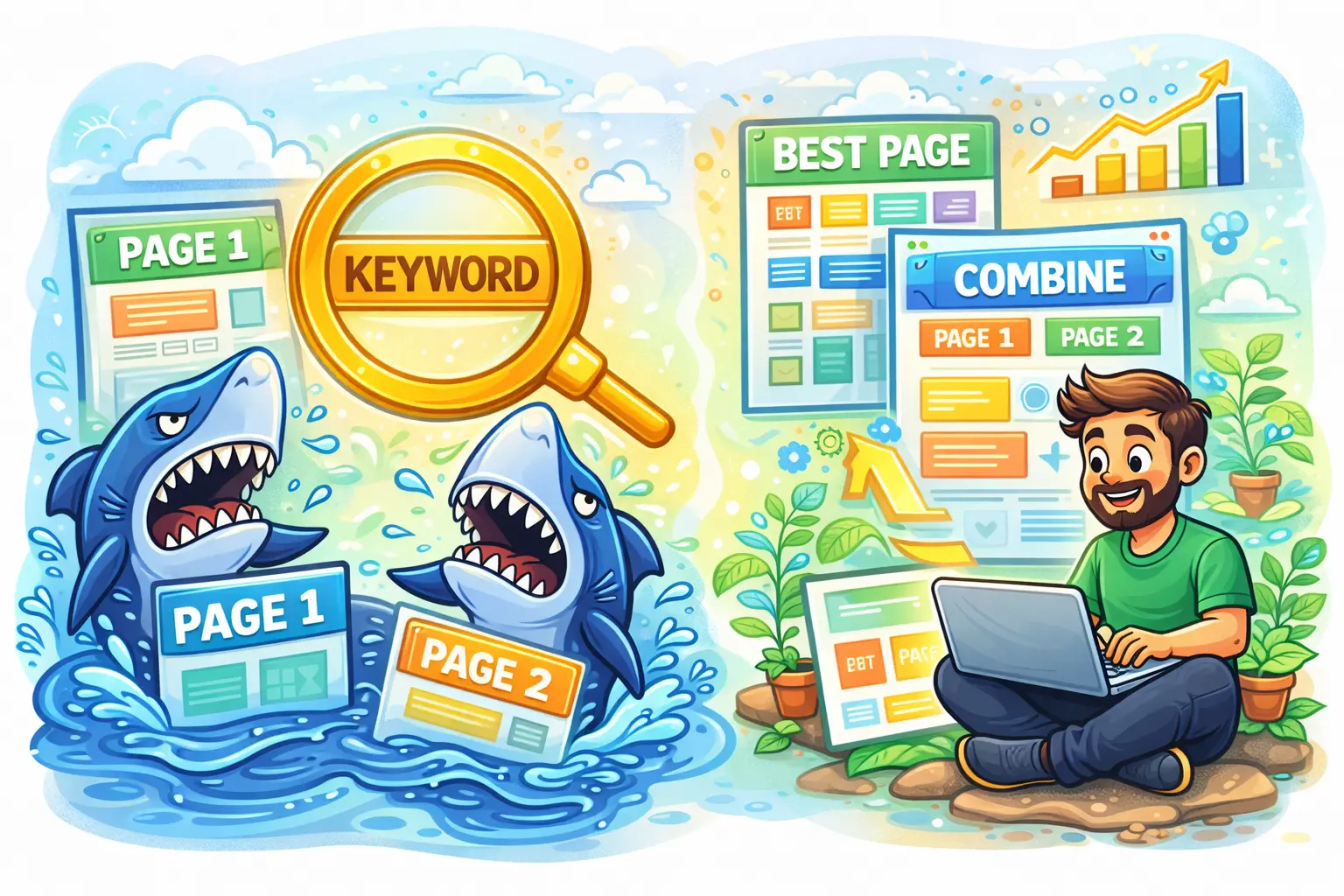
The biggest problem with keyword cannibalization is that it often leads to unstable rankings and weaker traffic growth. You might notice that one week Page A ranks on Google, and the next week Page B replaces it, and then it switches again. When rankings keep rotating, click-through rate usually drops because users are not always landing on the most relevant or most convincing page. It also reduces SEO authority because your internal links, external backlinks, and engagement signals get split across multiple URLs instead of strengthening one primary URL. Over time, this can prevent both pages from reaching their full potential, especially for competitive keywords. You may also experience situations where neither page ranks in the top positions because search engines can’t confidently decide which one is the “best answer.” For businesses, that means fewer calls, fewer leads, and missed opportunities even though you created enough content.
Cannibalization usually happens because of normal content growth. Many websites publish multiple similar blogs on the same topic, create new pages without updating old ones, or build service pages that overlap too much. It’s common in local business sites that have multiple location pages with nearly the same content, or websites that publish “guide,” “checklist,” and “tips” posts that all target the same keyword. It can also happen if your category pages, tag pages, and blog posts all rank for the same terms, or when you create separate pages for “pricing,” “services,” and “benefits” but optimize them using the exact same main keyword. Typical signs include two URLs showing impressions for the same query in Google Search Console, frequent switching of ranking pages, sudden drops in traffic for a page you recently published, or a strong page that never climbs because another page keeps competing with it.
To fix keyword cannibalization, start by deciding which page should be the main “winner” for the keyword and intent. Usually, the best choice is the page with stronger backlinks, better content depth, higher conversions, or the page that matches the intent most accurately. Once you select the primary page, the most effective solution is often to merge content: combine the best parts of both pages into one improved page, update it thoroughly, and then set up a 301 redirect from the weaker page to the primary one. If both pages deserve to exist, then differentiate their intent instead of letting them overlap. For example, one page can target “how to do keyword research for local SEO,” while another targets “local SEO keyword research tools,” so each page serves a distinct purpose. Update the titles, headings, and main keyword targeting so each page has its own unique focus.
If you must keep similar pages (for example, due to product variations or multiple location pages), you can use canonical tags to tell Google which page is the preferred version for ranking. You should also improve internal linking by pointing the most important keyword-focused links toward the primary page and using clearer anchor text that matches each page’s purpose. In some cases, you may also “de-optimize” the duplicate page by changing the keyword focus, reducing overlapping sections, or rewriting content so it answers a different question. The best long-term strategy is simple: for most websites, aim for one primary page per keyword or intent, and make that page the strongest resource on your site. When your content has clear roles and clear targets, Google can rank it more confidently, your rankings become more stable, and your traffic and leads improve consistently.
Blogroll
Categories
- 2016 SEO trends predictions
- AI for eCommerce
- AI Search & SEO
- author rank
- Authority Trust
- Bing search engine
- blogger
- CDN & Caching.
- Content Strategy
- Core Web Vitals
- eCommerce Growth
- Experience SEO
- Fake popularity
- gbp-optimization
- Google Adsense
- Google Business Profile Optimization
- google fault
- google impact
- google Investigation
- google knowledge
- Google panda
- Google penguin
- Google Plus
- Google Search Console
- Google Search Updates
- Google webmaster tools
- google-business-profile
- google-maps-ranking
- Hummingbird algorithm
- infographics
- link building
- Local SEO
- local-seo
- Mattcutts Video Transcript
- Microsoft
- Mobile Performance Optimization
- Mobile SEO
- MSN Live Search
- Negative SEO
- On-Page SEO
- Page Speed Optimization
- pagerank
- Paid links
- Panda and penguin timeline
- Panda Update
- Panda Update #22
- Panda Update 25
- Panda update releases 2012
- Penguin Update
- Performance Optimization
- Sandbox Tool
- search engines
- SEO
- SEO Audits
- SEO Audits & Monitoring
- SEO cartoons comics
- seo predictions
- SEO Recovery & Fixes
- SEO Reporting & Analytics
- seo techniques
- SEO Tips & Strategies
- SEO tools
- SEO Trends 2013
- seo updates
- Server Optimization
- Shopify Optimization
- Shopify SEO
- Shopify Services
- Small Business Marketing
- social bookmarking
- Social Media
- SOPA Act
- Spam
- Technical SEO
- Uncategorized
- User Experience (UX)
- Webmaster News
- website
- Website Security
- Website Speed Optimization
- Yahoo